+86 184 3796 0706
 info@destinytrans.com


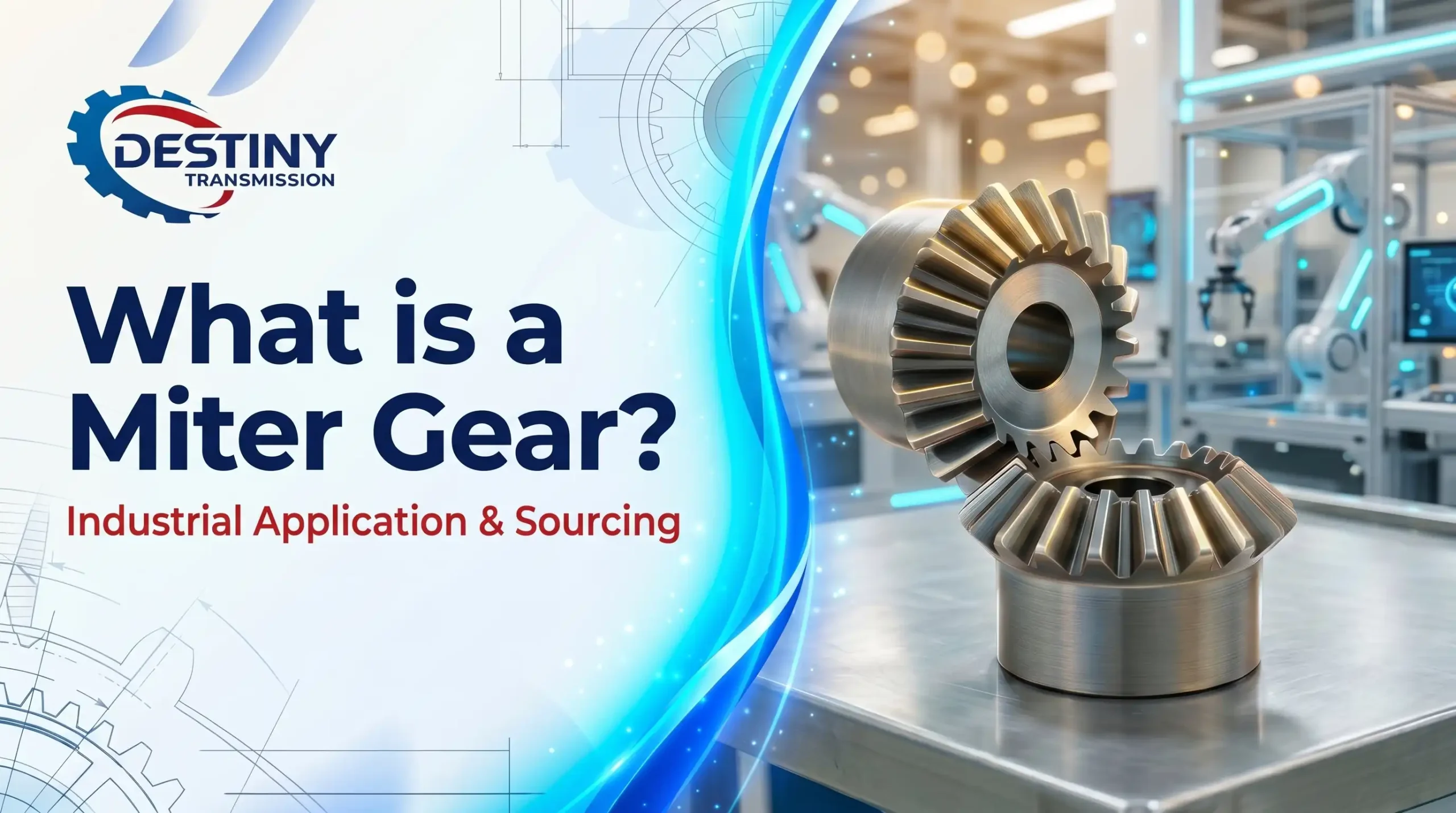
If you’ve ever sourced right-angle power transmission components for industrial equipment, you’ve almost certainly come across both bevel gears and miter gears — and you may have wondered what actually sets them apart. For many engineers and procurement teams, the difference looks minor on paper, but choosing the wrong style can lead to excess noise, premature wear, or unnecessary cost. In this guide, we break down exactly what a miter gear is, how it differs from standard bevel gears, which type fits your application, and how to source the right set for your project.
What Exactly Is a Miter Gear?
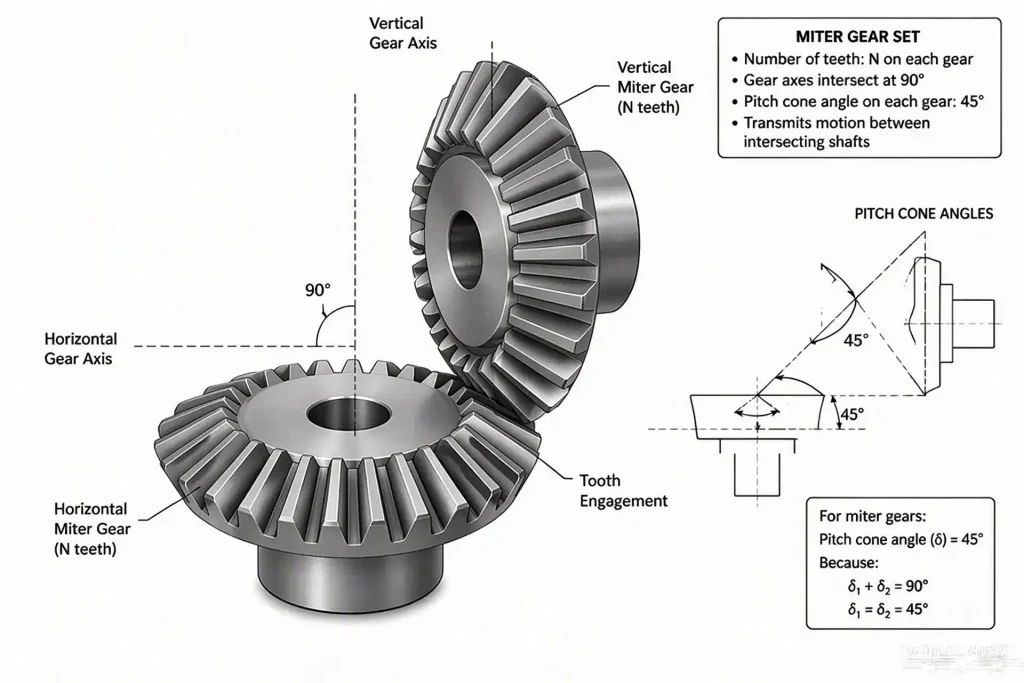
A miter gear is a specialized type of miter bevel gear engineered to transmit rotational power between two shafts that intersect at a 90-degree angle, with a fixed 1:1 gear ratio.
Unlike general bevel gears that use different tooth counts to adjust speed and torque, miter gears have identical pitch diameters and matching 45-degree pitch angles. This geometry means the output shaft spins at the exact same speed as the input shaft — the only change is the direction of rotation.
This simple, focused function is what makes miter gears unique. They don’t speed up, slow down, or multiply torque. They just redirect power cleanly at a right angle, in a compact footprint. For applications that only need a direction change, this makes them far more efficient and space-saving than a multi-gear reducer setup.
Miter Gear vs Standard Bevel Gear: When to Use Which
This is the most common question we hear from engineering teams, and the answer comes down to one core factor: do you need a speed change?
| Feature | Miter Gears | Standard Bevel Gears |
|---|---|---|
| Gear Ratio | Fixed at 1:1 | Variable (1.5:1 to 8:1+) |
| Shaft Angle | Fixed 90° | Configurable |
| Primary Function | Changes rotation direction only | Changes direction + adjusts speed/torque |
| Footprint | Most compact for 90° duty | Larger with higher ratios |
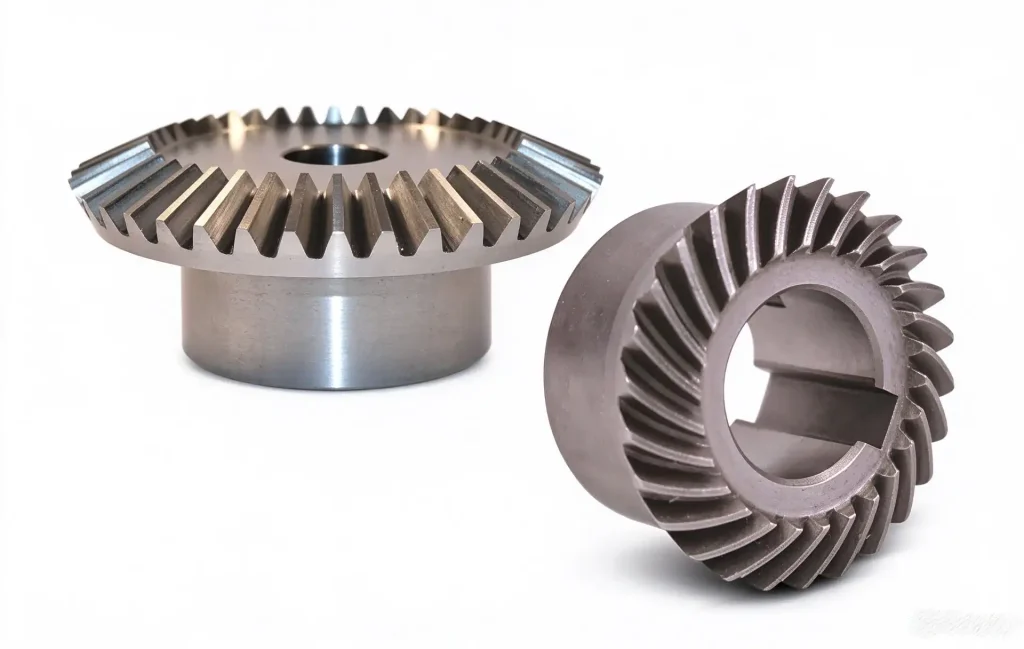
Standard bevel gears are built for speed reduction or torque multiplication. They use a larger gear and smaller pinion to step up or step down output speed, making them ideal for conveyors, machine tool spindles, and other drives that need a torque boost.
Miter gears, by contrast, are for pure 90-degree direction change. If your system needs to reroute power while keeping speed perfectly consistent — for example, to maintain uniform conveyor speed or synchronized machine motion — a miter gear set is the most precise and cost-effective solution.
For a deep dive into design details, installation best practices, and industry-specific application recommendations, see our full guide: [Straight Bevel Gear vs. Spiral Bevel Gear: Key Differences Explained]
Common Types & Material Options
Miter gears come in multiple tooth profiles and materials to match different speed, load, and environmental requirements. Here are the most widely used configurations in industrial applications:
Tooth Profile Styles
1. Straight Bevel Gears (Miter Configuration)
Straight tooth miter gears are the most economical and widely available option. Their teeth run straight toward the apex of the gear cone, engaging across the full face width all at once.
They excel in low-to-moderate speed applications where accurate positioning matters, such as indexing tables and light conveyors. Their simple design makes them easy to manufacture, inspect, and replace — individual gears are interchangeable with any identical miter gear of the same specification. The tradeoff is higher noise and vibration at high speeds, due to the sudden tooth engagement.
2. Spiral Miter Gears
Spiral miter gears have curved, angled teeth that engage gradually, with contact moving smoothly along the tooth face as the gear rotates.
This progressive engagement cuts down on impact forces, reduces noise and vibration, and allows more teeth to share the load at once. The result is smoother operation, higher load capacity, and longer service life at continuous high speeds. They are the preferred choice for precision machinery, high-speed packaging lines, and equipment where quiet operation is a priority.
The main tradeoffs are higher manufacturing cost and the requirement to replace gears as matched pairs — you cannot swap a single spiral miter gear individually. They also generate greater axial thrust, requiring stiffer bearings and mounting structures.
Common Materials
- Steel bevel gears: The industry standard for heavy-duty use. Carbon steel, alloy steel, and stainless steel options deliver high strength, wear resistance, and shock load capacity for industrial machinery, agricultural equipment, and outdoor applications.
- Plastic bevel gears: Lightweight, corrosion-resistant, and naturally quiet. Best suited for light-duty applications such as office automation, medical devices, and consumer electronics where low noise and low weight are priorities.
Real-World Industry Applications
Thanks to their compact form and reliable 1:1 right-angle drive, miter gears are used across nearly every industrial sector. Common use cases include:
- Material handling & packaging: Right angle bevel drives in conveyor systems, sorting equipment, and packaging machines, where consistent line speed must be maintained through direction changes.
- Machine tools: Bevel gear box assemblies in milling machines, lathes, and drill presses that require precise right-angle motion transfer for spindle and feed drives.
- Automation & robotics: Compact bevel gear assembly units in robotic joints, rotary indexing tables, and automated production lines where space is limited and positioning accuracy is critical.
- Agricultural equipment: Power transmission in harvesters, sprayers, and irrigation machinery, where durable, low-maintenance right-angle drives are needed for outdoor field conditions.
- Food & beverage processing: Stainless steel miter gear sets for washdown environments and sanitary processing equipment that requires corrosion resistance and easy cleaning.
How to Select the Right Miter Gear for Your Project
Choosing the correct miter gear doesn’t have to be guesswork. Use these four criteria to narrow down your options:
- Speed and duty cycle
- Low-speed, intermittent operation → Straight tooth miter gears
- High-speed, continuous duty → Spiral miter gears
- Load and operating environment
- Heavy loads, shock, or harsh outdoor conditions → Steel construction
- Light loads, clean rooms, or corrosive environments → Plastic or stainless steel
- Mounting and space constraints
- Confirm bore size, face width, and overall outer diameter fit your available housing
- Verify shaft alignment and mounting distances match your assembly
- Precision requirements
- General-purpose use → Standard cut teeth
- High-accuracy positioning → Ground tooth miter gears with controlled backlash
If standard catalog sizes don’t meet your needs, custom bevel gears can be manufactured to your exact drawings, including custom bore sizes, tooth counts, and surface treatments. We also support small bevel gears for prototype development and low-volume testing runs.
Why Source Miter Gears From a Direct Manufacturer?
When you’re sourcing miter gears for production or custom projects, working directly with a manufacturing factory eliminates middleman markup, shortens lead times, and gives you access to engineering support upfront.
At our facility, we specialize in precision miter and bevel gear production for industrial clients worldwide. Our capabilities include:
- Direct factory pricing: No distributors or resellers — you get competitive wholesale pricing for both volume production and custom projects.
- Full custom capability: We manufacture standard and custom bevel gears to your exact drawings, specifications, and material requirements.
- Flexible order volumes: From prototype small bevel gears to large-scale production runs, we support orders of every size.
- Rigorous quality control: Every bevel gear set is inspected for dimensional accuracy, tooth contact pattern, and material integrity before shipment.
FAQ:
1. What is the main difference between a bevel gear and a miter gear?
A miter gear is a specific type of bevel gear with a fixed 1:1 gear ratio and identical-sized gears, used only to change rotation direction at a 90-degree angle. Standard bevel gears have variable ratios and are used to both change direction and adjust speed/torque.
2. Can I replace a straight miter gear with a spiral one?
No, they are not directly interchangeable. Spiral miter gears must be installed as matched left-hand and right-hand pairs. Replacing only one gear will cause improper meshing, excessive wear, and premature failure.
3. Do you manufacture custom miter gears to non-standard dimensions?
Yes. We produce custom miter and bevel gears to customer drawings, including custom bore sizes, tooth profiles, materials, heat treatments, and surface finishes.
4. What materials are available for miter gear sets?
We offer carbon steel, alloy steel, stainless steel, and engineering plastics. Our engineering team can recommend the optimal material based on your load, speed, and operating environment.
5. Can I order small quantities for prototype testing?
Absolutely. We support both low-volume prototype orders and high-volume mass production, so you can source from a single supplier from initial testing through full production.
6. How do I request a quote for miter gears?
Simply send us your 2D/3D drawings, required quantity, material specifications, and any special requirements via email or direct message. Our team will get back to you with a detailed, itemized quote promptly.