+86 184 3796 0706
 info@destinytrans.com


1. What Is a Driving Shaft?
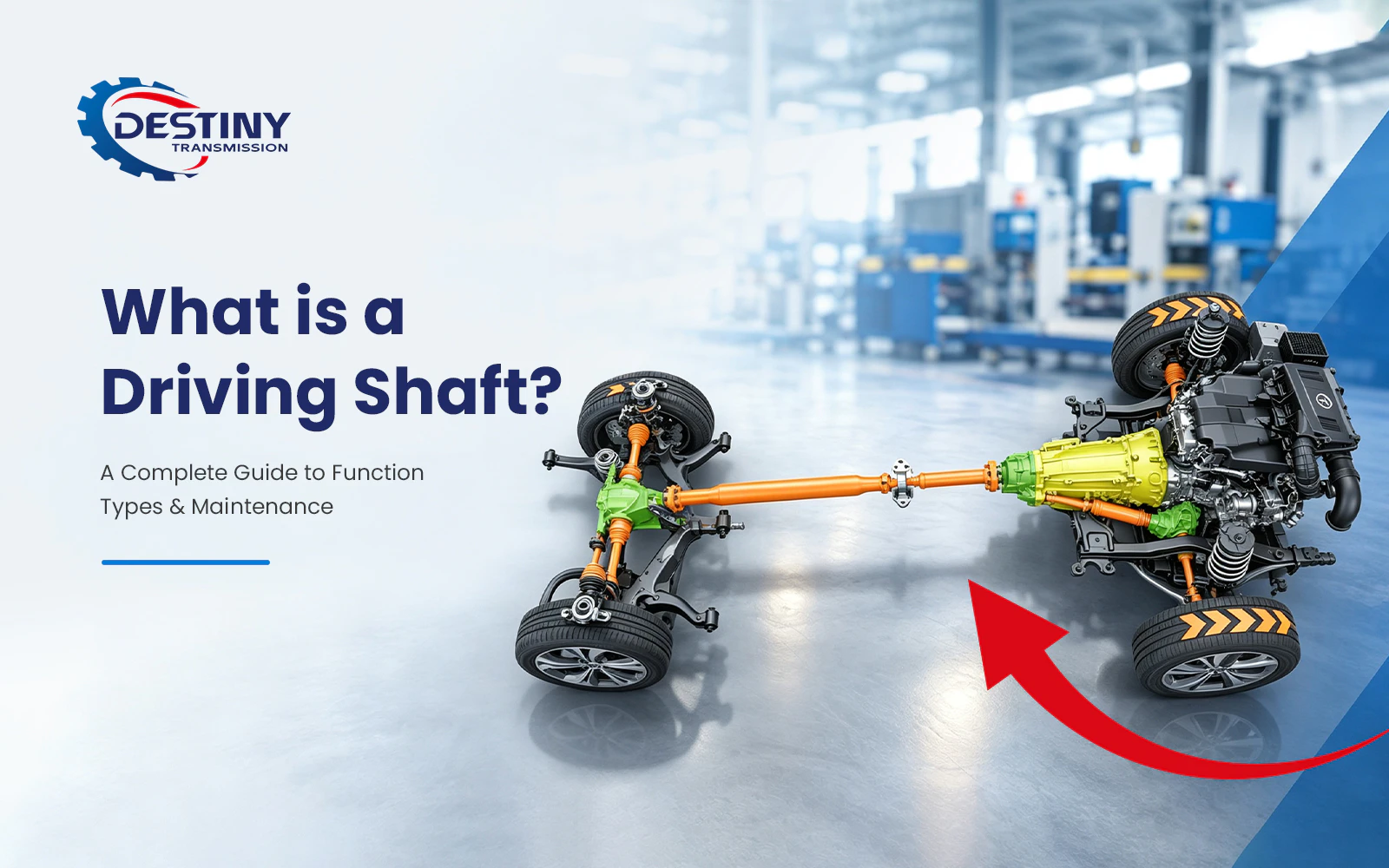
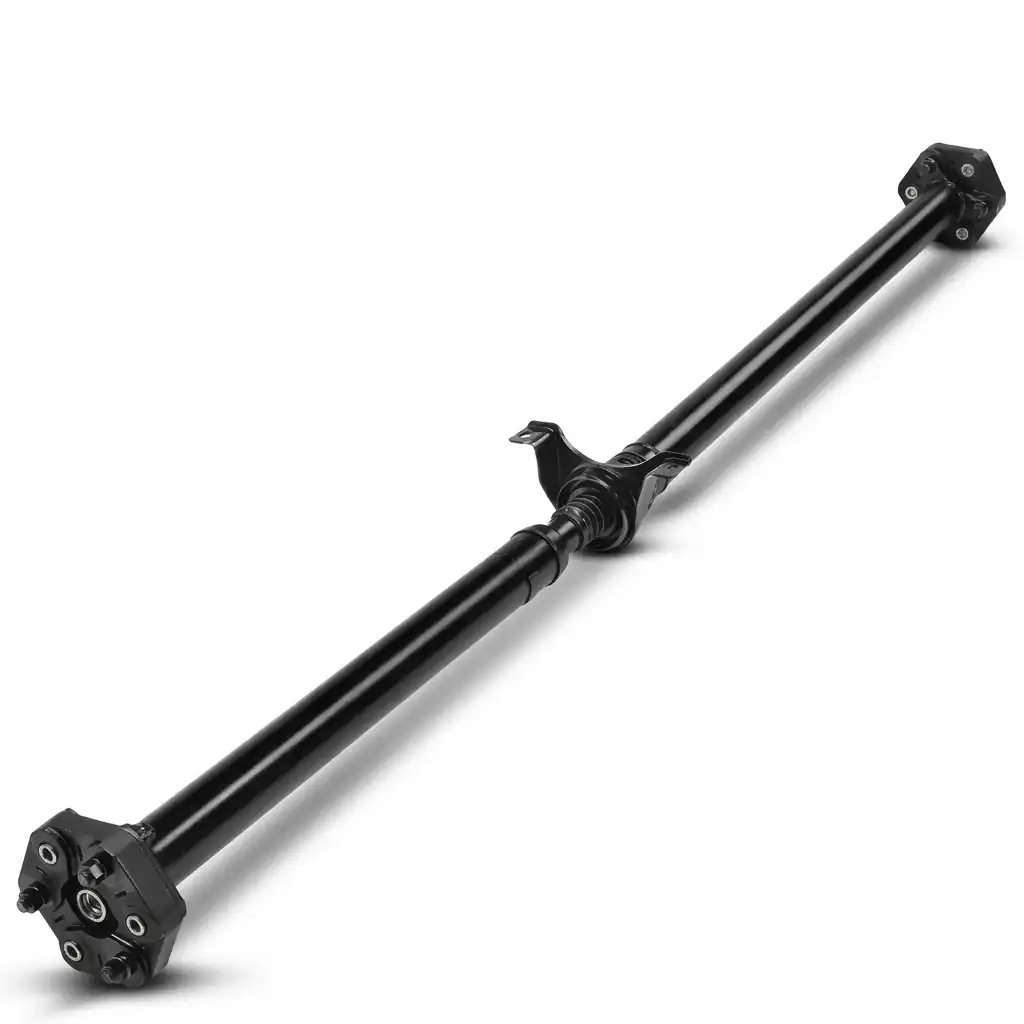
A driving shaft (also called a drive shaft, driveshaft, propeller shaft, propshaft, or Cardan shaft) is a mechanical component that transmits torque, rotation, and mechanical power between parts of a drivetrain that cannot be connected directly—usually because they are separated by distance or need to move relative to one another.
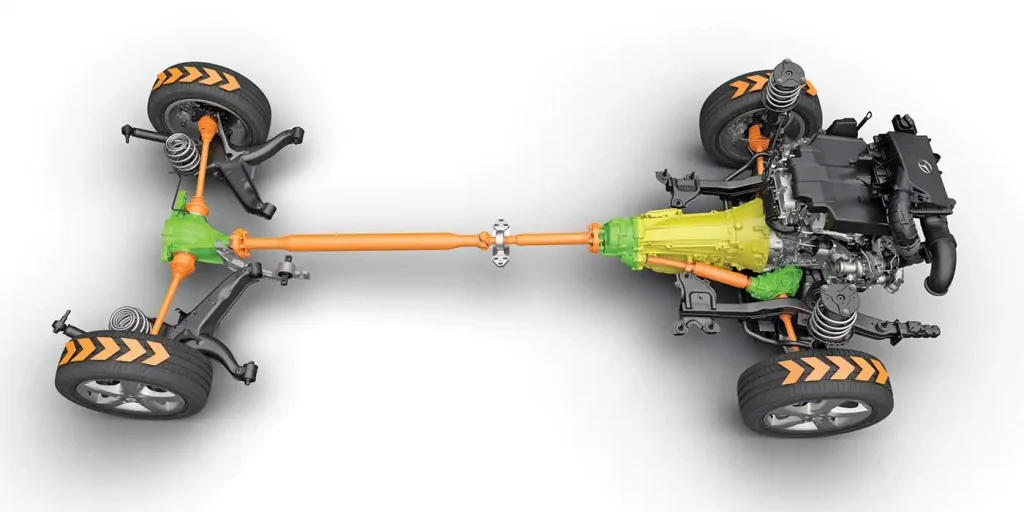
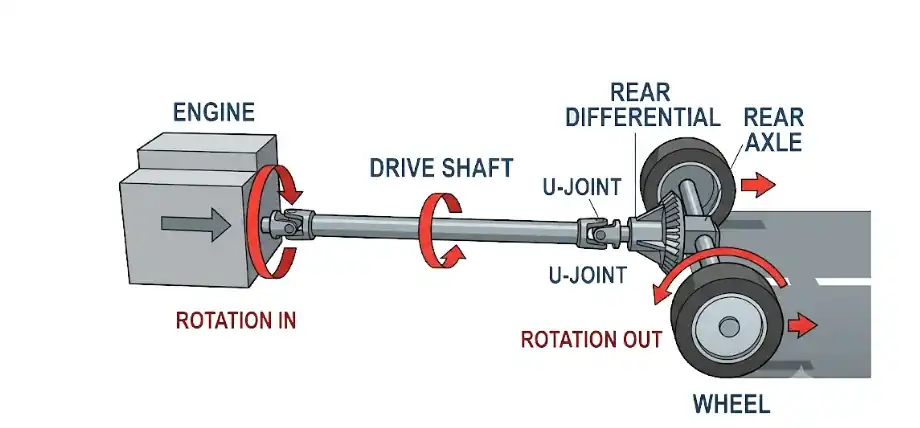
In a typical rear-wheel-drive car, the driving shaft runs along the chassis, transferring power from the transmission (gearbox) to the differential, which then sends torque to the wheels. In four-wheel-drive and all-wheel-drive vehicles, separate driving shafts may send power to the front axle, rear axle, or both.
Quick definition (for featured snippet): A driving shaft is a rotating tubular or solid shaft that transmits torque from a power source (engine, motor, or gearbox) to a driven component (wheels, propeller, or industrial machine), while allowing for changes in angle and distance.
Because driving shafts carry torque, they are subject to torsion and shear stress—the difference between the input torque and the load. They must be strong enough to survive these forces while remaining light enough to minimize rotational inertia.
2. How Does a Driving Shaft Work?
The operating principle is straightforward, but the engineering behind it is precise:
- The engine or electric motor generates rotational power.
- This power passes through the clutch (or coupling) and into the transmission.
- The transmission output shaft delivers torque to the driving shaft through a universal joint (U-joint).
- The driving shaft rotates, transferring that torque along its length.
- At the other end, a second universal joint connects to the differential or final drive.
- The differential distributes the torque to the axle shafts and then to the wheels.
Two design features make this possible despite a moving suspension:
- Universal joints (U-joints) allow the driving shaft to change angle as the suspension moves up and down.
- Slip yokes (splines) let the shaft change in length slightly, accommodating changes in distance between the transmission and the axle.
In many modern vehicles, a constant-velocity (CV) joint replaces the simple U-joint, delivering smoother power and fewer vibrations, especially at high angles.
3. Key Components of a Driving Shaft
A complete driving shaft assembly usually consists of:
| Component | Purpose |
| Shaft tube / yoke | The main cylindrical body that carries torque |
| Universal joint (U-joint) | Permits angular misalignment between shafts |
| CV joint (optional) | Maintains constant rotational speed at working angles |
| Slip yoke / spline | Compensates for changes in shaft length |
| Center support bearing | Supports long, two-piece shafts at their midpoint |
| Flange / weld yoke | Connects the shaft to the transmission or differential |
4. Types of Driving Shafts
Driving shafts are classified by both design and application.
By construction
- One-piece (single-piece) shaft – A single tube, common in light passenger cars with short wheelbases. Simple, rigid, and low-cost.
- Two-piece shaft – Split into two sections joined by a center support bearing. Used in long-wheelbase trucks, vans, and SUVs where a single shaft would vibrate excessively or sag.
- Hollow vs. solid shafts – Most automotive shafts are hollow tubes to reduce weight and rotational inertia; heavy-duty industrial shafts may be solid.
By universal joint type
- Single universal joint (Cardan shaft) – Inexpensive and strong, but produces uneven rotational speed when operating at an angle.
- Double Cardan / constant-velocity (CV) shaft – Two universal joints cancel out speed fluctuations, suitable for larger angles.
- Rigid vs. flexible U-joint shafts – Rigid joints use mechanical hinges for high torque; flexible joints use elastomer elements for vibration damping.
By material
- Steel shafts – High strength, lower cost, but heavier. Common in trucks and heavy equipment.
- Aluminum alloy shafts – Lighter, lower unsprung and rotating mass, improving acceleration and fuel economy.
- Carbon fiber composite shafts – Highest strength-to-weight ratio, used in performance and luxury vehicles.
5. Driving Shaft vs. Transmission Shaft vs. Axle Shaft
These three terms are often confused. Here is the clear distinction:
| Term | Location | Main Function |
|---|---|---|
| Driving shaft / drive shaft | Between transmission and differential (or gearbox and propeller) | Transmits torque over a distance, accommodating misalignment |
| Transmission shaft | Inside or closely attached to the gearbox | Distributes torque among gears and internal components |
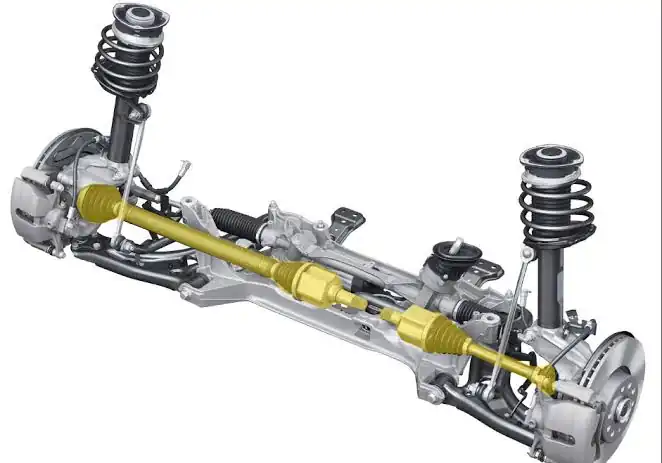
| Axle shaft | Between the differential and the wheels | Drives individual wheels; also called a half-shaft |
A useful rule: all drive shafts are transmission shafts, but not all transmission shafts are drive shafts.
6. Common Materials
- 1045 / 1050 steel – Medium-carbon steel, widely used for general-purpose shafts.
- 4140 / 4340 alloy steel – Chrome-moly steels used in high-torque and heavy-duty applications.
- 6061 / 6082 aluminum alloy – Lightweight automotive and marine shafts.
- Carbon fiber reinforced polymer (CFRP) – High-performance, NVH-sensitive applications.
Material selection balances torsional strength, fatigue life, weight, and cost.
7. Applications
- Automotive – Cars, trucks, buses, and vans (RWD, 4WD, AWD).
- Marine – Connects the gearbox to the propeller in boats and ships.
- Aerospace – Helicopter rotor drive shafts, auxiliary power units.
- Industrial machinery – Line shafts, pump drives, conveyor systems, and machine tools.
- Agricultural equipment – Tractors, combines, and harvesters.
8. Common Failure Signs
A failing driving shaft usually makes itself known. Watch for:
- Clunking or knocking noises, especially when shifting gears.
- Vibration under the vehicle that worsens with speed—often a sign of worn U-joints or an out-of-balance shaft.
- Squeaking or creaking at low speeds, typically from dry U-joints.
- Difficulty turning or shuddering during acceleration.
- Play (looseness) when gripping and rotating the shaft by hand.
- Visible rust, cracks, or missing bolts on the shaft and its joints.
Ignoring these symptoms can lead to complete shaft failure, which is dangerous at highway speed.
9.Maintenance Tips
- Inspect U-joints and CV boots during every service interval.
- Lube universal joints according to the manufacturer schedule (where greaseable fittings are present).
- Check the center support bearing for two-piece shafts.
- Balance the shaft after any repair or modification—an unbalanced shaft causes vibration and accelerates wear.
- Look under the vehicle for oil leaks, missing bolts, or contact with the exhaust or underbody.
- Listen for new noises; early detection prevents costly damage to the transmission and differential.
10. Frequently Asked Questions
Q: What is the difference between a driving shaft and a driven shaft?
A: A driving shaft actively transmits power from the engine or motor (it is the input). A driven shaft receives power—for example, the shaft that drives a wheel or a machine component. In a gear pair, the input gear sits on the driving shaft and the output gear on the driven shaft.
Q: Is a driveshaft the same as an axle?
A: No. The driveshaft connects the transmission to the differential. The axle (or axle shaft) connects the differential to the individual wheels. Every car has axle shafts; only RWD, 4WD, and AWD layouts have a long driveshaft.
Q: What causes a driveshaft to break?
A: Common causes include worn universal joints, impact damage from road debris or a crash, missing or loose bolts, corrosion, overloading, and lack of maintenance. High vibration can also fatigue the metal until it cracks.
Q: How long does a driveshaft last?
A: With proper maintenance, a driveshaft can last 100,000–150,000 miles (160,000–240,000 km) or more. U-joints and CV joints are wear items and may need replacement earlier.
Q: Can I drive with a bad driveshaft?
A: It is not recommended. A failing driveshaft can fail completely while driving, leading to sudden loss of power, loss of control, or the shaft dragging on the road. Have it inspected as soon as symptoms appear.
11. Conclusion
A driving shaft may look like a simple metal tube, but it is one of the most critical links in your vehicle’s drivetrain. Its job is to reliably transfer hundreds of pound-feet of torque at thousands of RPM while flexing with the suspension and absorbing vibration.
Understanding what a driving shaft is, how it works, and what to watch for helps you catch problems early, avoid expensive repairs, and keep your vehicle safe. Whether you are a DIY mechanic, a student of mechanical engineering, or a fleet manager, recognizing the role of the driveshaft—along with its components, types, and common failure modes—is essential knowledge.