+86 184 3796 0706
 info@destinytrans.com


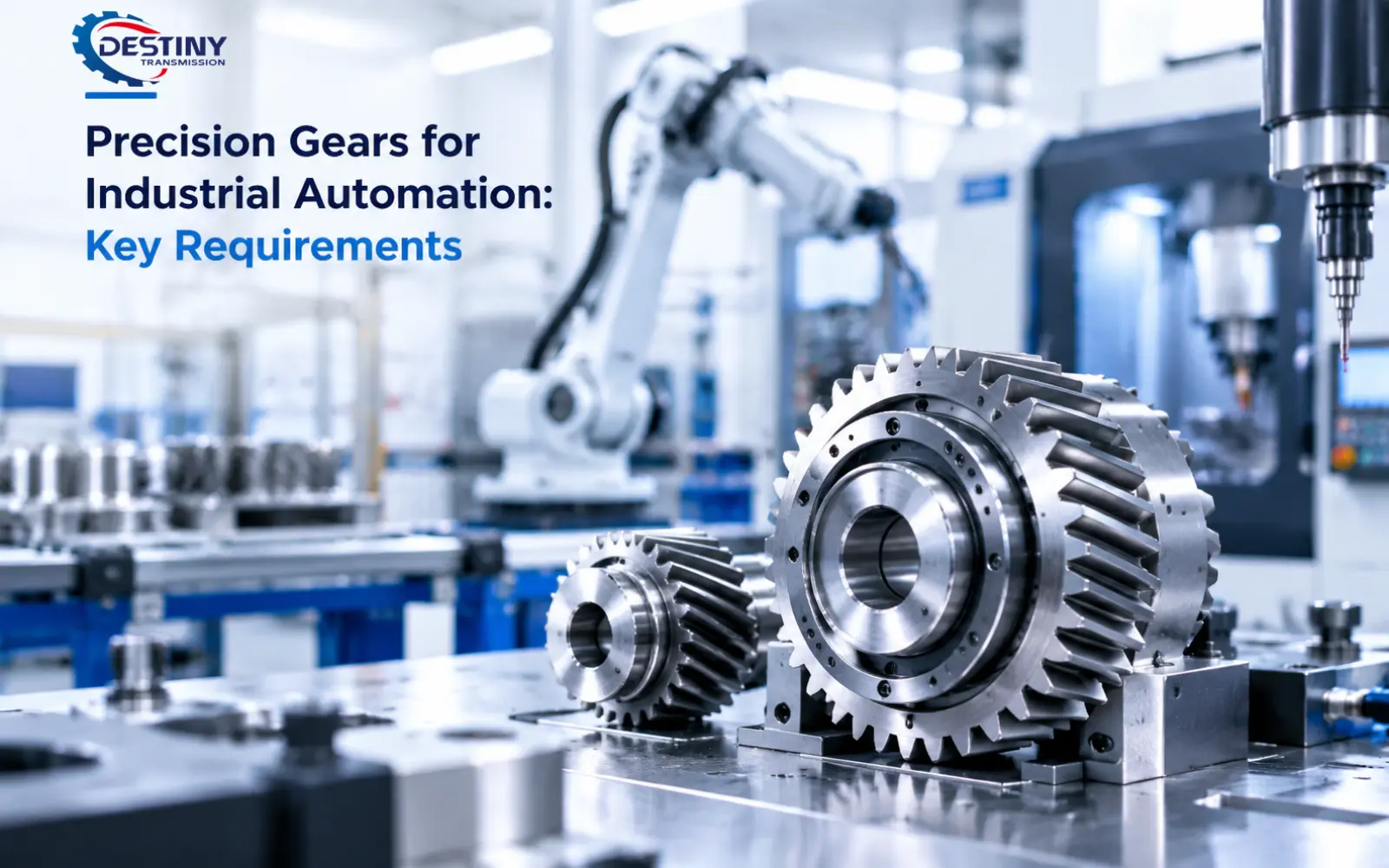
Industrial automation equipment often operates continuously for long periods. This places high demands on transmission accuracy, operational stability, and repeat positioning performance.
Gears are critical power transmission components in these systems. Their machining accuracy, tooth surface condition, wear resistance, and dimensional stability can directly affect overall equipment performance.
In high-speed transmission or high-precision positioning applications, gear machining errors can lead to vibration, noise, and positioning deviations. Therefore, manufacturing precision gears for industrial automation requires more than simply machining according to drawings. It involves comprehensive control of material selection, heat treatment distortion, precision finishing, and final inspection.
1. Why Do Industrial Automation Equipment Require Higher Gear Performance?
Compared with conventional machinery, industrial automation equipment is characterized by frequent motion and continuous operation. This requires not only individual gears to meet the specified accuracy requirements but also a high level of consistency between production batches.
If there are even slight variations in tooth profile or dimensions between different batches of gears, problems such as overly tight gear meshing or excessive backlash can easily occur during batch assembly, increasing machine setup and adjustment costs. For equipment that needs to operate reliably over long periods, consistent gear quality is essential for maintaining the efficiency of the entire production line.
2. Differences in Gear Performance Requirements Under Different Operating Conditions
Not all industrial automation equipment has exactly the same requirements for gears. The appropriate balance between performance and cost should be determined based on the actual operating conditions.
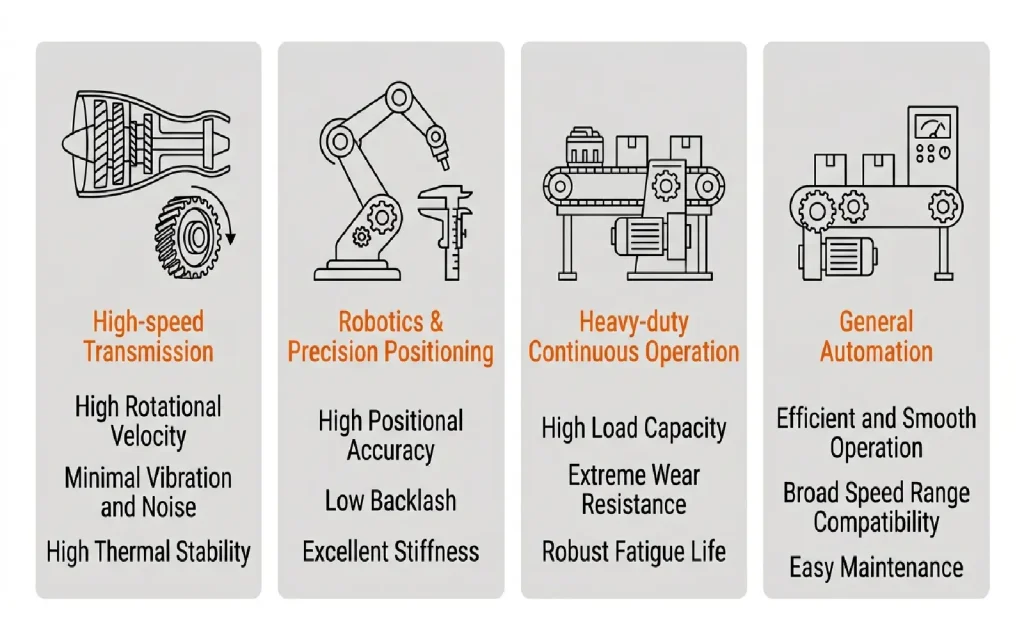
For high-speed transmission equipment, deviations in tooth profile, tooth spacing, and assembly accuracy are more likely to manifest as vibration and noise. Therefore, higher gear accuracy is usually required, with the specific accuracy grade determined according to the equipment speed, transmission error, and operating requirements. For applications with higher precision requirements, additional finishing processes such as gear grinding may be required after heat treatment.
In robotics and precision motion mechanisms, gears are responsible not only for power transmission but also for precise motion and positioning. In these applications, controlling backlash is particularly important to minimize transmission lag and prevent accumulated errors during motion transfer.
For heavy-duty and continuously operating equipment, such as conveyor and packaging production lines, greater emphasis is placed on material strength, tooth surface wear resistance, and fatigue resistance. Gears need to have sufficient hardness and toughness to withstand long-term cyclic loading.
3. Common Types of Precision Gears and Their Applications
Industrial automation equipment uses a wide range of transmission configurations, and the choice of gear type directly affects transmission efficiency and the compactness of the overall mechanical design.
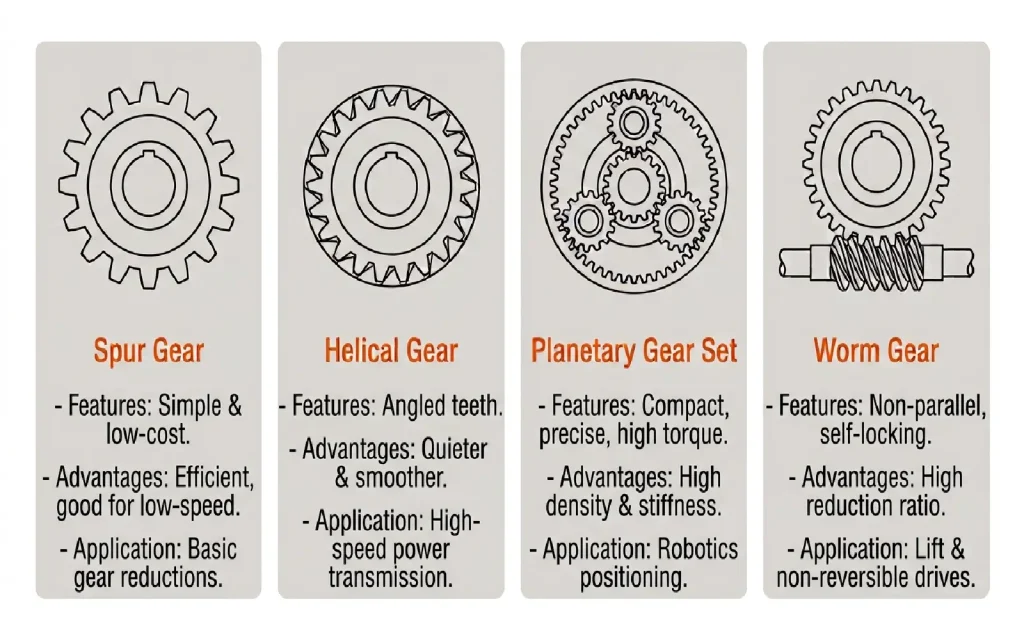
Precision spur gears feature a simple structure, ease of manufacturing, and no axial thrust, making them well suited for mechanisms with straightforward transmission requirements and moderate loads. Precision helical gears, on the other hand, provide smoother meshing through a higher contact ratio and are generally more suitable for applications requiring smooth operation, low noise, and higher load-carrying capacity.
In applications where installation space is limited but high power density is required, planetary gears are widely used in servo gear reducers and robot joints due to their compact structure and multiple-tooth load sharing. For mechanisms requiring high reduction ratios or specific shaft arrangements, worm gears are also a common choice. Their material selection and surface treatment should be determined according to the load, operating speed, and lubrication conditions.
4. Coordinated Design of Material Selection and Heat Treatment
The final performance of a gear is closely related to its material, heat treatment, and machining processes. Different load conditions require different combinations of materials and heat treatment processes.
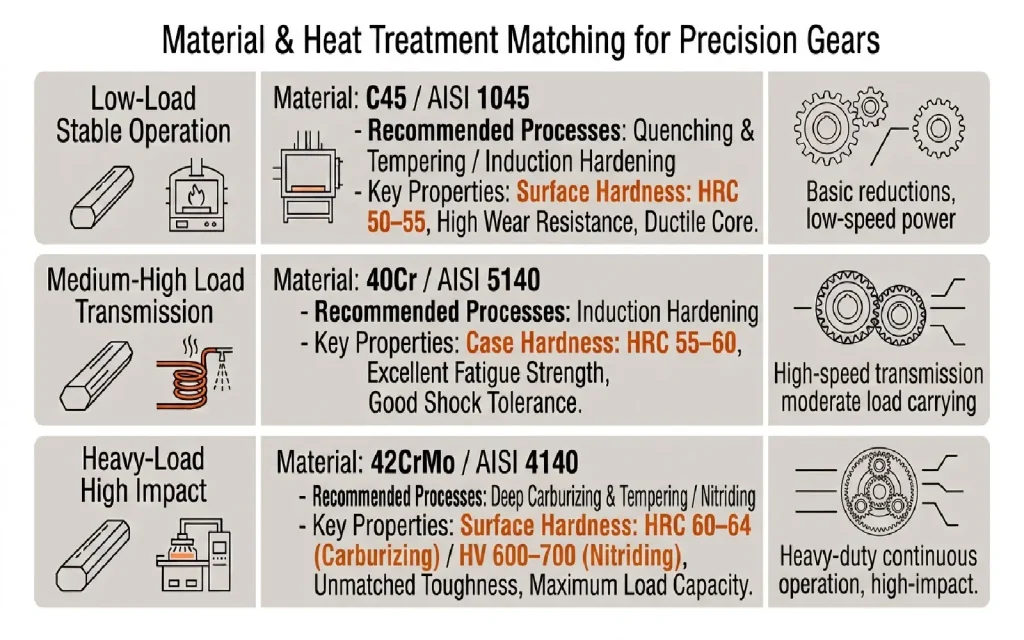
Low-load and stable operating conditions: C45 steel offers good machinability and cost-effectiveness. Depending on the actual requirements, processes such as quenching and tempering or induction hardening can be used. These processes can improve its overall mechanical properties and tooth surface hardness.
Medium- to high-load transmission: 40Cr offers good hardenability and well-balanced mechanical properties. Processes such as quenching and tempering or induction hardening can further improve its strength, wear resistance, and tooth surface properties.
Heavy-load and high-impact conditions: High-strength alloy steels such as 42CrMo can be selected according to gear size, loading conditions, and heat treatment requirements. Processes such as quenching and tempering, induction hardening, or nitriding can improve strength, wear resistance, and fatigue resistance. The specific hardness and hardened layer depth should be determined according to the gear structure, operating conditions, and heat treatment requirements.
It is important to note that heat treatment changes the material microstructure. It may also result in dimensional changes and deformation. For some gears with high precision requirements, stress relieving can be performed after rough machining. This can reduce the risk of deformation during subsequent heat treatment.
Before heat treatment, appropriate machining allowances should also be reserved. The allowance should be based on the expected deformation and subsequent finishing requirements. This allows dimensional and geometric errors to be corrected through subsequent finishing processes after heat treatment.
5. Key Process Controls Throughout the Gear Manufacturing Process
From tooth machining to final inspection, precision gear manufacturing requires coordinated process control at every stage.
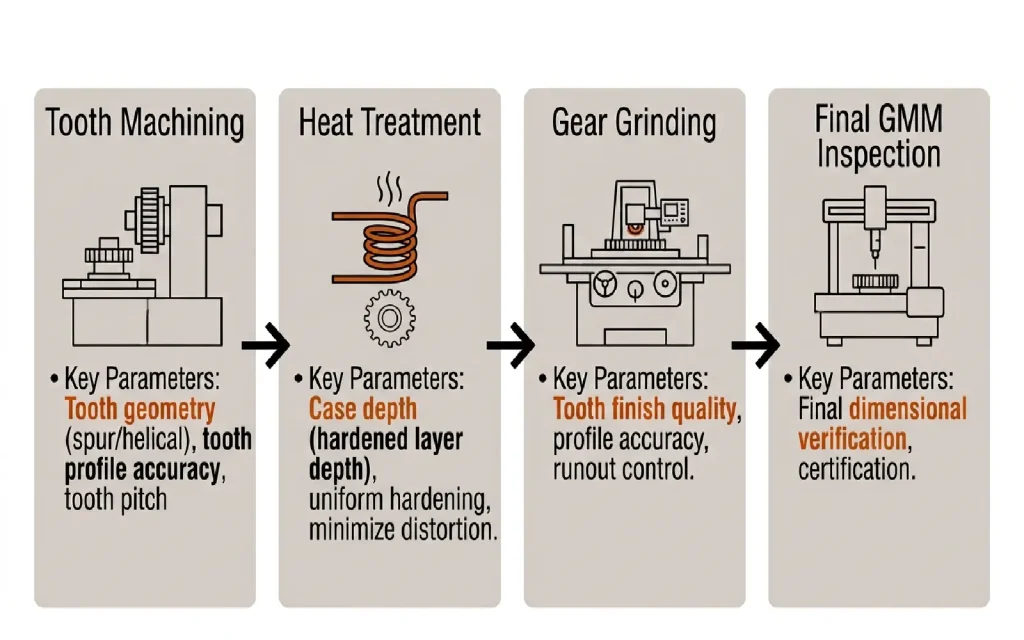
During the tooth machining stage, an appropriate machining process should be selected based on the gear structure, module, number of teeth, accuracy requirements, and production conditions. Key parameters such as tooth profile, tooth pitch, tooth thickness, and dimensional tolerances need to be carefully controlled throughout the machining process. During heat treatment, the heating, holding, and cooling processes should be properly controlled according to the material and specific heat treatment method. This helps minimize heat treatment distortion.
For hardened gears that have undergone heat treatment and require high precision, gear grinding and other finishing processes are often important subsequent operations. These processes can correct tooth profile, tooth lead, and tooth pitch errors caused by heat treatment. Gear grinding can also precisely correct cumulative pitch errors. This helps reduce meshing errors and improve vibration and noise performance during high-speed gear operation.
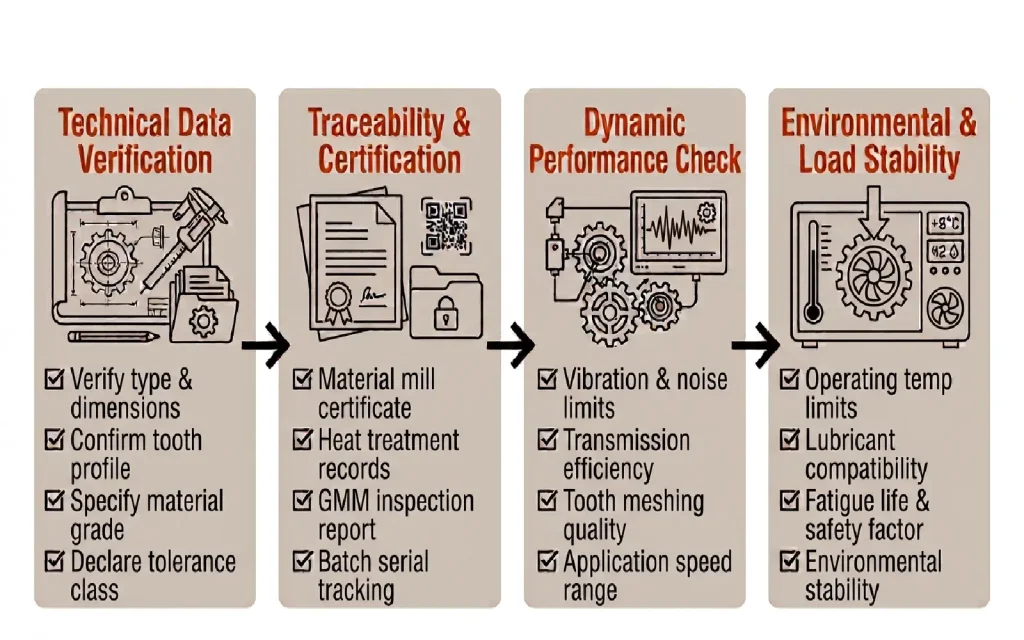
Finally, a Gear Measuring Center (GMM) can be used to inspect parameters such as tooth profile, tooth pitch, tooth lead, and radial runout. Depending on the product requirements, either 100% inspection or sampling inspection can be applied. This helps verify that the gears meet the specified drawings and technical requirements before batch delivery.
6. Fine-Tuned Customization and Procurement Recommendations
When customizing or purchasing precision gears for industrial automation equipment, blindly pursuing the highest possible accuracy grade can significantly increase manufacturing costs without necessarily improving performance. For example, standard conveyor equipment generally does not require the highest accuracy grade, while high-speed transmission systems and precision positioning mechanisms often require stricter gear accuracy. The appropriate accuracy grade should be determined based on factors such as rotational speed, load, positioning accuracy, and transmission requirements.
Before procurement, it is recommended to provide the manufacturer with complete technical information, including 2D/3D drawings, material and hardness requirements, module, number of teeth, accuracy grade, operating conditions such as rotational speed, transmitted torque, and load. This can help shorten technical communication time and allow the manufacturer to better evaluate the machining process and production cost.
If you are evaluating a precision gear solution for industrial automation equipment and require consistent quality across production batches, feel free to submit your drawings and technical specifications. Our engineering team can provide targeted process evaluation and customized manufacturing support based on your requirements.
FAQ
Q1: How is the accuracy of precision gears typically determined?
Gear accuracy should be determined based on the equipment’s transmission speed, positioning requirements, load conditions, and assembly requirements. Higher accuracy is not always better. Excessively high accuracy grades can increase machining costs. Therefore, the appropriate accuracy range should be selected according to the actual application requirements.
Q2: Do precision gears require gear grinding?
Not necessarily. Whether gear grinding is required depends on the gear accuracy grade, material, heat treatment condition, and equipment requirements. For high-precision gears used in automation equipment, gear grinding can correct dimensional and tooth profile errors after heat treatment. Gears with standard accuracy requirements may not require grinding.
Q3: How is heat treatment distortion controlled in precision gears?
Material selection, heat treatment method, gear structure, and machining allowance can all affect distortion. During manufacturing, the heat treatment process is usually planned in advance. The process is based on the material and gear structure, with appropriate machining allowance reserved for subsequent finishing operations.
Q4: What should be considered when purchasing precision gears in batches?
In addition to the accuracy and performance of individual gears, consistency between different batches should also be considered. Consistent materials, machining processes, heat treatment procedures, and inspection standards can help reduce dimensional variations. They can also reduce fitting problems during batch assembly.
Q5: What information should be provided to the manufacturer when customizing precision gears?
Customers should generally provide gear drawings or samples. They should also provide information such as material, module, number of teeth, accuracy grade, heat treatment requirements, quantity, and operating conditions. Clearly specifying the requirements for drawings, materials, accuracy, and heat treatment makes it easier for the manufacturer to arrange appropriate machining processes and quality inspection procedures.