+86 184 3796 0706
 info@destinytrans.com


1. What is an industrial robot base?
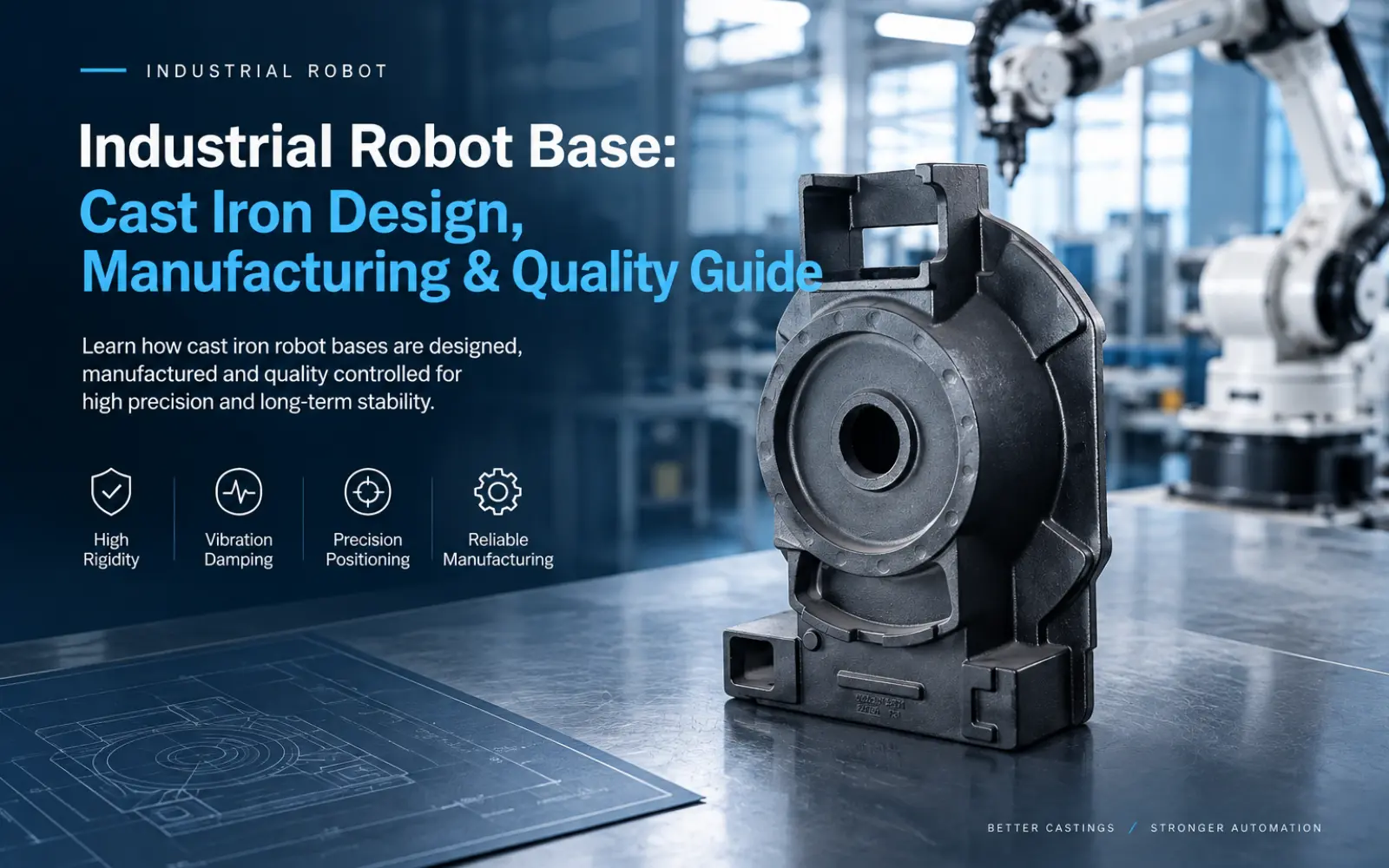
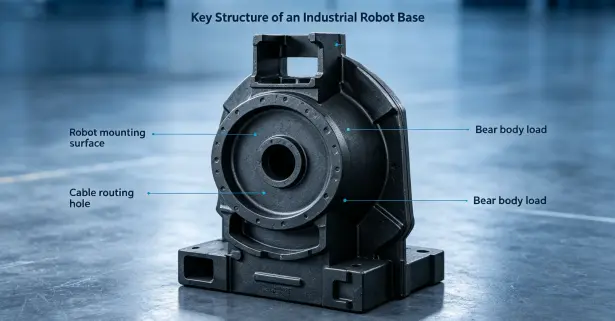
An industrial robot mount is a structural component used to secure a robot to the ground, machine frame, or production platform. It withstands static and dynamic loads and provides the mounting geometry required by the robot manufacturer. A well-designed mount should balance structural rigidity, dimensional stability, precise mounting interfaces, and appropriate cable routing.
Typical features include: machined robot mounting surfaces, bolt and pin locations, rigid rib structures, foundation anchors, and internal or external cable routing. Dimensions and tolerances should be based on the robot manufacturer’s mounting drawings, not generic dimensions.
2. Why is the robot’s base made of cast iron?
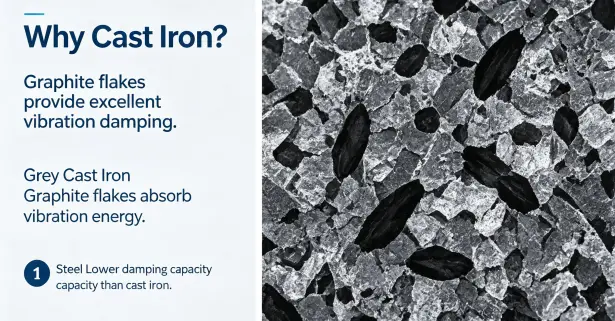
Cast iron is widely used in industrial robot bases due to its combination of rigidity, quality, casting performance, and good vibration damping properties. Gray cast iron is particularly suitable for complex ribbed structures, while ductile iron can be used in applications requiring higher strength. Structural steel is also an option, especially suitable for welded bases.
| Material | Main features | Typical considerations |
| gray cast iron | Good damping properties, castability and dimensional stability | Precision structural foundation |
| Ductile iron | Higher strength and toughness | High-load applications |
| Structural steel | High strength; suitable for processing | Welded or impact-guided structures |
The material grade should be selected based on the robot’s payload, reach, cycle speed, installation conditions, and the customer’s technical specifications.
3. Key Design Features
The robot mounting interface is the most critical functional area. Flatness, parallelism, bolt hole positions, and locating pin hole positions determine the robot’s mounting accuracy. The base geometry should also provide sufficient rigidity without adding unnecessary weight or machining.
- Mounting surface: CNC machined to meet the specified flatness and surface finish requirements.
- Bolt and pin patterns: made directly from the robot manufacturer’s drawings.
- Ribs and wall thickness: designed to control stiffness, mass, casting quality, and ease of machining.
- Cable routing: Smooth, burr-free channels provide ample space and bending radius for cables and hoses.
- Basic interface: Designed for the required anchoring, leveling and load transfer.
4. How are cast iron robot bases manufactured?
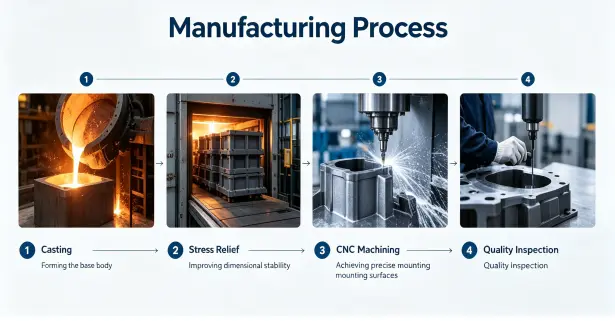
A typical production process includes pattern and mold preparation, melting and casting, blanking and cleaning, shot peening, stress relief if necessary, CNC machining, inspection and protective packaging.
| stage | Main controller |
| casting | Material grade, mold quality, filling and curing |
| clean | Remove sand, gates, risers and surface defects |
| Relieve stress | Control measures may be necessary to improve dimensional stability. |
| CNC machining | Key mounting surfaces, holes and interfaces |
| examine | Dimensions, surface condition, casting quality and documentation |
Process parameters should be determined based on the material, casting design, tolerance requirements, and production specifications. Non-functional surfaces can remain as-cast under appropriate conditions, while critical interfaces require precision machining.
5. Vibration damping and robot positioning accuracy
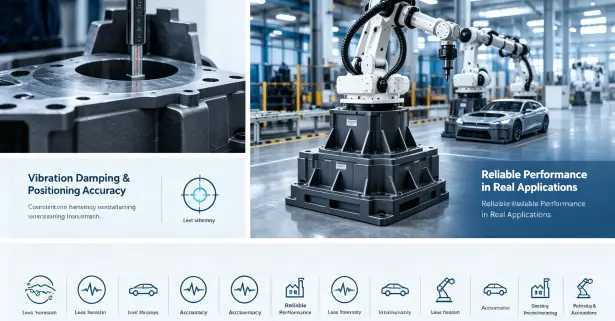
The robot’s acceleration, deceleration, and changes in the robotic arm’s orientation generate reaction forces and torques at the base. Movement or vibration of the base can cause positional errors in the end effector. The actual impact depends on the robot’s working range, robotic arm configuration, payload, motion trajectory, base rigidity, and installation conditions.
The graphite flake structure of gray cast iron can provide effective damping, thus helping to reduce vibration transmission. However, damping is only one part of the system. Foundation stiffness, mass distribution, anchorage, and foundation design also need to be considered.
6. Stress relief and dimensional stability
During the casting process, residual stress may remain due to varying cooling rates in different areas. Machining removes material and can disrupt this stress balance, leading to dimensional deviations. For precision robot bases, proper stress relief treatment before final machining can improve dimensional stability.
Depending on the material, casting geometry, tolerance requirements, and production process, thermal stress relief, vibration stress relief, or other controllable processes can be selected. If the process specifications include relevant treatment methods, the supplier should be able to provide corresponding supporting documentation.
7. Common robot base failure modes
| Failure Mode | Possible reasons | prevention |
| Flatness drift | Residual stress or dimensional instability | Process control and dimensional verification |
| vibration | Insufficient stiffness or external excitation | Dynamic and basic assessment |
| dislocation | Uneven foundation or incorrect installation | Levelness and anchorage inspection |
| cable damage | Sharp edges or improper milling | Deburring and appropriate bending radius |
| Anchor loose | Insufficient preload or excessive load | Proper installation and torque control |
8. Quality inspection of robot base
Inspections should focus on factors that affect installation and service performance. Depending on the specific project, quality documentation may include material certificates, work records, dimensional inspection reports, and non-destructive testing reports.
- Mounting surface flatness and parallelism
- Dimensions and positions of bolt holes and pin holes
- Key overall dimensions and installation height
- Surface finish of the machining interface
- Inspection of casting surface condition and specific defects
- Parts, heat pack numbers, and production traceability
9. How to choose a robot base supplier
For custom robot bases, buyers should evaluate the supplier’s entire process, not just the unit price. Key evaluation metrics include casting capabilities, material control, stress relief capabilities, CNC machining capabilities, testing equipment, traceability, customization capabilities, and engineering communication skills.
- Capable of casting and core manufacturing with complex rib structures
- Controlled melting and material certification
- CNC machining of precision mounting interfaces
- Coordinate measuring machine or equivalent size inspection
- Recorded processes and traceability controls
- Capable of manufacturing according to robot-specific blueprints
10. Basic Applications of Industrial Robots
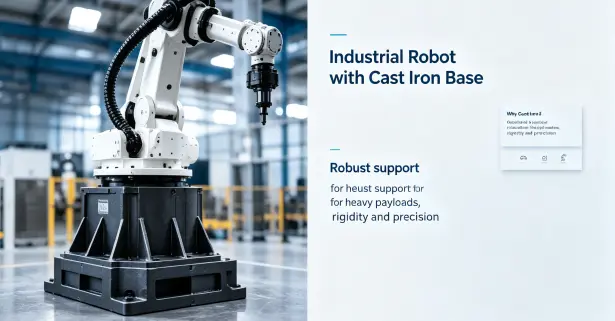
Industrial robot bases are widely used in automotive welding, machine tool loading and unloading, material handling, palletizing, assembly, and automated inspection. Different application scenarios have different requirements for base height, installation method, cable routing, rigidity, and basic interface.
Therefore, the correct configuration should be designed around the robot model, payload, reach, end effector, cycle time, installation environment, and installation drawings.
11. Technical Specifications
| scope | Typical requirements |
| Material | Depending on the application requirements, gray cast iron, ductile iron, or steel can be used. |
| process | Casting + necessary stress relief + CNC machining |
| Mounting surface | Processing according to project/robot drawings |
| Bolt and pin patterns | According to the robot manufacturer’s specifications |
| Cable wiring | Deburring or CNC machining |
| examine | Dimensional and casting quality inspections shall be conducted in accordance with regulations. |
| custom made | Height, ribs, holes, cable routing and interface geometry |
12. Frequently Asked Questions
What materials are used for the base of industrial robots?
Gray cast iron, ductile iron, and structural steel can all be used. The specific choice depends on the load, stiffness, vibration, geometry, and project requirements.
Why use cast iron instead of steel?
Gray cast iron has good vibration damping properties and excellent casting performance, making it suitable for complex structures. However, when high strength, high toughness, or weldable structures are required, steel may be a better choice.
Does the robot’s base need decompression?
For precision castings with strict dimensional requirements, controllable stress relief is an important manufacturing process consideration. This method should be tailored to the material and casting design.
How flat does the robot’s base need to be?
There is no uniform standard value. The required flatness should be based on the robot manufacturer’s installation specifications or customer drawings.
Can the robot base be customized?
Yes. Bolt hole positions, locating pin locations, installation height, cable routing, reinforcing ribs, leveling functions, and other interfaces can all be customized according to approved drawings.
13. Why choose to purchase the robot base from a supplier that integrates casting and machining?
For precision robot mounts, casting quality alone does not determine the final performance. Material control, stress relief, CNC machining, dimensional inspection, and traceability all affect the final mounting interface. A supplier that integrates casting and machining can coordinate these aspects within a single production system.
Ruixi Foundry Co., Ltd. provides customized industrial casting production services, including casting, CNC machining, material control, inspection, and quality documentation. Buyers can provide robot installation drawings, material requirements, critical tolerances, and expected quantities for technical review and quotation.
WhatsApp:+86 184 3796 0706
Email: info@destinytrans.com