+86 184 3796 0706
 info@destinytrans.com


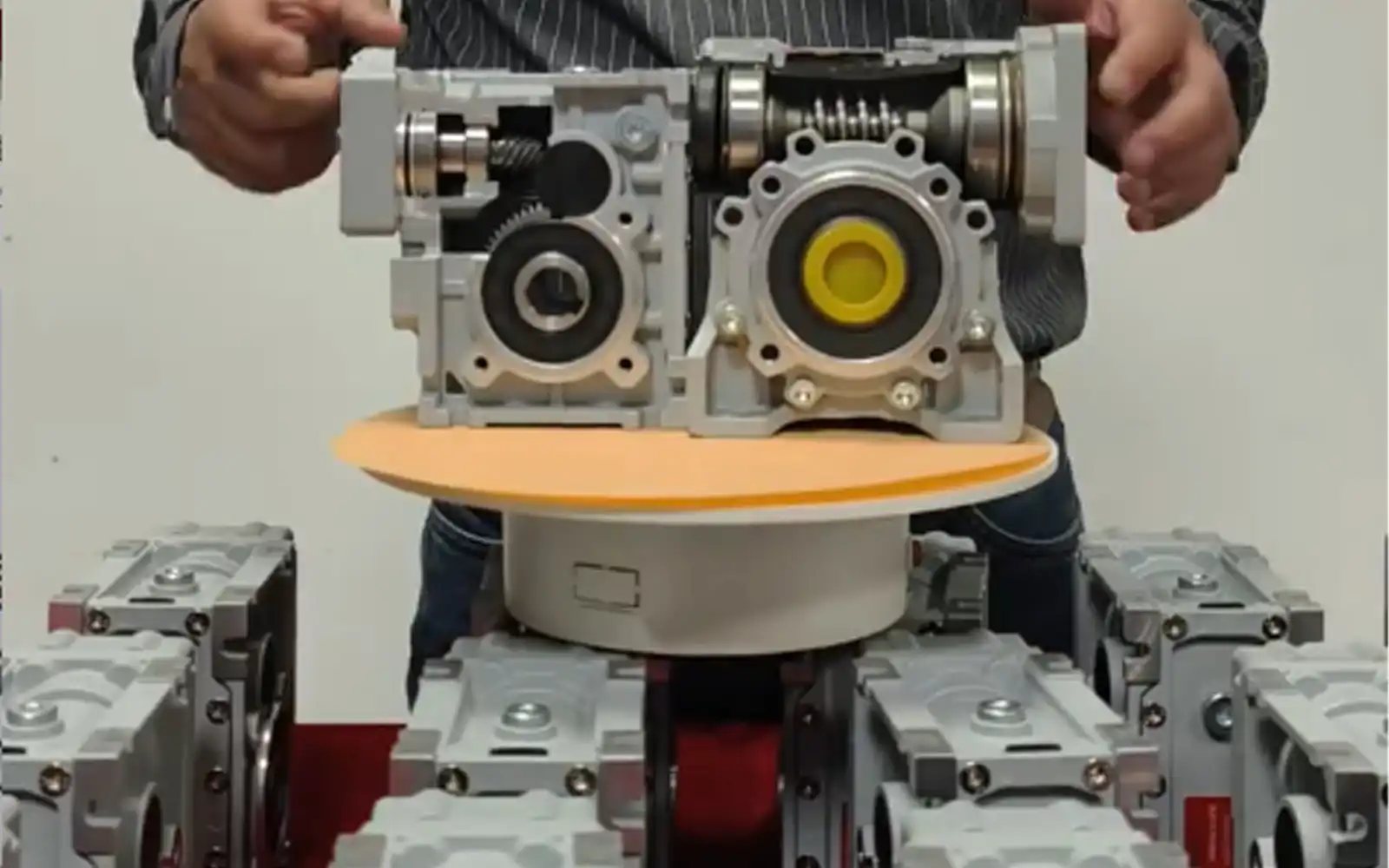
When designing right-angle drive systems for automation, packaging, and conveyor equipment, machine builders often face a critical selection choice: Should you specify a traditional RV worm gear reducer (NMRV series) or upgrade to a high-efficiency Hypoid gear reducer?
While both gearbox types feature a compact square housing with a 90-degree right-angle layout, their internal gear mechanics, mechanical efficiency, thermal behavior, and service life differ drastically.
In this comprehensive guide, we compare Hypoid gearboxes and RV worm reducers across core performance metrics to help engineers and procurement managers select the optimal drive unit for their machinery.
Understanding the Transmission Principles
To understand their performance differences, we must look at how power is transferred inside each gearbox:
- RV Worm Reducer (NMRV): Utilizes a hardened steel worm shaft meshing with a bronze worm wheel. Power is transferred primarily through sliding friction.
- Hypoid Gear Reducer: Utilizes precision-machined steel hypoid gears (a hybrid between spiral bevel and worm gears with offset shafts). Power is transferred primarily through rolling contactwith minimal sliding.
Thermal Behavior and Operating Temperature
- Hypoid Gearbox: Low internal friction results in minimal heat build-up, making it ideal for 24/7 continuous duty and heat-sensitive environments (such as food processing and pharmaceuticals).
- RV Worm Reducer: Generates noticeable operating heat during continuous operation, requiring strict monitoring of ambient temperature, duty cycles, and thermal power limits.
Service Life and Wear Resistance
- Hypoid Gearbox: All gears are manufactured from case-hardened alloy steel. With no wear-prone bronze components, Hypoid gearboxes offer an exceptionally long service life with minimal maintenance.
- RV Worm Reducer: The bronze worm wheel acts as a sacrificial wear component. Over extended operation under heavy load, the bronze teeth gradually wear down, requiring periodic inspection and eventual replacement.
Reduction Ratios and Self-Locking
- Hypoid Gearbox: Offers single-stage ratios typically between $7.5:1$ and $30:1$. Hypoid gearing does not self-lock, allowing free back-driving when power is off.
- RV Worm Reducer: Achieves large single-stage reduction ratios up to $100:1$. At higher ratios (typically ratio $i \ge 30$), worm gearboxes offer inherent self-locking capability, preventing reverse driving on inclined conveyors or hoists.
Side-by-Side Comparison Table
| Performance Metric | Hypoid Gear Reducer | RV Worm Reducer (NMRV) |
| Gear Material | Hardened Steel to Steel | Hardened Steel Worm + Bronze Wheel |
| Meshing Contact | Rolling Contact (High Efficiency) | Sliding Contact (Higher Friction) |
| Transmission Efficiency | 90% – 96% (High) | 50% – 85% (Medium/Low) |
| Heat Generation | Very Low | Moderate to High |
| Service Life | Extremely Long (All-Steel) | Medium (Bronze Wheel Wears) |
| Single-Stage Ratios | 7.5:1 – 30:1 | 7.5:1 – 100:1 (High Ratio) |
| Self-Locking Capability | No | Yes (at ratios $i \ge 30$) |
| Mounting Compatibility | 100% Drop-in replacement for NMRV | Standard NMRV Square Housing |
| Initial Purchase Cost | Moderate | Low (Economical) |
Selection Guide: Which Gearbox Should You Choose?
Choose a Hypoid Gearbox If:
- Your equipment operates on a 24/7 continuous duty cycle(e.g., automated logistics sorting, packaging lines), where energy savings yield a fast ROI.
- You need a direct drop-in replacement for an NMRV gearboxto solve overheating or energy consumption issues without redesigning machine frames.
- Your application is in a heat-sensitive industrysuch as food processing, bottling, or pharmaceutical manufacturing.
- You demand a long service life with zero bronze wheel wear.
Choose an RV Worm Reducer If:
- Your application is cost-sensitive and operates on a light-to-medium or intermittent duty cycle.
- You require a high single-stage reduction ratio (e.g., $50:1$, $80:1$, or $100:1$) in a compact footprint.
- You need mechanical reverse self-locking for safety on inclined conveyors or small hoists.
Conclusion & Request a Technical Quote
Both Hypoid gearboxes and RV worm reducers play vital roles in right-angle industrial automation. Upgrading from standard RV worm units to high-efficiency Hypoid gearboxes is one of the most effective ways for machinery OEMs to improve energy efficiency and thermal stability.
Looking for CAD 2D/3D models, drop-in replacement guides, or a factory-direct quote? [Contact Our Engineering Team] or [Download the Complete Hypoid & RV Reducer Catalog (PDF)].