+86 184 3796 0706
 info@destinytrans.com


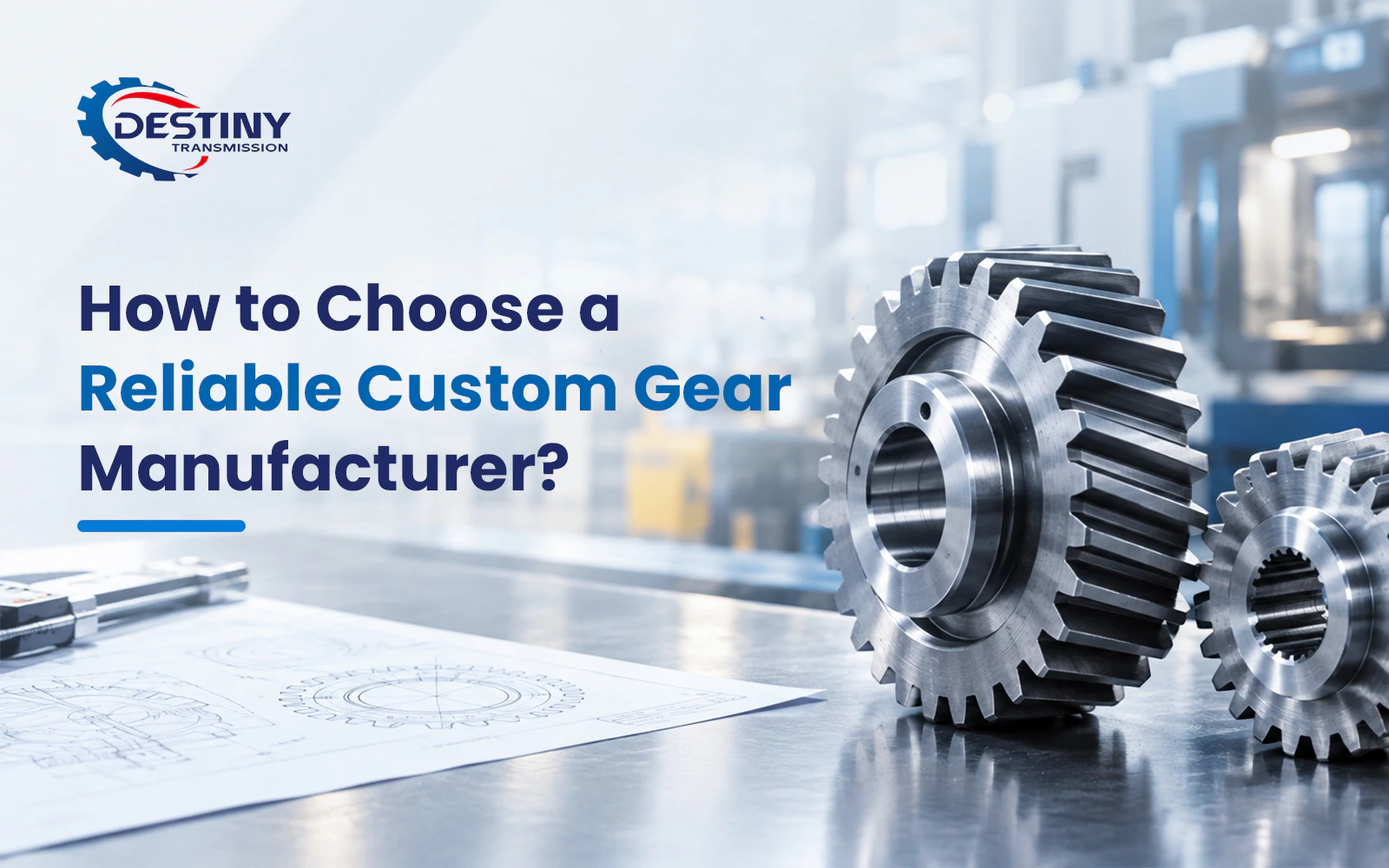
Introduction: Choosing a Reliable Custom Gear Manufacturer
When choosing a custom gear manufacturer, price is usually not the only deciding factor. A supplier’s machining capabilities, material and heat-treatment expertise, inspection methods, engineering experience, and production stability can all affect gear quality and total project cost.
A reliable manufacturer should be able to manufacture gears according to drawings and verify whether the specified material, manufacturing process, heat treatment, and accuracy requirements suit the equipment’s load, speed, and working environment.
For buyers, the key question is whether the supplier can turn a gear drawing into a controlled manufacturing, heat-treatment, and inspection process and provide evidence that the finished gears meet the specified requirements.
Quick Answer
To choose a reliable custom gear manufacturer, evaluate machining capabilities, relevant engineering experience, material and heat-treatment control, inspection capabilities, technical support, prototype and production management, and delivery consistency. The strongest evidence is a clear connection between the drawing, manufacturing process, inspection method, measured results, and traceable production records.
1. Evaluate the Manufacturer’s Gear Machining Capabilities
Custom gears can require different processes and equipment depending on their geometry, material, accuracy, and production volume.
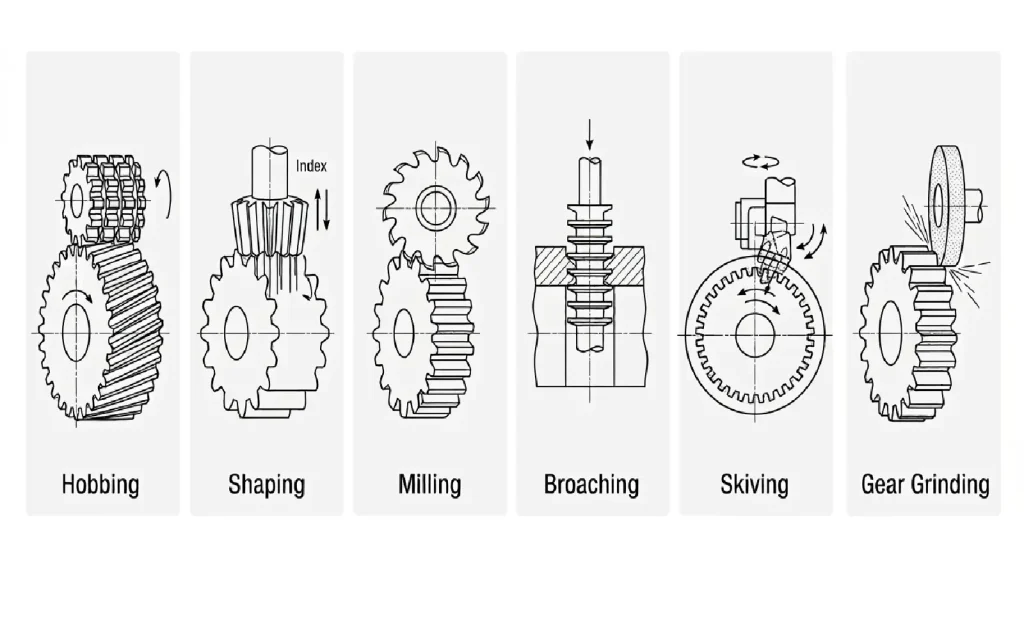
Spur gears, helical gears, bevel gears, internal gears, and gear racks may require hobbing, shaping, milling, broaching, skiving, gear grinding, or other finishing operations.
Buyers should confirm whether the manufacturer has the required equipment and whether critical processes are performed in-house or outsourced. For outsourced grinding or heat treatment, ask how process specifications, acceptance criteria, inspection, and traceability are controlled.
Machine quantity alone does not establish gear-manufacturing capability. A supplier may have many CNC machines but lack the gear-cutting equipment, tooling, fixtures, or measurement capability required for a particular gear.
Why Gear Accuracy Requires More Than a Grade Number
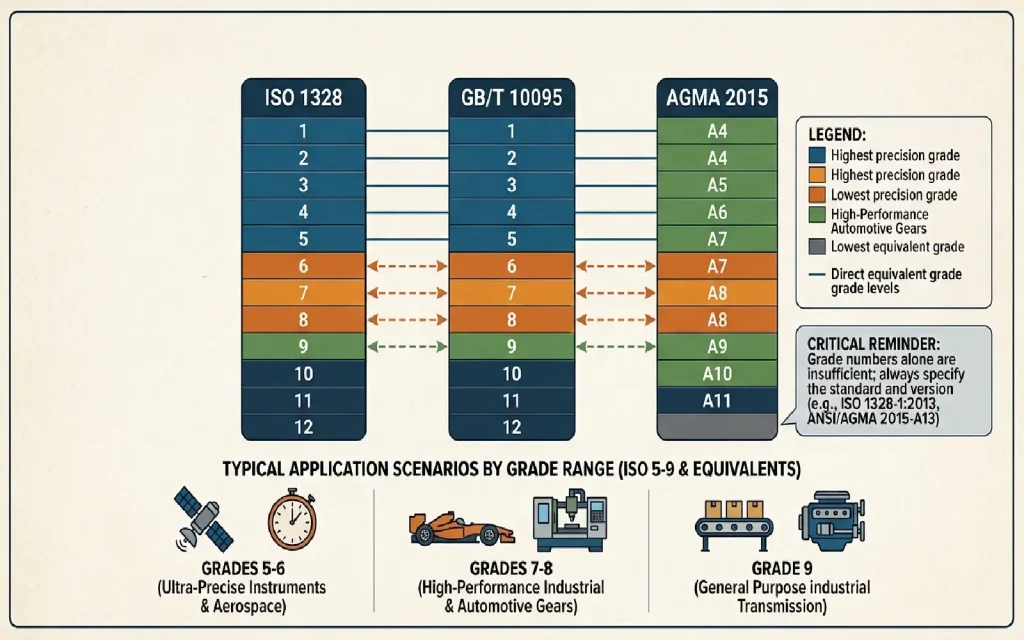
For cylindrical involute gears, ISO 1328-1:2013 defines 11 flank tolerance classes, numbered 1 to 11 in order of increasing tolerance. Its stated scope includes gears from 5 to 1,000 teeth, reference diameters from 5 to 15,000 mm, normal modules from 0.5 to 70 mm, and face widths from 4 to 1,200 mm.
A drawing that only states “high precision” provides less information than one that specifies an accuracy class and the characteristics to be controlled. A requirement such as ISO 1328-1 Grade 6 should be considered together with profile deviation, helix deviation, pitch deviations, runout, tooth thickness, and specified profile or lead modifications.
A higher accuracy requirement may increase the need for gear grinding, but no ISO grade automatically requires a particular finishing process. The manufacturing route depends on the gear geometry, material, heat treatment, surface condition, required accuracy, and production volume.
2. Consider the Manufacturer’s Industry Experience and Technical Expertise
Relevant experience is more important than simply counting years in business. Buyers should look for experience with similar gear types, materials, sizes, accuracy requirements, heat treatments, and operating conditions.
Useful experience may include heat-treatment distortion control, profile and lead modification, tooth contact, shaft and bore fits, runout control, final accuracy inspection, and prototype-to-production process control.
Instead of relying on claims such as “many years of experience,” ask for examples involving similar technical requirements. Even limited information about the gear type, material, heat treatment, accuracy class, quantity, and inspection scope can be useful.
Relevant process experience may help identify issues such as heat-treatment distortion, insufficient tooth strength, excessive runout, incorrect fits, or assembly interference before mass production.
For load-related projects, buyers should distinguish between gear accuracy and load capacity. ISO 6336 covers load-capacity calculations for spur and helical gears, while ISO 10300 covers bevel gears.
Industry Standards Buyers May Encounter
| Standard | Main purpose | Buyer relevance |
| ISO 1328-1:2013 | Cylindrical involute gear flank tolerances | Accuracy classification and inspection |
| ISO 1328-2:2020 | Double-flank radial composite deviations | Relevant when composite testing is specified |
| GB/T 10095.1-2022 | Chinese cylindrical gear flank tolerances | Useful for Chinese-standard requirements |
| ISO 6336-1:2019 | Spur and helical gear load capacity | Load-related design evaluation |
| ISO 10300-1:2023 | Bevel gear load capacity | Bevel gear design and load evaluation |
Buyers should specify the applicable standard and edition rather than assume different accuracy systems are interchangeable.
3. Check Material Selection and Heat-Treatment Capabilities
Material selection should be considered together with gear geometry, load, speed, dimensions, heat treatment, wear requirements, and operating environment.
Common materials include C45 steel, 40Cr, 42CrMo, stainless steel, and engineering plastics.
C45 steel offers a balance of machinability, mechanical properties, and cost for many general-purpose gears. 40Cr can provide higher strength and wear resistance after heat treatment and is widely used in industrial machinery. 42CrMo provides high strength, toughness, and fatigue resistance for demanding applications where its additional capability is justified. Stainless steel may be selected when corrosion resistance is important, while engineering plastics may suit applications requiring low weight, reduced noise, or specific chemical or self-lubricating properties.
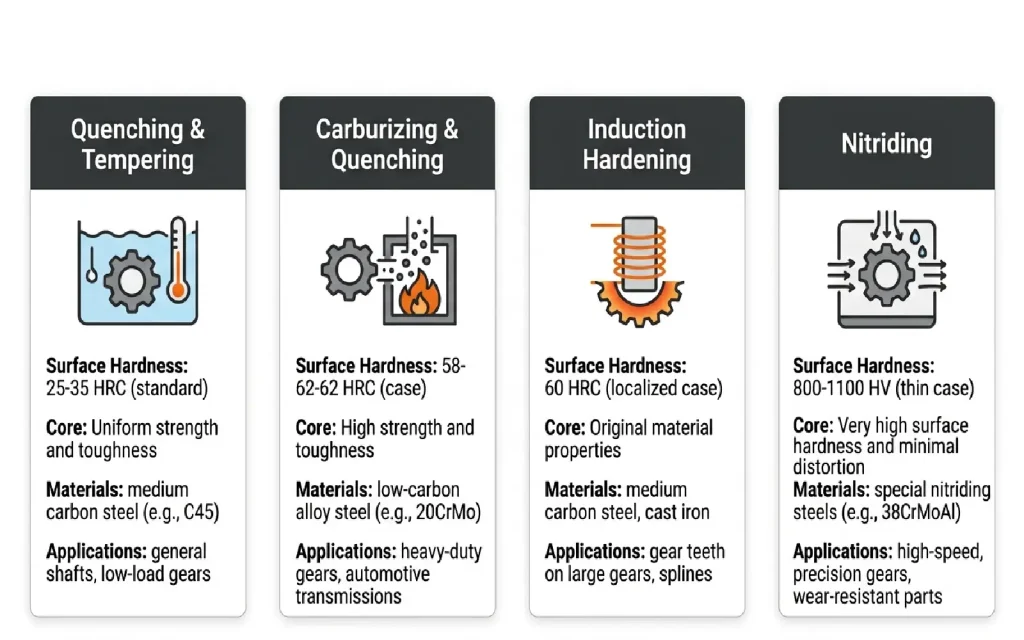
For purchasing purposes, material grade and heat treatment should be treated as one specification. Common processes include quenching and tempering, carburizing and quenching, induction hardening, and nitriding, each providing different combinations of hardness, wear resistance, fatigue resistance, and core toughness.
Ask for Numerical Heat-Treatment Requirements
A description such as “hardened gear” is not sufficiently precise. Buyers should confirm:
- surface hardness
- core hardness
- effective case depth
- hardness range or minimum value
- heat-treatment method
- post-treatment dimensional requirements
The required values depend on the material, gear size, load, heat-treatment process, tooth geometry, and application.
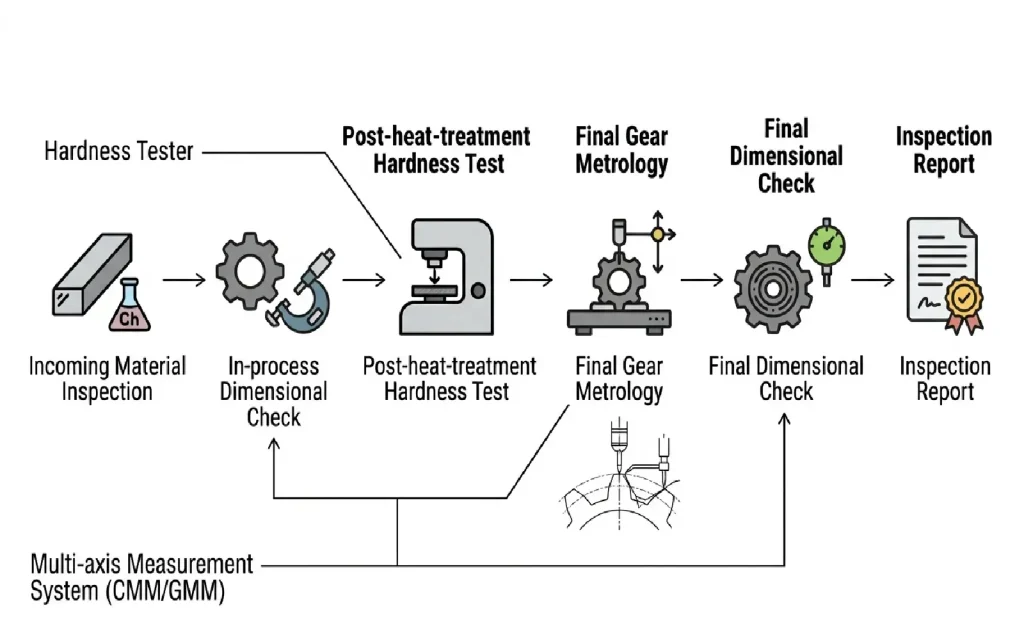
For precision gears, also consider heat-treatment distortion. Final inspection should verify critical requirements after the complete manufacturing process, not only before heat treatment.
4. Check Quality Control and Inspection Capabilities
A supplier’s inspection capability should match the drawing requirements. Statements such as “100% inspection” are less useful than knowing what is measured, how it is measured, and which standard defines acceptance.
| Inspection item | What it helps verify | Typical measurement approach |
| Profile deviation | Tooth profile accuracy | Gear measuring machine or suitable CMM |
| Helix deviation | Tooth alignment | Gear measuring machine or suitable CMM |
| Pitch deviation | Indexing consistency | Gear measuring machine / pitch system |
| Runout | Radial positioning | Runout or gear measurement system |
| Tooth thickness | Tooth size and clearance | Gear gauges or dimensional measurement |
| Surface roughness | Flank surface condition | Roughness measuring equipment |
| Hardness | Heat-treatment result | Rockwell or specified hardness method |
| Tooth contact / meshing | Contact condition | Contact-pattern or rolling test, when required |
For precision gears, buyers can ask whether the supplier uses a dedicated gear measuring machine or gear measurement center.
The key is whether the supplier can connect the drawing requirement → measurement method → inspection result → acceptance decision.
What Should an Inspection Report Show?
A useful report may include the part number, drawing revision, production batch, material, heat treatment, inspection standard, measuring equipment, measured values, tolerance limits, and final acceptance result.
Traceability is particularly important for repeat orders. Material certificates, heat-treatment records, dimensional results, and gear measurement data should be linked to the relevant production batch.
ISO 9001 certification can indicate a documented quality-management system, but it does not by itself prove that a particular gear meets its drawing requirements.
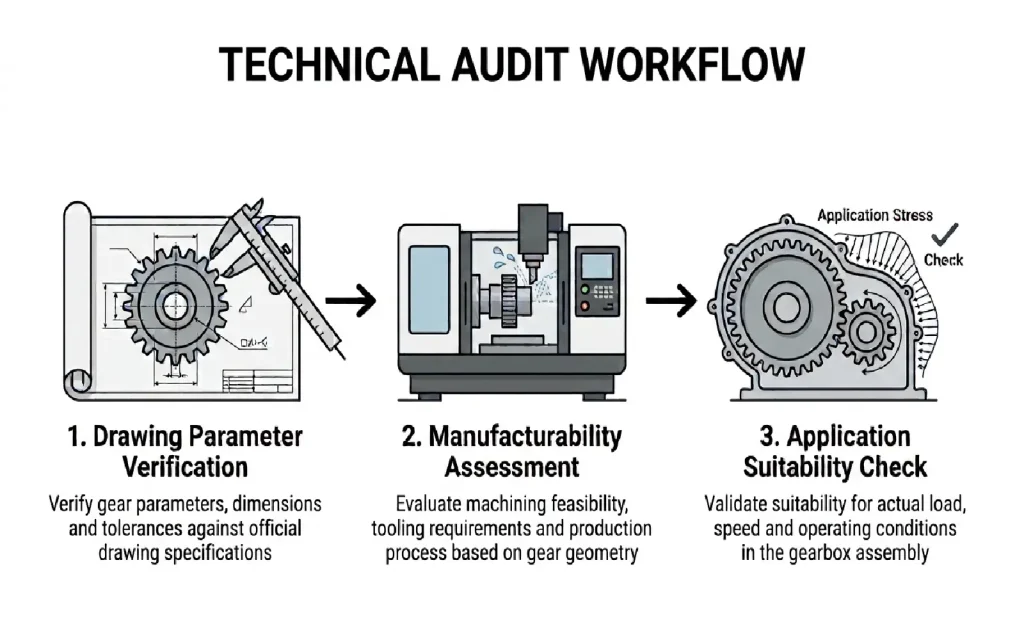
5. Evaluate Custom Design and Technical Support Capabilities
Custom gear projects may begin with a drawing, 3D model, old gear, sample, or basic equipment parameters.
A manufacturer should be able to review gear type, module, number of teeth, pressure angle, face width, material, accuracy, mounting dimensions, load, speed, and working environment before production.
The technical review should confirm that the requirements are manufacturable and consistent with the intended operating conditions. High-speed applications may require greater attention to accuracy, flank quality, balance, and profile or lead modifications, while heavy-load applications may require review of material, heat treatment, face width, and tooth geometry.
Buyers should also ask whether the supplier performs a drawing review before quotation or production release to identify missing dimensions, unclear tolerances, conflicting requirements, or manufacturing risks.
6. Consider Prototype, Tooling, MOQ, and Production Stability
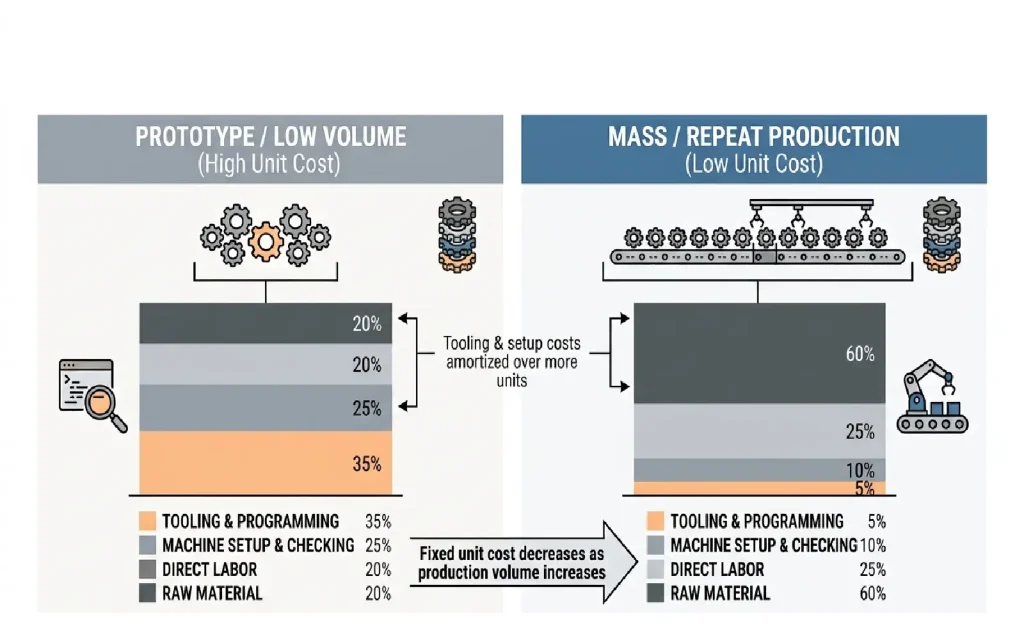
Prototype and mass-production orders can have different cost structures. Small quantities may carry higher costs for programming, setup, fixtures, tooling, inspection, and engineering.
Prototype vs. Repeat Production
| Cost or process item | Prototype / small quantity | Repeat / mass production |
| Programming and setup | Larger effect on unit cost | Spread across more parts |
| Custom tooling | May be a major one-time cost | Usually amortized over production |
| Inspection | Often includes first-article verification | More standardized |
| Process optimization | May still be under adjustment | Stable parameters can be reused |
| Lead time | May include engineering and setup | More predictable after stabilization |
Custom gears may not have a fixed minimum order quantity (MOQ). Buyers should ask whether the quotation includes tooling, setup, engineering or programming, inspection, and other one-time costs, and whether these apply again to future orders.
For repeat production, confirm that process specifications, inspection criteria, tooling information, and production records are maintained so the process can be reproduced consistently.
Illustrative Purchasing Scenario: Why Two Gear Quotations May Not Be Comparable
The following comparison is illustrative only and does not represent actual supplier quotations.
| Quotation factor | Supplier A | Supplier B |
| Material | C45 | 40Cr |
| Heat treatment | Specified treatment | Specified hardness requirement |
| Finishing | Outsourced | Defined finishing process |
| Inspection | General dimensional inspection | Dimensional + gear accuracy measurement |
| Traceability | Batch-level records | Material and inspection records |
| Tooling | Included or unspecified | Separately identified |
| Quantity | Same | Same |
Even with identical basic dimensions, the two quotations may not represent the same technical and inspection scope. Buyers should compare material, heat treatment, finishing, inspection, tooling, documentation, and other terms before comparing unit prices.
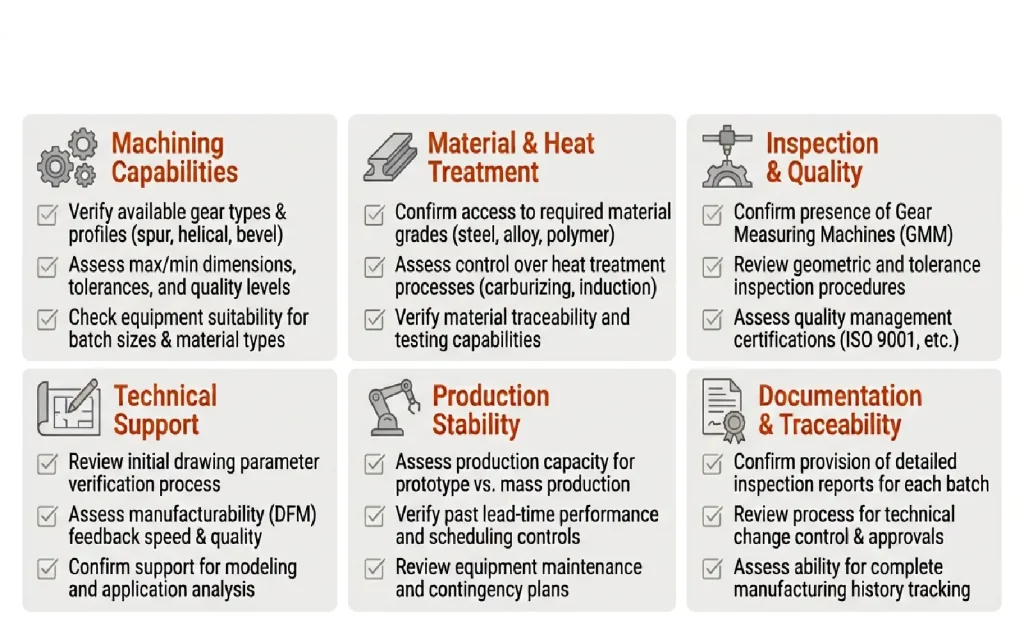
7. Practical Checklist Before Choosing a Custom Gear Manufacturer
Does the Manufacturer Support Non-Standard Customization?
Confirm whether it accepts drawings, samples, 3D models, or operating-condition requirements and reviews non-standard requirements before production.
Does It Have Relevant Gear-Manufacturing Experience?
Ask about similar gear types, materials, sizes, accuracy classes, heat treatments, and operating conditions.
Can It Explain Its Accuracy and Inspection Methods?
Ask which characteristics are inspected, which standard is used, what equipment is used, and whether final measured values are documented.
Can It Provide Numerical Heat-Treatment Requirements?
Confirm the hardness range, case depth where applicable, heat-treatment method, and final dimensional requirements.
Can Quality Records Be Traced?
Check whether material certificates, heat-treatment records, inspection reports, and gear measurement results can be linked to the relevant production batch.
How Are Prototype and Production Costs Calculated?
Confirm tooling, setup, programming, engineering, inspection, and other one-time costs, and whether future orders use the same process and tooling.
Can It Maintain Consistency in Repeat Orders?
Ask whether the supplier maintains stable process specifications, inspection criteria, tooling information, and production records.
Can It Meet the Required Delivery Schedule?
Confirm the expected schedule for drawing review, material preparation, machining, heat treatment, finishing, inspection, and delivery, including which stages are outsourced.
8. Common Mistakes When Choosing a Custom Gear Manufacturer
Comparing Only the Lowest Unit Price
A lower quotation may reflect differences in material, heat treatment, finishing, inspection, tooling, documentation, or delivery terms.
Comparing Suppliers Before Standardizing the Specification
Ensure suppliers quote against the same requirements for material, hardness, accuracy, heat treatment, inspection scope, tooling, quantity, packaging, and delivery terms.
Treating an Accuracy Grade as a Complete Quality Specification
An accuracy class does not replace individual requirements such as profile deviation, helix deviation, pitch deviation, runout, tooth thickness, and surface condition.
Assuming More Machines Mean Better Gear Capability
Machine quantity does not prove that a supplier has the required gear-cutting, finishing, tooling, or measurement capability.
Checking Dimensions Only Before Heat Treatment
Critical final requirements should be verified after the complete manufacturing process because heat treatment can affect dimensions and tooth geometry.
Ignoring Prototype and Tooling Costs
Small orders may have higher unit costs because setup, tooling, programming, and inspection costs are spread over fewer parts.
FAQ
1. What Is a Custom Gear Manufacturer?
A custom gear manufacturer produces non-standard gears according to drawings, samples, 3D models, or technical requirements and may also provide process review, heat treatment, finishing, and inspection.
2. What Information Is Needed for a Custom Gear?
Typical information includes gear type, module, number of teeth, pressure angle, face width, material, accuracy, mounting dimensions, heat treatment, load, speed, and working environment.
3. What Gear Accuracy Standards Should Buyers Know?
For cylindrical involute gears, ISO 1328-1:2013 covers flank tolerance classification, ISO 1328-2:2020 covers double-flank radial composite deviations, and GB/T 10095.1-2022 provides the Chinese national-standard framework for cylindrical gear flank tolerances.
4. What Should a Gear Inspection Report Include?
It may include the part number, drawing revision, production batch, material, heat treatment, inspection standard, measuring equipment, measured values, tolerance limits, and acceptance result.
5. How Can You Tell Whether a Gear Manufacturer Is Reliable?
Review its machining capabilities, technical experience, material and heat-treatment practices, inspection methods, documentation, prototype support, production stability, and delivery performance. More importantly, ask for evidence linking the drawing, manufacturing process, inspection, acceptance, and traceability records.
6. How Long Does Custom Gear Production Usually Take?
Lead time depends on the gear structure, material, accuracy, heat treatment, finishing, quantity, tooling, and inspection scope. Buyers should request a schedule covering the main production stages.
7. How Do Tooling and MOQ Affect Custom Gear Pricing?
Small quantities may have higher unit costs because setup, programming, fixture, tooling, and inspection costs are distributed across fewer parts. Ask which costs are one-time charges and which are included in the unit price.
8. How Do You Choose Between Custom and Standard Gears?
Standard gears can be used when their dimensions, interfaces, performance, and availability match the application. Custom gears are considered when non-standard dimensions, mounting features, geometry, interfaces, or accuracy requirements are needed.
Conclusion
Choosing a custom gear manufacturer requires more than comparing quotations. Buyers should evaluate machining capabilities, engineering experience, material and heat-treatment practices, inspection capabilities, prototype and tooling costs, production stability, delivery performance, and technical support against the actual gear requirements.
The strongest evidence is a clear connection between the drawing, manufacturing process, heat treatment, inspection method, measured result, and production record, together with the ability to reproduce the process consistently for repeat orders.
For custom gear manufacturing based on drawings or samples, you can contact our team to discuss your requirements and request further technical information or a quotation.