+86 184 3796 0706
 info@destinytrans.com


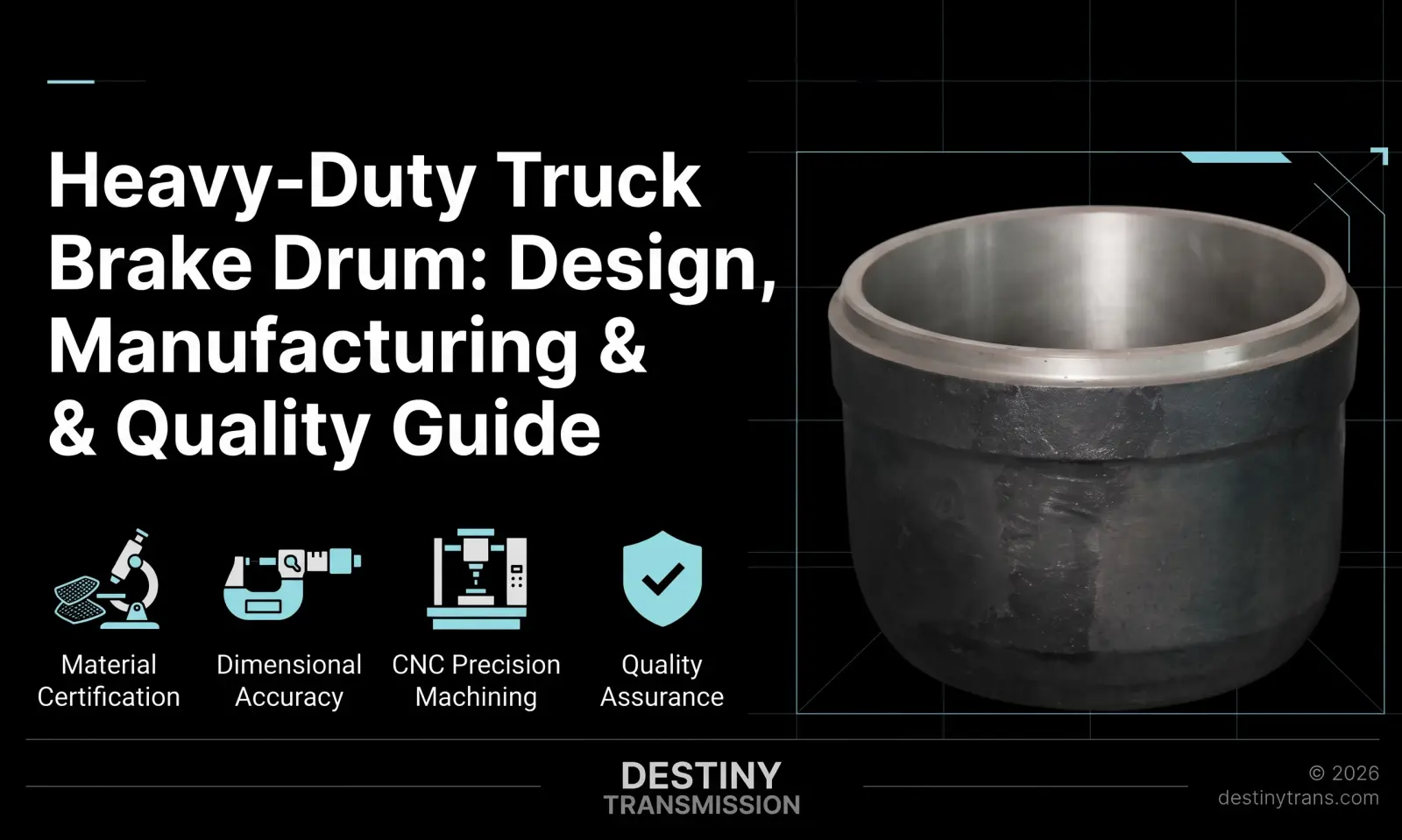
A technical handbook on grey iron metallurgy, failure analysis, CNC machining standards, and OEM procurement for commercial vehicle axles.
Executive Summary & Target Audience
Heavy-duty truck brake drums are safety-critical friction components subjected to extreme mechanical loads and cyclic thermal shock. In commercial vehicles (Class 7-8 trucks, semi-trailers, transit buses, and heavy vocational equipment), brake drums convert kinetic vehicle energy into heat while transmitting braking torque to the wheel hub.
For aftermarket distributors, fleet maintenance engineers, and global procurement managers, selecting the right brake drum is a balance of metallurgy, dimensional repeatability, thermal crack resistance, and dynamic balancing. This guide breaks down global material standards, wear limits, casting quality inspection, and OEM sourcing considerations.
1. What Is a Heavy-Duty Truck Brake Drum?
A truck brake drum is an internally expanding friction cylinder mounted directly to the wheel hub assembly. When compressed air actuates the S-cam brake foundation, the brake shoes force friction linings against the rotating inner drum bore, converting motion into friction-induced heat (temperatures often exceeding 400°C to 600°C during heavy braking).
Key Functional Systems:
- Friction Surface (Inner Bore): Determines contact geometry, friction coefficient stability, and brake lining wear rate. Standard North American heavy truck setups commonly utilize 16.5″ x 7″ (approx. 419 x 178 mm) brake profiles, while European trailer axles often specify 420 x 180 mm or 420 x 200 mm configurations.
- Thermal Mass & Heat Dissipation: Heavy-duty drum walls act as thermal capacitors. Sufficient wall thickness prevents thermal distortion, brake fade, and catastrophic fracture.
- Mounting Flange & Hub Pilot: Features precise bolt circles (PCD), stud holes, and pilot diameters (hub-piloted or stud-piloted) that ensure concentricity with wheel bearings.
2. Grey Cast Iron Metallurgy: International Standards & Chemistry
Commercial vehicle brake drums are manufactured almost exclusively from grey cast iron (flake graphite cast iron). The flake graphite structure provides:
- Superior Thermal Conductivity: Rapidly conducts surface heat away from the friction interface.
- High Vibration Damping: Absorbs acoustic harmonics and reduces brake squeal.
- Thermal Fatigue Resistance: Flake graphite acts as internal expansion cushions against thermal cycling stress.
- Anti-Galling Properties: Graphite provides micro-lubrication during emergency high-load stops.
International Grade Equivalence
International buyers require compliance with localized automotive standards. Below is the global cross-reference for heavy-duty commercial vehicle brake drums:
| Standard / Society | Material Grade | Tensile Strength (MPa) | Brinell Hardness (HBW) | Typical Application |
|---|---|---|---|---|
| SAE J431 | G3000 / G3500 | 207 – 241+ | 187 – 241 | North American heavy trucks & trailers |
| ASTM A48 | Class 30B / 35B | 207 – 241+ | 190 – 240 | Heavy commercial & industrial machinery |
| EN 1561 | EN-GJL-250 | 250 – 350 | 170 – 240 | European commercial vehicles & trailers |
| ISO 185 | Grade 250 | 250 – 350 | 180 – 230 | International export standard |
| GB/T 9439 | HT250 | ≥ 250 | 180 – 230 | Domestic commercial vehicles |
| JIS G5501 | FC250 | ≥ 250 | 180 – 240 | Japanese commercial vehicles |
Target Chemical Composition (Typical Benchmark)
To achieve high thermal durability and prevent brittle failure, melting chemistry should fall within controlled metallurgical bands:
- Carbon (C): 3.20% – 3.60% (ensures adequate graphite volume for heat transfer)
- Silicon (Si): 1.80% – 2.30% (controls graphitization and pearlite balance)
- Manganese (Mn): 0.60% – 0.90% (promotes pearlite formation and strength)
- Sulfur (S): 0.06% – 0.12% (optimizes manganese sulfide nucleation)
- Phosphorus (P): ≤ 0.10% (strictly controlled to prevent phosphide eutectic brittleness)
- Microstructure Specification: Minimum 90% fully pearlitic matrix with Type A graphite flakes (Size 4–6 according to ASTM A247), free of excessive carbides or uncombined ferrite.
3. Wear Mechanisms, Cracking & Discard Limits
Common Failure Modes in Severe-Duty Service
- Heat Checking (Craze Cracking): Fine, hair-like surface fissures resulting from cyclic thermal expansion and contraction. Normal surface micro-crazing is acceptable, but interconnected fissures deeper than 0.5 mm or extending through the edge require immediate replacement.
- Thermal Stress Cracks: Deep transverse cracks propagating across the friction face. Usually caused by sustained dragging brakes, severe mountain descents, or lining misalignment. Drums with structural cracks must be condemned immediately.
- Out-of-Round (Bore Ovality): Caused by uneven heat dissipation, dragging shoes, or improper pneumatic chamber pressure. Results in pedal pulsation and erratic vehicle braking.
- Scoring & Grooving: Foreign debris or worn-out shoe rivets gouging concentric channels into the drum bore.
- Localized Blueing / Hot Spots: Dark blue or martensitic hard spots resulting from localized temperature spikes (>700°C) followed by rapid quenching.
Wear Limits and Discard Criteria
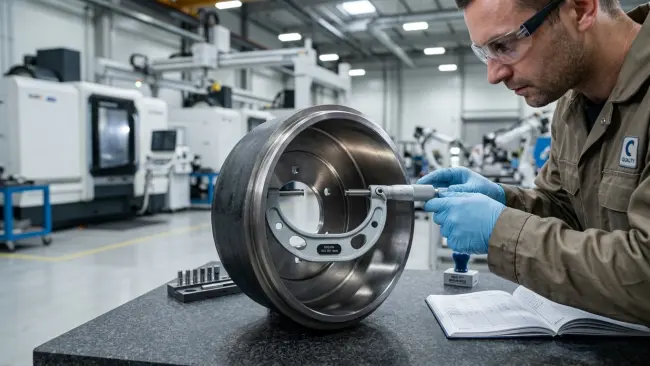
Every high-quality brake drum has its Maximum Allowable Discard Diameter (e.g., MAX DIA 423.5 mm) cast or permanently laser-engraved onto the outer rim.
- Nominal Diameter: E.g., 420.0 mm.
- Machining / Re-bore Limit: Nominal + 2.0 mm (422.0 mm).
- Discard Limit: Nominal + 3.5 mm to 4.5 mm (e.g., 423.5 mm – 424.5 mm depending on OEM specification). Once the inner bore exceeds this limit, wall thickness is insufficient to resist burst pressures.
4. Manufacturing Process & Quality Verification
Reliable brake drum casting requires tight integration between the foundry floor and CNC machining cells.
Process Flowchart
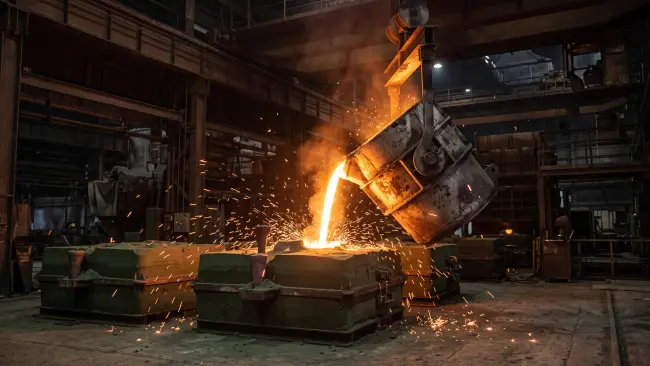
- Tooling & Molding: Automatic vertical or horizontal green sand molding lines (e.g., Disamatic or furan resin sand lines) ensure tight pattern dimensional consistency and minimal sand inclusions.
- Induction Melting & Inoculation: Medium-frequency induction furnaces with optical emission spectrometer (OES) chemical analysis before pouring. Ladle inoculation stabilizes Type A graphite nucleation.
- Shakeout & Shot Blasting: Controlled cooling avoids internal residual stresses. Automated shot blasting removes casting scale.
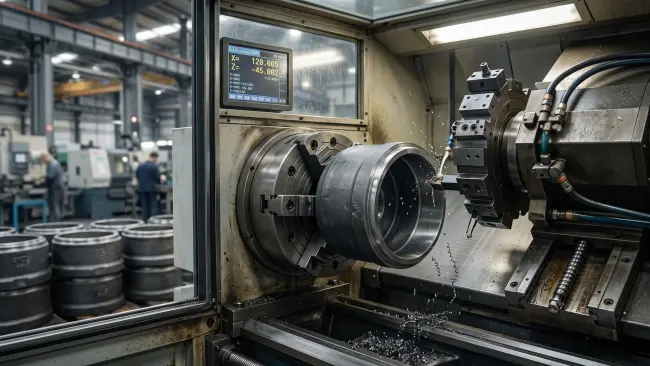
- Precision CNC Machining: High-rigidity vertical turning lathes (VTL) machine the inner friction surface, pilot bore, and hub mounting face in a single clamping setup to maintain concentricity.
- Bore Surface Roughness: Ra 1.6 μm – 3.2 μm (cross-hatch or fine micro-groove finish prevents shoe glazing).
- Radial Runout: ≤ 0.05 mm (ensures uniform brake contact).
- Pilot Bore Tolerance: H7 or ISO standard commercial axle tolerance.
- Dynamic Balancing: Every drum is balanced on automated dynamic balancing rigs.
- Tolerance: ISO 1940 Grade G6.3.
- Residual Unbalance: Strictly controlled (e.g., ≤ 80–100 g·cm) by milled weight relief pockets or spot-welded balance weights, preventing high-speed driveline vibration.
- Non-Destructive Testing (NDT): Ultrasonic testing (UT) and magnetic particle inspection (MPI) detect internal shrinkage cavities and surface cracks on critical batches.
5. Commercial Vehicle Compatibility & Cross-Reference Matrix
Brake drum casting suppliers must demonstrate engineering compatibility with major international axle manufacturers and truck platforms:
| OEM / Axle Platform | Typical Brake Sizes | Common Sizing / Mounting | Target Markets |
|---|---|---|---|
| BPW Eco / Eco Plus | 420 x 180 mm / 420 x 200 mm | 10-Hole ISO 335 mm PCD, Pilot 280 mm | Europe, Middle East, Australia |
| SAF Holland | 420 x 180 mm / 420 x 200 mm | 10-Hole ISO 335 mm PCD | Europe, Global |
| Meritor (Rockwell) / Dana Spicer | 16.5″ x 7″ / 16.5″ x 8.62″ | 10-Hole Hub-Piloted 285.75 mm PCD | North America, Australia |
| Scania / Volvo / MAN / DAF | 410 x 180 mm / 420 x 180 mm | 10-Hole 335 mm PCD | Europe, CIS, South America |
| Sinotruk HOWO / Shacman / FAW | 420 x 180 mm / 420 x 200 mm | Steyr / MAN axle 10-hole patterns | Africa, Central Asia, SE Asia |
6. Sourcing & Quality Audit Checklist for Buyers
When selecting a Chinese casting partner for heavy-duty brake drums, evaluate key operational criteria:
| Evaluation Item | Mandatory Verification Evidence | Procurement Risk Mitigated |
|---|---|---|
| Material Integrity | EN 10204 3.1 Mill Test Report (MTR) with spectrometer chemistry & tensile results | Prevents brittle fracture and thermal fade |
| Microstructure | Metallographic report showing Type A graphite (>90% pearlite matrix) | Prevents premature craze cracking & high lining wear |
| Dimensional Accuracy | CMM inspection report covering bore runout, PCD, and pilot diameter | Guarantees seamless hub fit and zero wheel wobble |
| Dynamic Balance | 100% balancing inspection log with residual unbalance certification | Eliminates high-speed chassis vibration and uneven tire wear |
| Foundry Capability | In-house casting + CNC turning + dynamic balancing under ISO/IATF 16949 | Eliminates cross-supplier disputes and delivery delays |
7. Frequently Asked Questions (FAQ)
Q1: What is the primary difference between SAE G3000 and G3500 for brake drums?
SAE G3000 offers higher thermal conductivity due to slightly higher carbon equivalent, making it ideal for standard commercial highway applications. SAE G3500 features higher tensile strength (minimum 241 MPa) and greater wear resistance, suited for severe-duty cycles such as transit buses, refuse trucks, and logging trailers.
Q2: Why is dynamic balancing critical for commercial vehicle brake drums?
A typical heavy-duty brake drum weighs between 45 kg and 65 kg. An unbalance of even 150 g·cm creates substantial centrifugal forces at 90 km/h, leading to premature wheel bearing wear, steering vibration, uneven lining degradation, and compromised braking safety.
Q3: Can thermal cracked brake drums be resurfaced by turning?
Light surface micro-checking (heat checking under 0.5 mm depth) can occasionally be turned if the final diameter remains comfortably within the manufacturer’s discard specification. However, drums with deep thermal cracks, cracks propagating to the outer edge, or blue heat spots must be scrapped immediately, as structural integrity has been compromised.
Q4: Does Ruixi Casting offer OEM custom brake drum development?
Yes. With in-house mold tooling, automated casting lines, and multi-axis CNC vertical turning lathes, customized brake drums can be manufactured directly from 2D drawings (DWG/PDF) or 3D CAD models (STEP/IGES) conforming to SAE J431, EN 1561, or ISO 185 standards.
Technical Sourcing with Ruixi Casting
Ruixi Casting is an integrated iron casting and precision machining manufacturer specializing in heavy-duty commercial vehicle chassis and braking components.
- Production Scope: Grey cast iron (HT250, G3000, G3500, EN-GJL-250) and ductile iron castings.
- Quality Assurance: 100% optical spectrometry per heat lot, CMM dimensional verification, and dynamic balancing certification.
- Fast Customization: Prototype samples ready in 25–35 days from approved CAD drawings.
Looking to develop replacement brake drums or optimize fleet procurement?
Contact Ruixi Casting Technical Sales Team | Request Material Test Report (MTR) & Sourcing Checklist