+86 184 3796 0706
 info@destinytrans.com


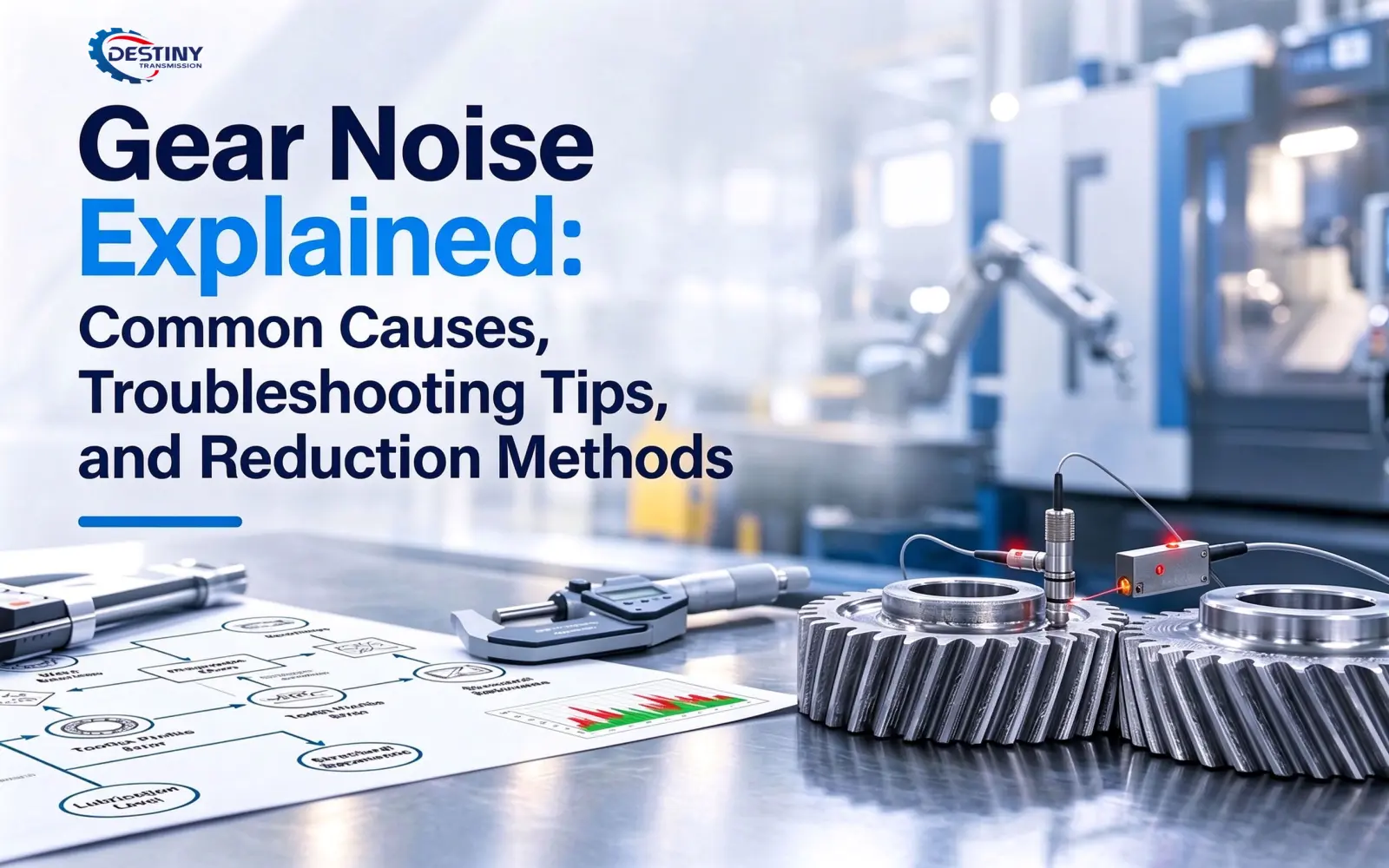
Gear noise during operation is normal to some extent. However, if a gear develops abnormal whine, periodic knocking, or rubbing sounds, or if the noise suddenly increases and is accompanied by noticeable vibration, it usually indicates a change in the operating condition of the gear or transmission system and requires further investigation.
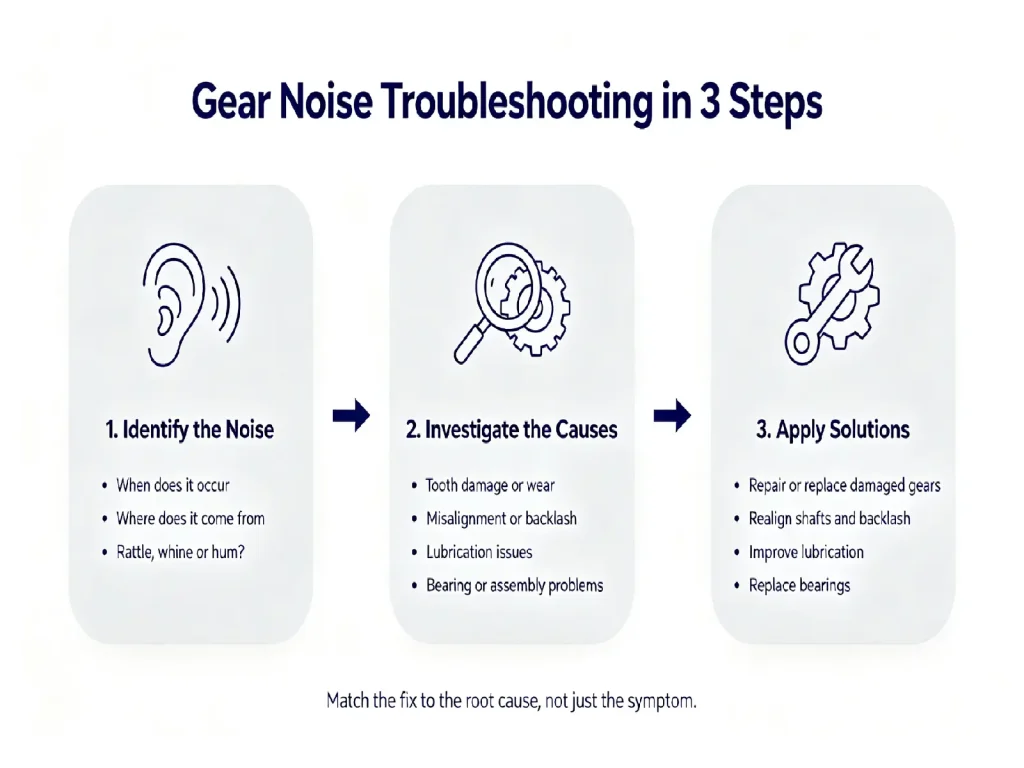
It is important to note that gear noise is not necessarily caused by the gear itself. Gear noise is often a system-level issue involving the gear pair, shafts, bearings, lubrication, housing, and operating conditions. Factors such as gear accuracy, meshing condition, installation alignment, lubrication, bearing and shaft condition, as well as load and rotational speed can all affect operating noise. This article examines the common causes of gear noise in the order of cause → inspection → corrective action and provides practical noise reduction methods, followed by answers to frequently asked questions.
1. How Is Gear Noise Generated?
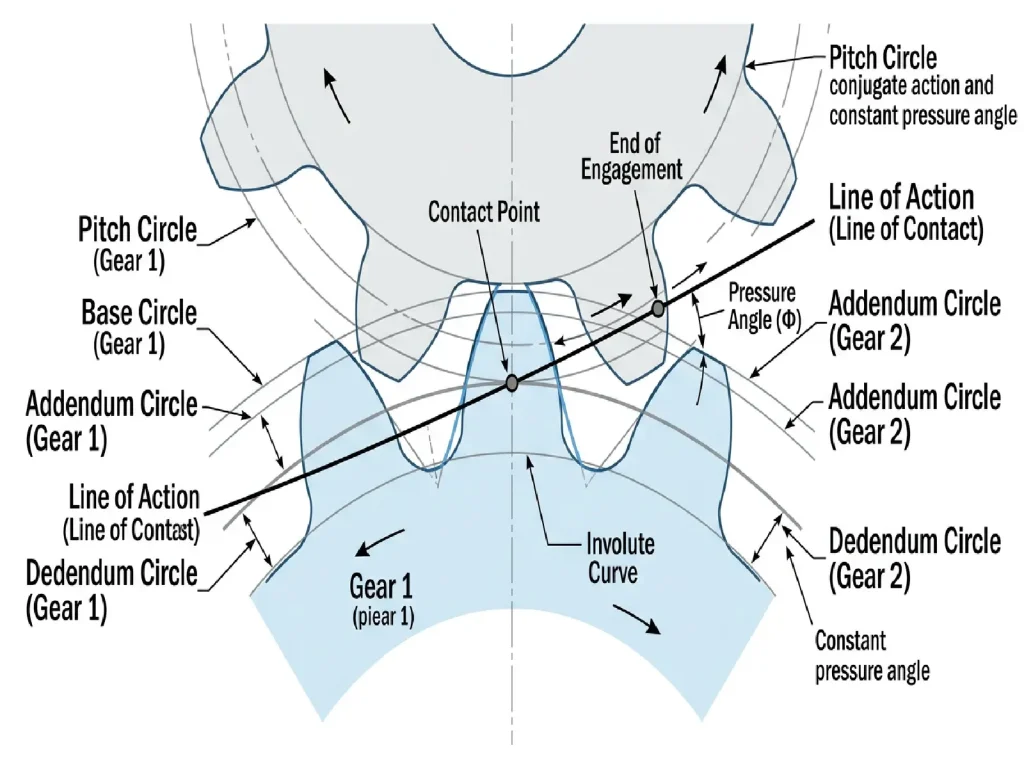
Gear noise is mainly caused by gear meshing forces, transmission error, periodic changes in mesh stiffness, tooth surface friction, and vibration transmitted through the shaft and housing.
The meshing process itself naturally produces some vibration and noise.During gear operation, the tooth surfaces continuously engage, disengage, and transmit load. Meshing impact, tooth surface friction, and load variations can cause vibration in the gears and shaft system, which is then transmitted through the housing and bearing seats as audible sound. Therefore, a certain level of noise during gear operation does not necessarily indicate a fault.
Periodic variation in mesh stiffness is one of the important excitation sources of gear vibration and noise.As different pairs of teeth enter and leave mesh, the number of load-carrying teeth and the contact conditions continuously change, causing the mesh stiffness to fluctuate periodically. This variation, together with factors such as transmission error, can generate vibration. The fundamental frequency associated with gear meshing is the gear mesh frequency, f = z × n / 60, where zis the number of teeth and n is the rotational speed in r/min. Abnormal gear whine can often appear as characteristic components around the gear mesh frequency and its harmonics in the vibration spectrum. Comparing these frequency components with rotational speed and operating conditions can help determine whether the dominant excitation is related to gear meshing or another part of the transmission system.
Design and manufacturing quality can significantly affect the baseline noise level.Gear type, manufacturing accuracy, tooth surface quality, rotational speed, and design parameters such as contact ratio and helix angleall influence the baseline noise level. In practice, gear noise should be evaluated as the combined result of gear design, manufacturing accuracy, meshing conditions, lubrication, supporting components, and operating conditions rather than by a single parameter.
2. Common Causes of Abnormal Gear Noise
The most common causes of abnormal gear noise include gear accuracy errors, poor shaft alignment, inadequate lubrication, tooth surface damage, excessive load or speed, bearing or shaft problems, and structural resonance.
Insufficient Gear Manufacturing Accuracy
Tooth profile error, tooth lead error, tooth pitch error, eccentricity, and runout can introduce additional transmission errors and vibration, resulting in unstable gear meshing during operation. Poor tooth surface quality may also increase friction and localized impact, making operating noise more noticeable. For applications requiring consistent meshing performance, explore our custom precision gears for different transmission requirements.
When abnormal noise appears at or around the gear mesh frequency, gear accuracy, tooth-to-tooth consistency, and runout should be among the first items to inspect.
Poor Installation or Shaft Alignment
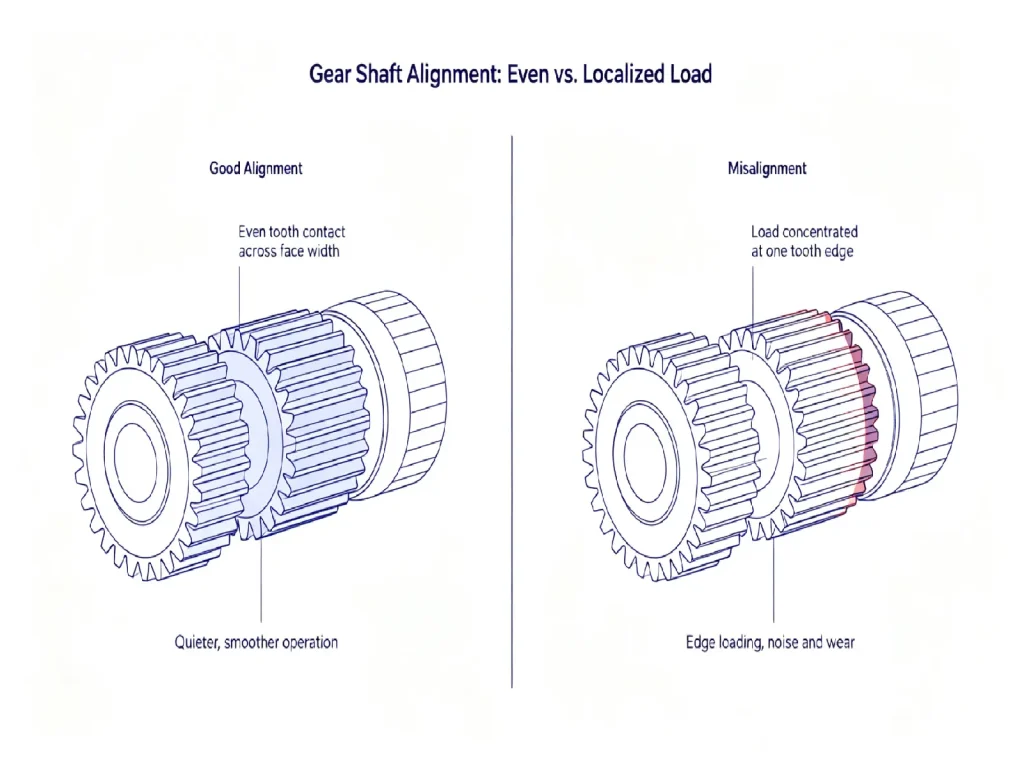
Center distance errors, shaft misalignment, non-parallel shafts, or incorrect installation angles can change the actual tooth contact pattern, resulting in uneven load distribution, localized loading, and abnormal wear. Therefore, when investigating gear noise, it is important to check not only the gears themselves but also installation accuracy and shaft alignment.
A change in tooth contact pattern can concentrate the load on a smaller part of the tooth surface, increasing local contact stress, vibration, and noise.
Insufficient or Improper Lubrication
Insufficient lubricant, inappropriate viscosity, oil contamination, or a lubrication method that does not match the operating conditions can increase tooth surface friction and temperature, further accelerating wear and noise.
Gear Wear or Tooth Surface Damage
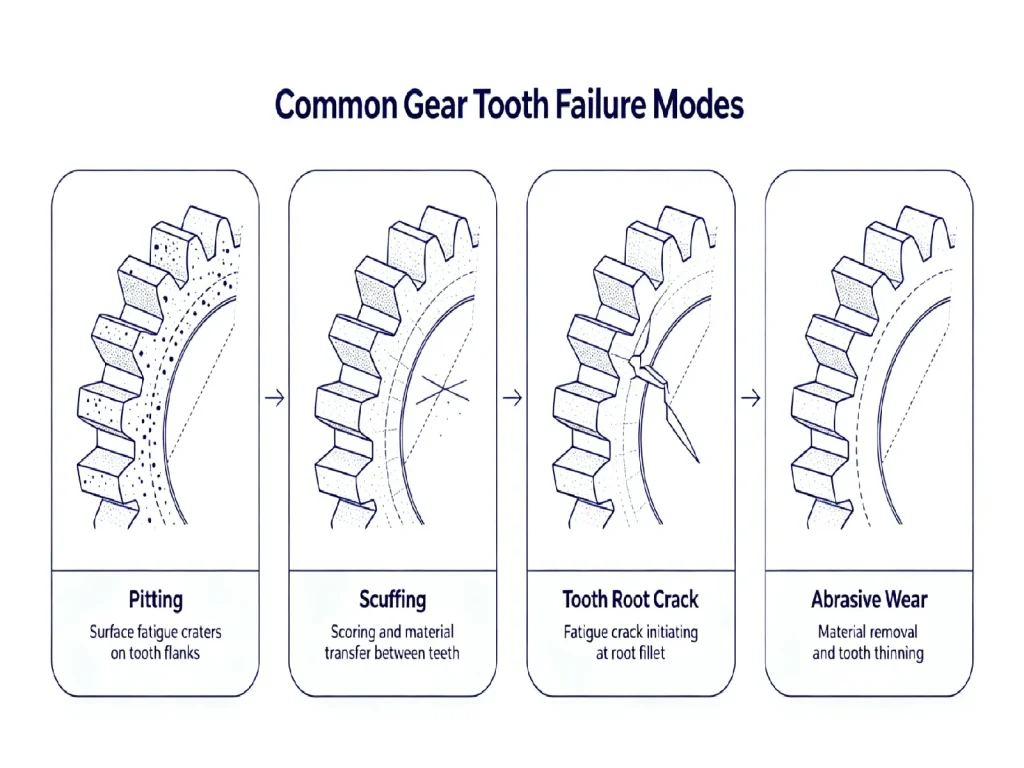
Prolonged operation may result in wear, pitting, scuffing, scoring, scratches, tooth root cracks, or even tooth breakage, altering the original tooth contact condition and making meshing less stable. If noise gradually increases during operation and is accompanied by vibration, temperature rise, or metal debris in the lubricant, particular attention should be paid to tooth surface wear and damage, while also checking the lubrication system and bearing condition.
Excessive Load or Rotational Speed
Overloading increases tooth forces and meshing impact, while high rotational speeds place greater demands on accuracy, installation, lubrication, and dynamic performance. However, noise does not simply increase with rotational speed. It also depends on design and manufacturing quality, so the same gear may exhibit significantly different noise characteristics at different speeds and under different operating conditions.
Bearing or Shaft Problems
Bearing wear, abnormal clearance, or improper installation, as well as shaft bending and axial or radial movement, can alter the actual gear meshing position. If no obvious damage is found on the gear itself, the associated bearings and shaft system should also be inspected.
Structural Resonance
Gear vibration can propagate through the shaft system, bearings, and housing. When the gear mesh frequency or its harmonics approach the natural frequency of a relevant component, resonance may occur, significantly amplifying vibration and noise. This is also a common reason why noise suddenly increases at certain rotational speeds. During troubleshooting, the vibration characteristics of the entire machine should therefore be considered rather than focusing only on the gear.
If gear noise rises sharply only within a specific speed range, structural resonance should be considered before concluding that the gear itself is defective.
3. Gear Noise Troubleshooting Checklist
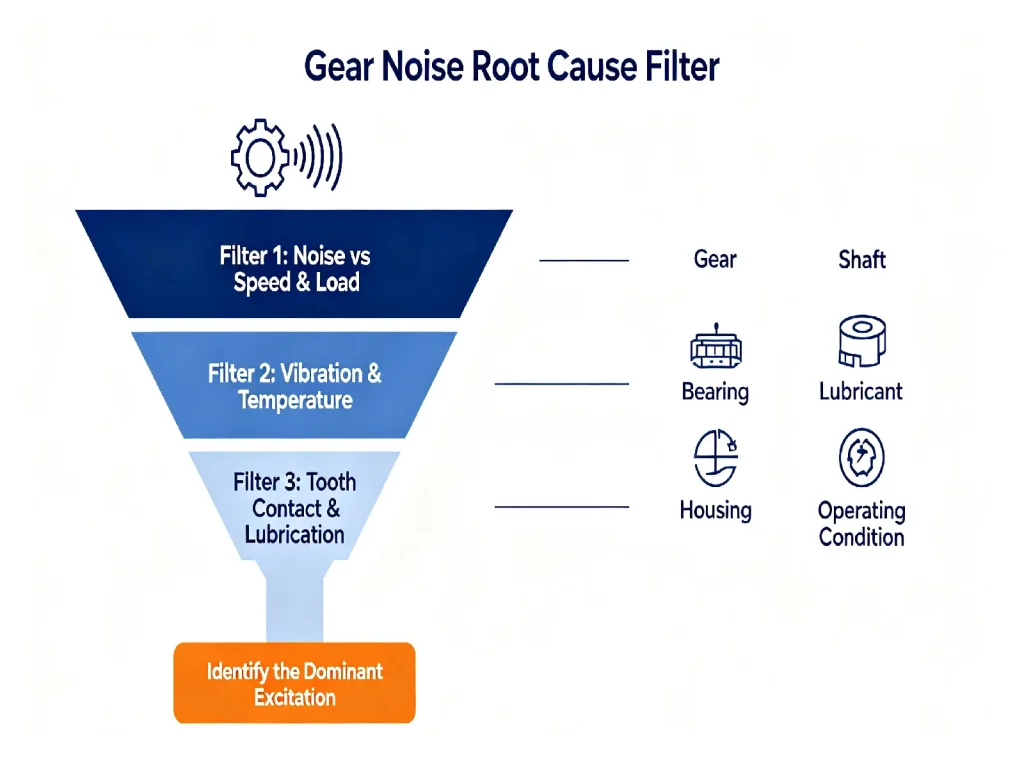
Noise characteristics can be used to narrow down the possible causes, but they should not be treated as a diagnosis by themselves. The most useful approach is to compare the noise pattern with changes in rotational speed, load, vibration, temperature, and lubrication condition, then inspect the relevant components.
|
Noise Symptom |
Possible Causes |
Priority Checks |
|
Continuous high-frequency whine |
Gear accuracy, tooth contact condition, transmission error, or high-speed operating conditions |
Tooth contact condition, gear accuracy, and gear mesh frequency |
|
Periodic knocking noise |
Localized tooth surface damage, tooth pitch error, or eccentricity |
Tooth surface condition, tooth pitch error, and radial runout |
|
Obvious rubbing / grinding noise |
Insufficient lubrication or tooth surface wear |
Oil level and condition, lubricant viscosity, and signs of tooth surface scuffing |
|
Noise increases as the load increases |
Poor shaft alignment, abnormal meshing condition, or excessive load |
Center distance, shaft alignment, and tooth contact area |
|
Noise gradually becomes louder after a period of operation |
Progressive tooth wear, pitting, lubricant deterioration, or bearing abnormalities |
Tooth surfaces, metal debris in the lubricant, and bearing vibration |
|
Noise accompanied by significant vibration |
Shaft misalignment, bearing or shaft abnormalities, or structural resonance |
Vibration spectrum, bearing condition, shaft alignment, and critical speed |
|
Noise suddenly increases at a specific speed |
Structural resonance or excitation near a critical speed |
Comparison of rotational speed, gear mesh frequency, and natural frequency |
Note: The same noise symptom may have different causes, so the source of a problem cannot be diagnosed from sound alone. A comprehensive assessment should include tooth surface condition, vibration, temperature, lubrication, and bearing and shaft system inspections.
4. Noise Reduction Methods: Address the root cause
Effective gear noise reduction starts with identifying the actual excitation source. Simply increasing gear accuracy or replacing the gear may not solve the problem if the dominant cause is alignment, lubrication, bearings, operating conditions, or structural resonance.
|
Cause Category |
Corresponding Action |
Key Control Points |
|
Insufficient manufacturing accuracy |
Improve manufacturing accuracy as appropriate and control tooth profile, tooth lead, and tooth pitch errors |
Final accuracy inspection and tooth surface quality control |
|
Poor installation / alignment |
Correct the center distance and shaft alignment |
Proper tooth contact pattern and shaft parallelism |
|
Improper lubrication |
Select the appropriate lubricant viscosity and lubrication method based on operating conditions, and replace the lubricant regularly |
Oil level, lubricant condition, oil temperature, and contamination prevention |
|
Wear / tooth surface damage |
Stop the equipment for inspection and repair or replace components when necessary |
Metal debris, pitting / scuffing area, and cracks |
|
Load / speed exceeding limits |
Keep operating conditions within the design range |
Rated torque and rotational speed; avoid prolonged overloading |
|
Bearing / shaft system abnormalities |
Check bearing clearance, replace worn components, and straighten bent shafts |
Bearing vibration and temperature rise, and axial movement |
|
Structural resonance |
Adjust the operating speed to avoid resonance zones and optimize structural stiffness when necessary |
Vibration spectrum and critical speed |
5. Does Gear Noise Mean the Gear Is Damaged?
Not necessarily. Gears naturally produce some meshing noise during normal operation, and the noise level can vary depending on factors such as gear type, rotational speed, load, accuracy, and structural design. The presence of noise alone does not mean that the gear is damaged. What really needs attention is whether there has been an abnormal change in the noise:
- The noise suddenly increases while the load and rotational speed remain unchanged;
- The noise gradually becomes louder as operating time increases;
- Noticeable knocking, abnormal whine, or grinding noises appear;
- The noise is accompanied by significant vibration or an abnormal rise in gear or bearing temperature;
- Metal debris is found in the lubricant, or abnormal wear or damage is observed on the tooth surfaces.
These signs may indicate an abnormal condition in the transmission system. Further inspection should focus on the tooth surfaces, lubrication, bearings, shaft system, and installation condition, rather than immediately concluding that the gear needs to be scrapped.
6. Controlling Gear Noise from the Manufacturing Side
Gear noise cannot usually be controlled through a single manufacturing parameter or process. It depends on the consistency of machining, heat treatment, tooth finishing, inspection, and final assembly. It is a comprehensive effort involving material selection, machining, heat treatment, tooth surface finishing, accuracy inspection, and overall quality control. From the manufacturing side, two areas are particularly important:
- Accuracy and tooth surface quality:Control tooth profile, tooth lead, and tooth pitch errors to reduce transmission error. Good tooth surface quality also helps reduce friction and localized impact.
- Consistency and traceability:Stable manufacturing processes and strict final inspection help maintain consistency across batches of gears and reduce variations in noise caused by individual differences.
For applications with strict requirements for noise, vibration, or transmission stability, focusing only on the material or a single accuracy parameter is not enough. Control should cover the entire “machining → inspection → assembly” process. For custom gears, controlling accuracy, tooth surface quality, and meshing consistency according to the actual operating conditions is often more important than simply pursuing a single parameter.
FAQ
1. Why Does a Gear Make a Whining Noise?
Gear whine is commonly related to gear accuracy, transmission error, tooth contact, rotational speed, or installation and alignment. In the vibration spectrum, relevant abnormalities can often be identified by characteristic components around the gear mesh frequency and its harmonics.
2. Can Insufficient Lubrication Increase Gear Noise?
Insufficient lubrication or an inappropriate lubricant viscosity can increase tooth surface friction and temperature, accelerate wear, and consequently increase operating noise.
3. Does Increased Gear Noise Always Mean the Gear Is Damaged?
Not necessarily. Installation deviations, lubrication problems, bearing abnormalities, load changes, or structural resonancecan also cause increased noise. A comprehensive assessment should consider vibration, temperature, tooth surface condition, and lubricant condition.
4. Can Improving Gear Accuracy Reduce Noise?
It can help. Improving tooth profile, tooth lead, and tooth pitch accuracy can reduce transmission error and improve meshing smoothness, but gear accuracy is only one factor affecting noise.
5. How Can Gear Operating Noise Be Reduced?
Start with manufacturing accuracy, installation alignment, lubrication, load and speed control, and regular inspection, and address the problem according to the specific cause. For applications with stringent noise requirements, gear design can also be optimized through measures such as tooth profile and lead modifications and increased contact ratio.
6. How Should Gear Noise Be Troubleshot?
Consider changes in noise, vibration, temperature, and load, and use the troubleshooting table to inspect the tooth surfaces, lubrication, installation alignment, bearings, and shafts. The cause should not be determined based on sound alone.
7. Why Does Gear Noise Increase at a Certain Speed?
Gear noise that increases sharply at a specific rotational speed may be related to structural resonance or excitation near a critical speed. The gear mesh frequency or its harmonics may interact with the natural frequency of the shaft, bearing, housing, or another structural component, amplifying vibration and noise.
Looking for a Custom Gear Manufacturer?
Reliable gear performance starts with appropriate design, consistent manufacturing quality, and accurate inspection. Destiny Transmission provides gear manufacturing solutions for different industrial transmission applications.
If you are sourcing gears for a new project or need to address specific requirements for accuracy, noise, or transmission performance, send us your gear drawings or technical specifications for further discussion.