+86 184 3796 0706
 info@destinytrans.com


Introduction: Why Do Gears Require Grinding After Tooth Cutting?
Gear hobbing and gear shaping are primarily used to generate the basic tooth geometry of a gear. For many gears with standard accuracy requirements, these tooth-cutting processes may already be sufficient to meet the drawing and application requirements. However, gears used in high-precision, high-speed, heavy-duty, or low-noise applications may require tighter control over tooth profile, tooth lead, tooth pitch, and tooth surface quality.
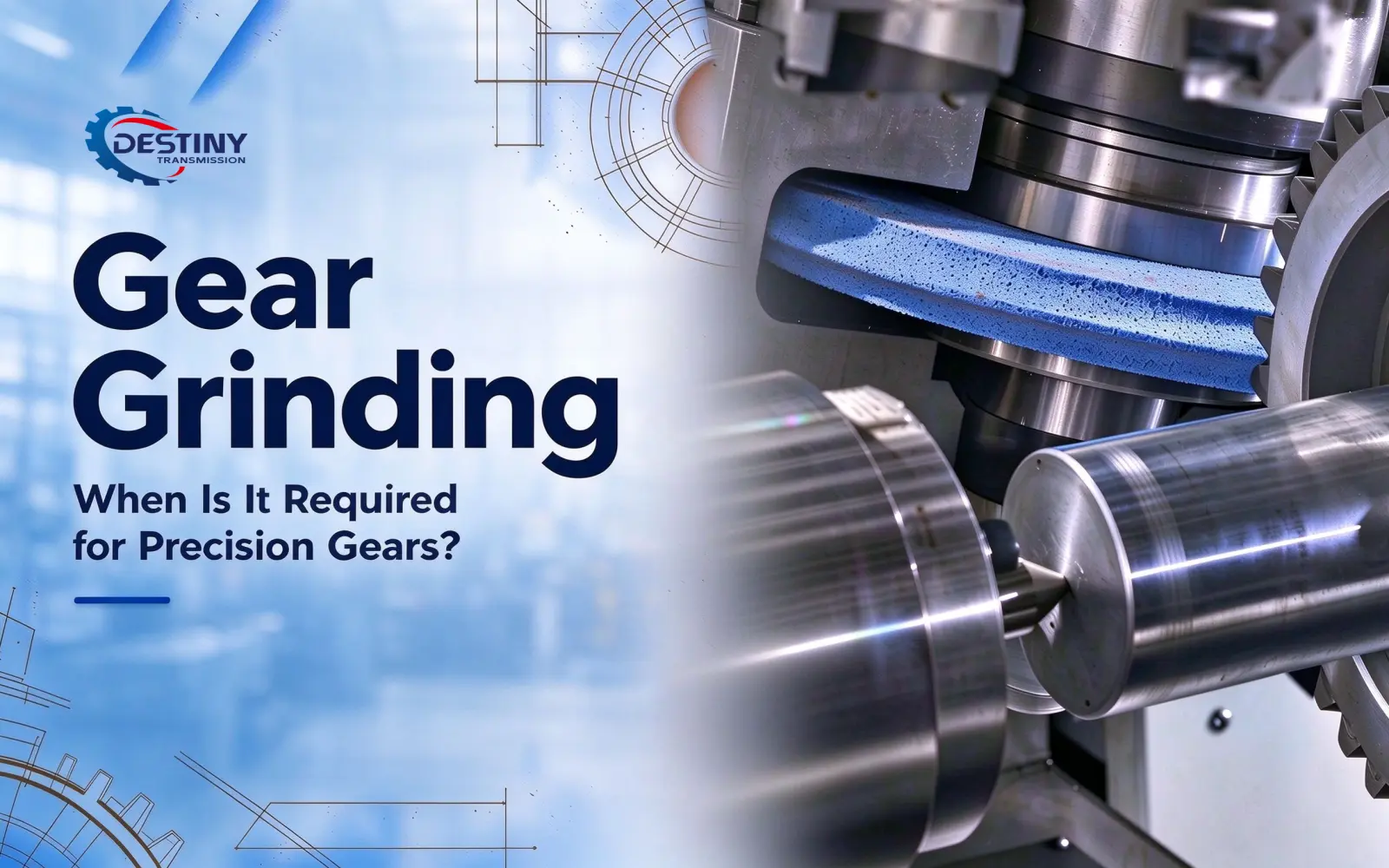
Gear grinding is a precision finishing process used when the preceding manufacturing processes cannot consistently achieve the required final specifications. It is typically performed after heat treatment and removes a controlled amount of material from the tooth surfaces to improve gear accuracy and surface quality.
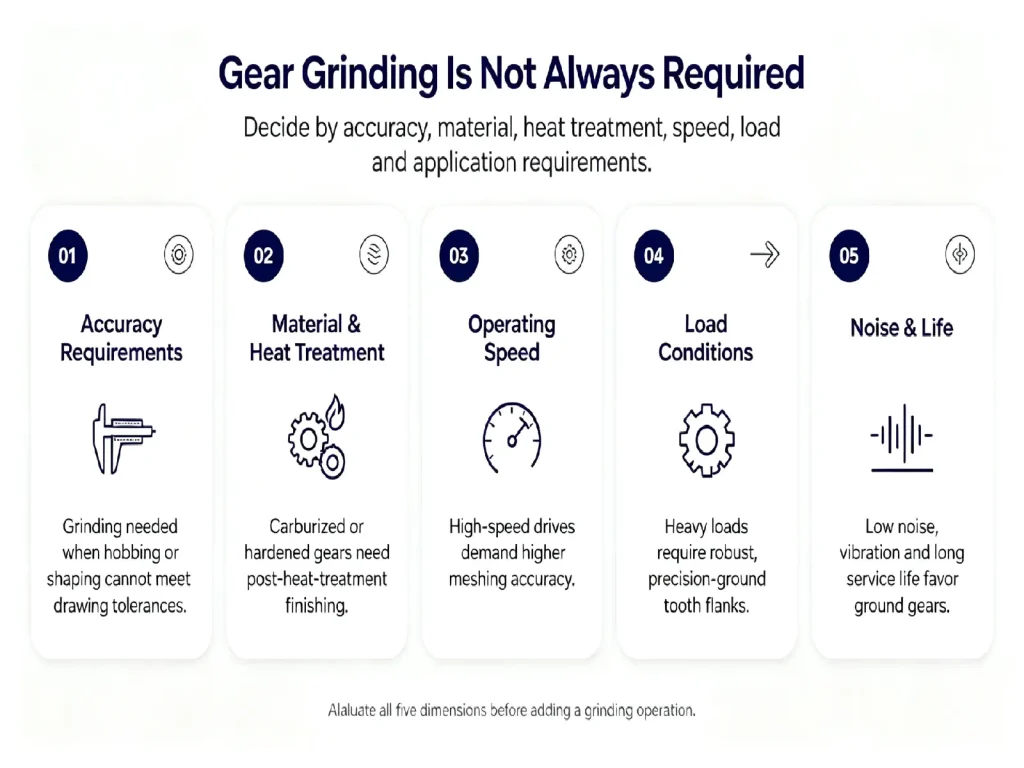
However, not every gear requires grinding. The decision should be based on the gear’s accuracy requirements, material, heat treatment condition, operating speed, load, noise requirements, and actual application conditions.
1. The Role of Gear Grinding in the Manufacturing Process
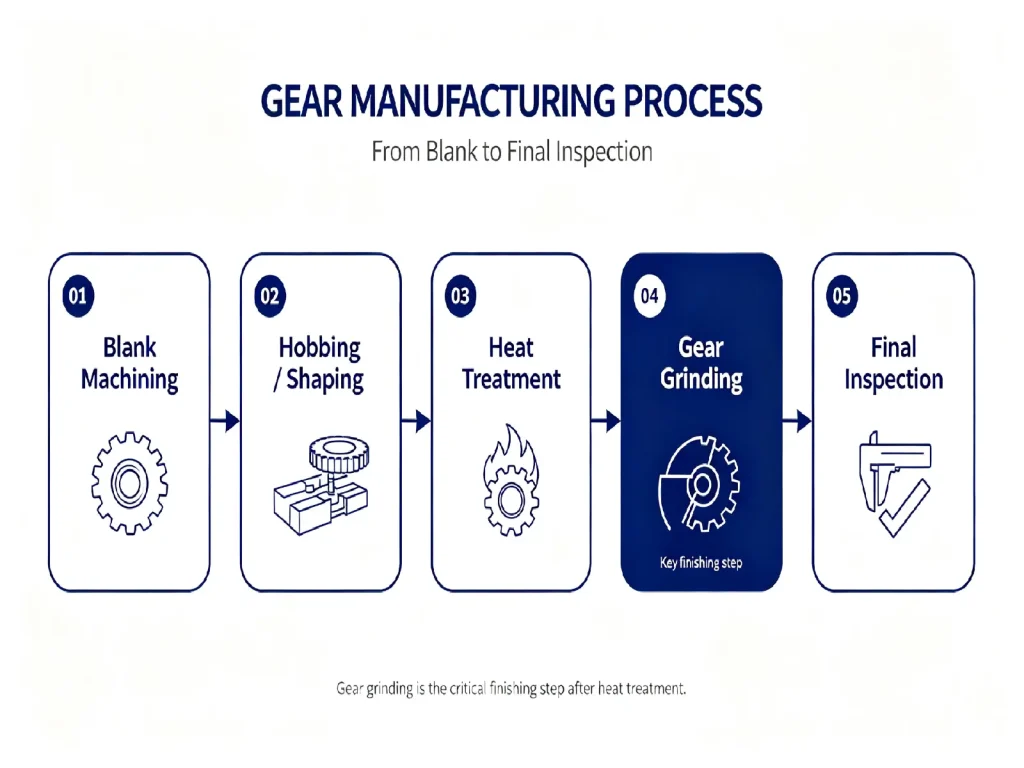
Gear grinding is a finishing operation typically performed after heat treatment. A typical manufacturing process is:
Gear Blank Machining → Gear Hobbing / Gear Shaping → Heat Treatment → Gear Grinding → Final Inspection
For case-carburized and hardened gears, gear grinding is commonly used to correct minor dimensional and geometric deviations that remain after heat treatment, provided they are within the available grinding allowance. With an appropriate grinding allowance, the gear can be finished to the accuracy requirements specified on the drawing.
It is important to note that gear grinding is not intended to compensate for severe heat treatment distortion. If a gear develops significant warping or deformation beyond the available grinding allowance, the issue should be addressed through the heat treatment process, such as by optimizing workholding, quenching parameters, and distortion control measures.
2. What Improvements Can Gear Grinding Provide?
2.1 Improve Gear Accuracy
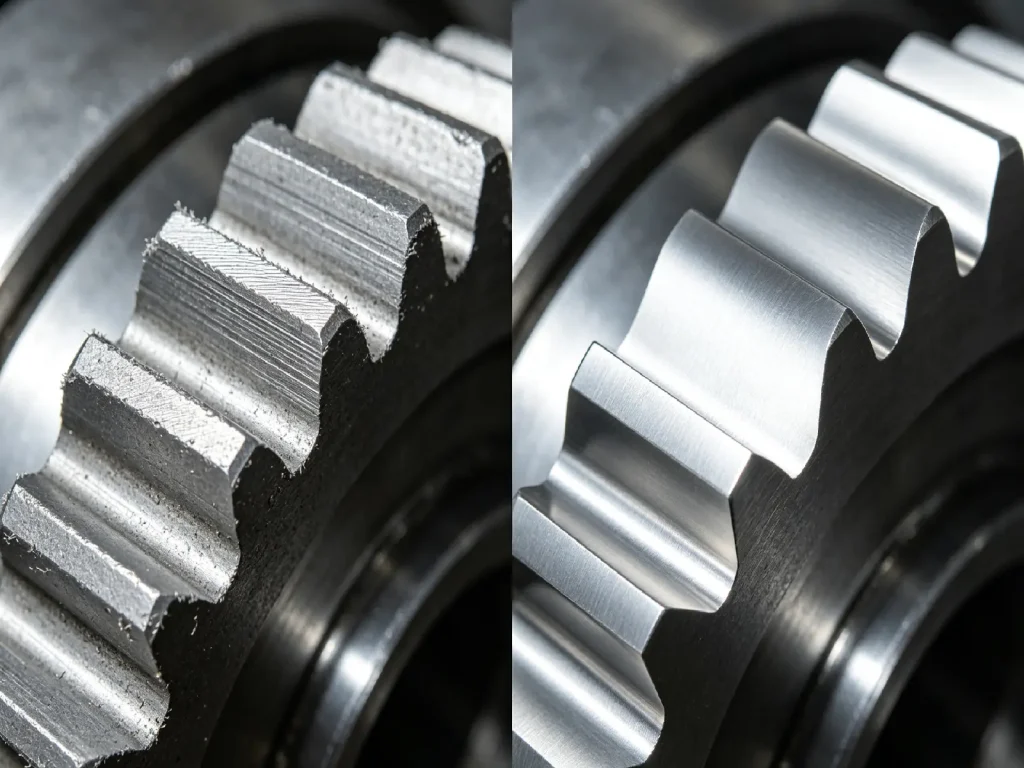
Conventional tooth cutting processes such as gear hobbing and gear shaping can meet the accuracy requirements of many standard gears. Gear grinding, however, generally provides greater control over final accuracy and can provide tighter control of characteristics such as tooth profile, tooth lead, and tooth pitch, making it suitable for gears with tighter drawing tolerances.
2.2 Improve Tooth Surface Quality
Tooth surfaces after cutting typically retain machining marks and relatively high surface roughness. Gear grinding can further reduce tooth surface roughness, producing a smoother surface that can help improve tooth contact and meshing smoothness.
2.3 Enable Precise Gear Modification
High-speed, heavy-duty gears often require tooth profile modifications, such as tip relief, to reduce the risk of edge contact, as well as lead modifications, such as crowning, to improve load distribution. CNC gear grinding machines can provide precise and repeatable control of tooth profile and lead modifications through carefully controlled grinding parameters, making them particularly suitable for gears requiring high accuracy, complex modifications, and consistent production quality. Compared with conventional hobbing and shaping, gear grinding generally provides greater flexibility and control for finishing gears that require precise profile and lead modifications.
For custom gear projects, explore our custom gear manufacturing solutions to learn more about our capabilities in producing gears to specific drawing and application requirements.
2.4 Improve Consistency After Heat Treatment
Heat treatment can introduce minor dimensional and geometric changes that affect the final accuracy of a gear. When these deviations remain within the available grinding allowance, gear grinding can provide a controlled finishing step to bring the tooth surfaces closer to the specified profile, lead, pitch, and dimensional requirements.
The key point is that gear grinding provides a finishing capability; it does not replace proper heat-treatment distortion control. The amount of material available for grinding should therefore be considered during the earlier manufacturing stages.
3. When Is Gear Grinding Required?
Gear grinding should be considered as a preferred finishing process when any of the following conditions apply:
3.1 Tight Accuracy Requirements
When the drawing specifies tight tolerances for tooth profile, tooth lead, tooth pitch, runout, or other accuracy characteristics, and conventional tooth cutting cannot consistently meet these requirements, gear grinding becomes an important finishing option for achieving the required accuracy.
The key consideration is not simply whether the gear has a high accuracy grade, but whether the selected manufacturing process can consistently meet the specified tolerances. Typical applications include precision machine tool spindle gears, instrument gears, and other gears requiring tight geometric tolerances.
3.2 Hardened Gears
Gears subjected to heat treatment such as carburizing and hardening have relatively high tooth surface hardness and require finishing processes that are suitable for the hardened surface condition. For high-precision hardened gears, gear grinding is a common and well-established finishing method for controlling tooth profile, tooth lead, tooth pitch, and tooth surface quality.
However, a hardened gear does not automatically require grinding. The final finishing method should still be selected according to the specified accuracy, surface requirements, operating conditions, and production economics.
3.3 Heat Treatment Distortion Requires Correction
For high-precision gears subjected to carburizing and hardening, heat treatment may cause dimensional and geometric changes that affect the final gear accuracy. When the resulting deviations are within the available grinding allowance, gear grinding can be used after heat treatment to correct the affected tooth geometry and bring the finished gear closer to the drawing requirements.
However, grinding should not be treated as a solution for severe heat treatment distortion. If the deformation exceeds the available grinding allowance or affects the gear beyond what can be safely removed during finishing, the heat-treatment process and earlier manufacturing stages should be reviewed to control the source of the distortion.
3.4 High-Speed, Heavy-Duty, or Low-Noise Applications
Gears operating at high speeds or under heavy loads are generally more sensitive to manufacturing errors, which can contribute to vibration, noise, and uneven tooth contact. In applications such as automotive transmissions, wind turbine gearboxes, compressors, and robot reducers, high-precision gears may therefore require gear grinding or other finishing processes to achieve the required operating smoothness and reliability.
However, the application category alone does not determine whether grinding is required. The decision should be based on the actual gear accuracy, speed, load, noise requirements, tooth modifications, and performance targets.
3.5 Tooth Profile or Lead Modification Is Required
Gears used in high-speed, heavy-duty, or demanding meshing applications may require modifications such as tip relief and lead crowning. CNC gear grinding can provide high precision and consistency when producing these modifications, making it suitable for gears requiring precise tooth profile and lead modifications.
4. When Is Gear Grinding Not Necessarily Required?
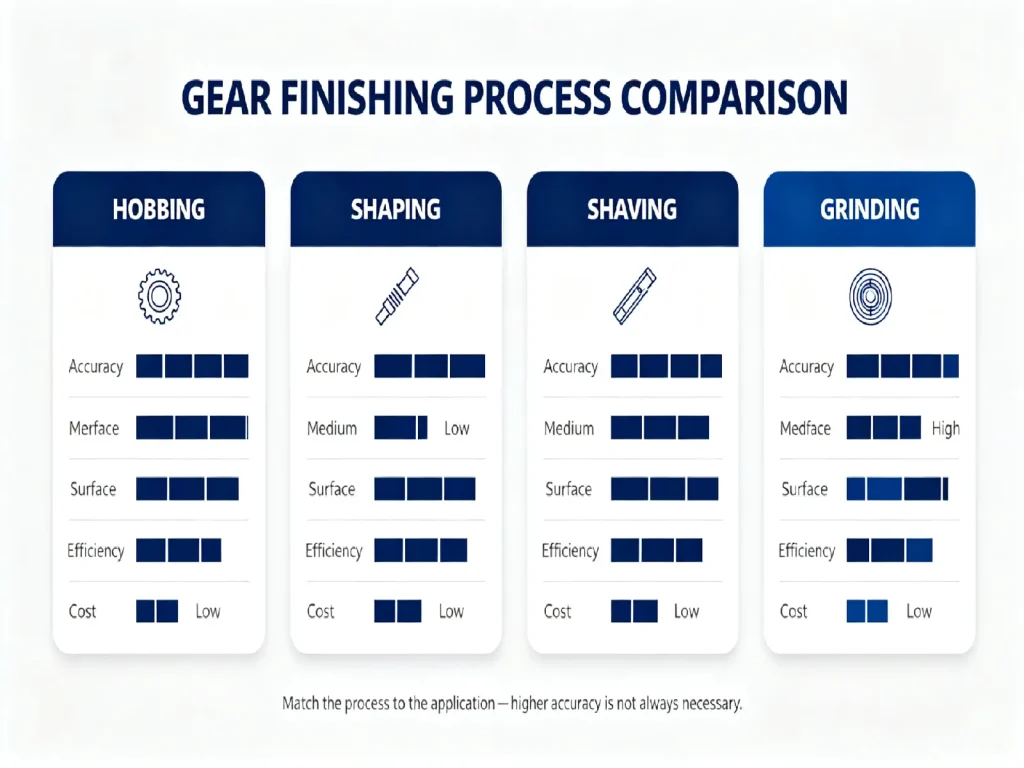
Higher accuracy is not always better if the additional accuracy does not improve the actual performance of the gear. The manufacturing process should be matched to the actual requirements of the application:
- Low-Speed Applications with Moderate Accuracy Requirements:If gear hobbing or gear shaping can consistently meet the drawing specifications and operating requirements, gear grinding may not be necessary.
- Soft Gears:When hardened tooth surfaces and very high accuracy are not required, gear shaving may be used to finish suitable soft gears before heat treatment. It can improve tooth surface quality and profile accuracy while maintaining high production efficiency. In suitable batch production applications, gear shaving can also provide a more economical finishing option than gear grinding.
- Cost- and Lead-Time-Sensitive Applications:Gear grinding adds machine time, labor, and inspection costs. If the additional accuracy does not provide meaningful value for the final application, adding a grinding operation may not be justified.
For example, consider a soft external gear used in a conventional low-speed reduction mechanism. If the drawing specifies moderate accuracy requirements, with no special requirements for operating noise or vibration, and gear hobbing can consistently meet the specified tolerances, adding gear grinding is generally unnecessary.
In contrast, if a gear is subjected to carburizing and hardening and used in a high-speed transmission system with stringent requirements for noise, vibration, and meshing accuracy, the post-heat-treatment finishing process should be carefully evaluated. In such cases, gear grinding may be an important process for achieving the final requirements.
This illustrates that whether gear grinding is required does not depend on whether a gear is considered “high-end,” but on its final technical requirements and actual application conditions.
5. How to Choose Between Gear Hobbing, Gear Shaping, Gear Shaving, and Gear Grinding?
|
Manufacturing Process |
Processing Stage |
Relative Accuracy Potential |
Tooth Surface Condition |
Relative Efficiency |
Typical Cost |
|
Gear Hobbing |
Tooth cutting |
Medium–High* |
Mainly soft |
High |
Low–Medium |
|
Gear Shaping |
Tooth cutting |
Medium–High* |
Mainly soft |
Medium |
Medium |
|
Gear Shaving |
Finishing before heat treatment |
High* |
Soft |
High |
Medium |
|
Gear Grinding |
Finishing after heat treatment |
Very High* |
Mainly hardened |
Medium |
High |
Note: Accuracy grades and classification systems vary among standards such as ISO, DIN, JIS, and AGMA, so their grades should not be treated as directly interchangeable. The table provides only a relative comparison of the typical roles and capabilities of these processes. Specific requirements should always be determined from the applicable standard and the tolerances specified on the gear drawing.
6. Key Quality Considerations for Gear Grinding
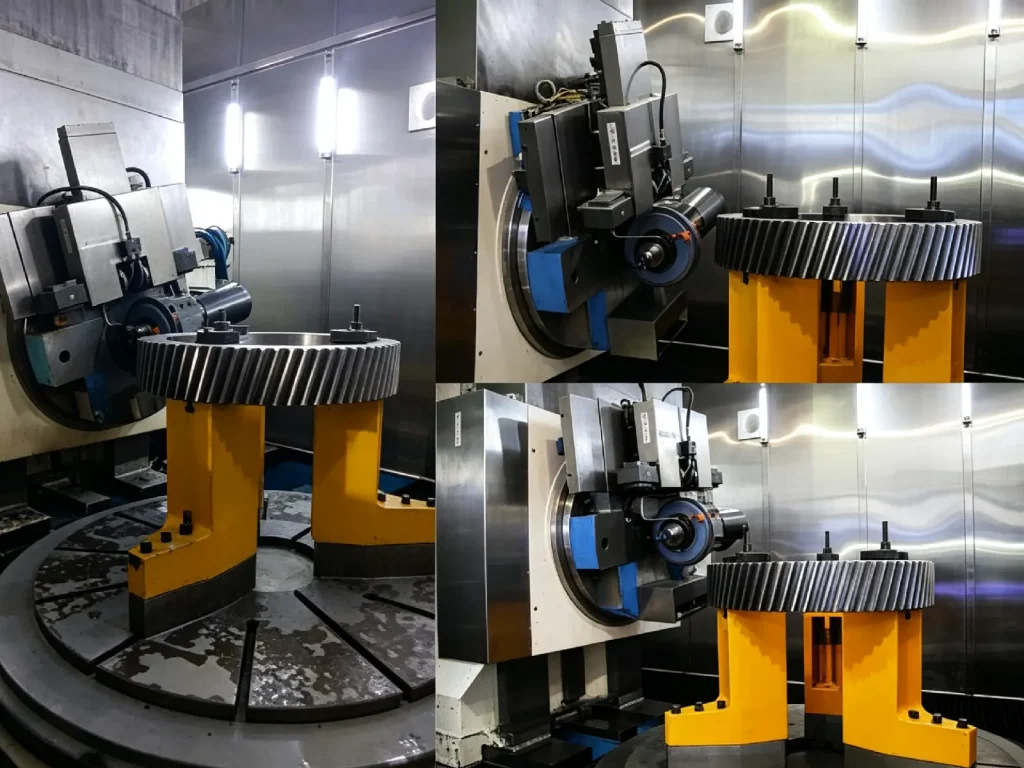
During gear grinding, the grinding wheel contacts the tooth surface at high speed and generates significant heat. If cooling is insufficient, grinding parameters are inappropriate, or the grinding wheel is in poor condition, grinding burn or other surface damage may occur, potentially affecting tooth surface hardness, microstructure, and fatigue life.
Therefore, gear grinding should be controlled through adequate coolant flow, appropriate grinding parameters, and suitable inspection methods. For custom gear projects, customers can require the supplier to provide relevant grinding burn inspection results or quality inspection records according to the specified quality requirements.
7. How Can You Determine Whether Your Gears Require Gear Grinding?
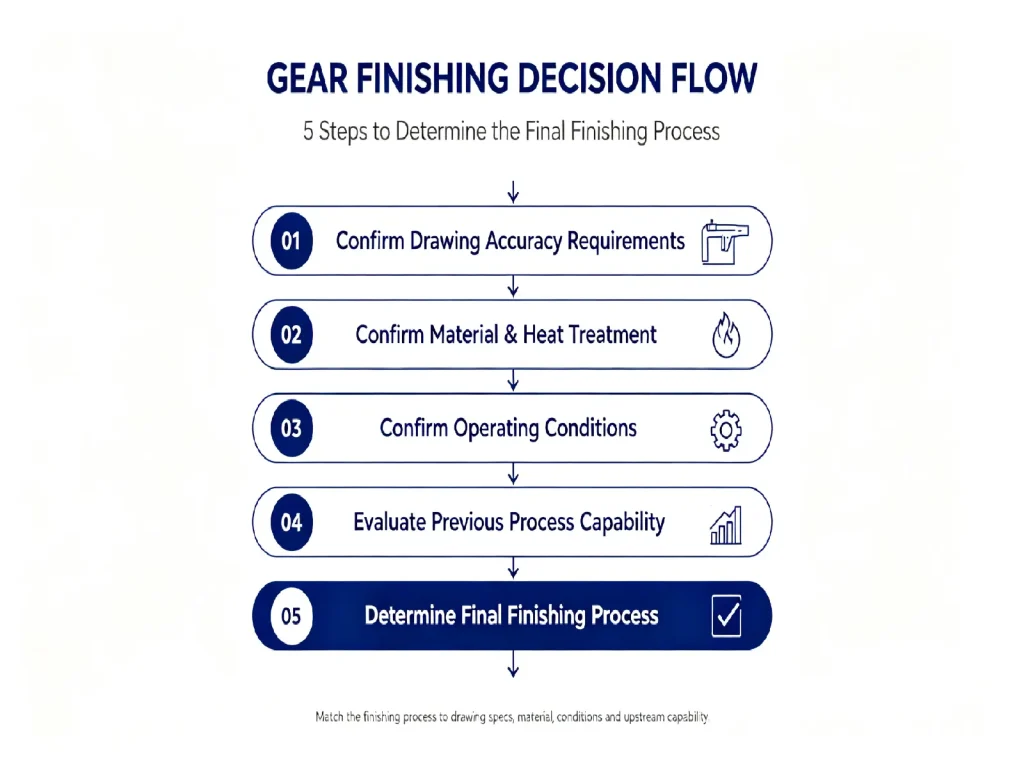
For custom gears, the need for gear grinding should be evaluated by considering the gear’s final requirements and the capability of the preceding manufacturing processes. The goal is not to add grinding automatically, but to determine whether it is necessary to achieve the required final performance.
A practical evaluation can follow these steps:
Step 1: Confirm the accuracy requirements on the drawing.
Check the specified accuracy grade, tolerances, tooth profile, tooth lead, tooth pitch, runout, and other geometric requirements.
Step 2: Confirm the material and heat treatment.
Determine whether the gear has a soft or hardened tooth surface and whether post-heat-treatment finishing is required.
Step 3: Confirm the operating conditions.
Pay particular attention to operating speed, load, noise, vibration, and required service life.
Step 4: Evaluate the capability of the preceding processes.
Evaluate whether the selected tooth-cutting or pre-finishing process can consistently achieve the required tolerances under normal production conditions.
Step 5: Determine the final finishing process.
If the preceding processes can meet the specified requirements, additional grinding may not be necessary. If they cannot, evaluate gear grinding or another suitable finishing process based on the required accuracy, tooth surface quality, and application conditions.
When requesting a quotation, customers should provide the manufacturer with gear drawings, material and heat treatment requirements, accuracy and tolerance requirements, operating speed, load, and application conditions. This information allows the manufacturer to evaluate the complete manufacturing process and determine whether gear grinding is actually required.
FAQ: Common Questions About Gear Grinding
Q1: Do All Gears Require Gear Grinding?
No. Whether gear grinding is required depends on drawing accuracy requirements, material, heat treatment condition, operating speed, load, noise requirements, and manufacturing cost. If gear hobbing, gear shaping, or gear shaving can consistently meet the final requirements, there is no need to add a gear grinding operation.
Q2: Is Gear Grinding Performed Before or After Heat Treatment?
For high-precision hardened gears that require grinding, gear grinding is typically performed after heat treatment to further control tooth profile, tooth lead, tooth pitch, and dimensional accuracy. Soft gears are commonly processed using hobbing, shaping, or shaving, while the need for gear grinding should still be determined by the final accuracy requirements.
Q3: Is Gear Grinding More Accurate Than Gear Hobbing?
Generally, gear grinding provides greater potential for controlling final gear accuracy than conventional gear hobbing, especially for hardened gears. However, grinding is a finishing process, while hobbing is primarily a tooth-cutting process, so they should not be compared simply as competing processes.
Q4: Can Gear Grinding Extend Gear Service Life?
Gear grinding does not directly determine gear service life. However, by improving tooth profile, tooth lead, tooth surface finish, and meshing condition, it can help reduce the risk of localized abnormal contact and excessive vibration, potentially improving operating reliability. Ultimately, service life depends on multiple factors, including material, heat treatment, lubrication, load, and gear design.
Q5: How Much Heat Treatment Distortion Can Gear Grinding Correct?
Gear grinding is mainly used to correct minor heat treatment distortion within a controllable range, rather than severe warping. The available grinding allowance and allowable correction amount depend on factors such as gear dimensions, module, material, heat treatment condition, and drawing requirements. For deformation that exceeds the available grinding allowance, the underlying issue should be addressed through heat treatment and the overall manufacturing process.
Q6: What Is the Difference Between Gear Grinding and Gear Shaving?
Gear shaving is generally performed on relatively soft gears before heat treatment, while gear grinding is typically used as a finishing process after heat treatment, particularly for hardened, high-precision gears. The choice depends on the required accuracy, material condition, production volume, and final application requirements.
Conclusion
Gear grinding is not required for every gear. Standard gears may meet drawing specifications and operating requirements through hobbing, shaping, or shaving alone. However, high-precision, hardened, high-speed, heavy-duty, and low-noise gears may require grinding to achieve the necessary accuracy, tooth surface quality, and meshing performance.
The key question is whether gear grinding is necessary, not whether it is better. Higher accuracy offers limited benefits when existing processes already meet the required specifications. If hobbing, shaping, or shaving achieves the required tolerances consistently, additional grinding may increase costs and processing time without significant performance gains.
The final manufacturing process depends on the gear structure, material, heat treatment, accuracy requirements, and operating conditions. For custom gear projects, customers should provide complete drawings, material specifications, heat treatment requirements, tolerances, operating speed, load, and application details. This information helps manufacturers determine whether grinding is necessary and select suitable machining and finishing processes.
If you are unsure whether your gears require grinding, send your gear drawings and operating requirements for a suitable machining and finishing recommendation.