+86 184 3796 0706
 info@destinytrans.com


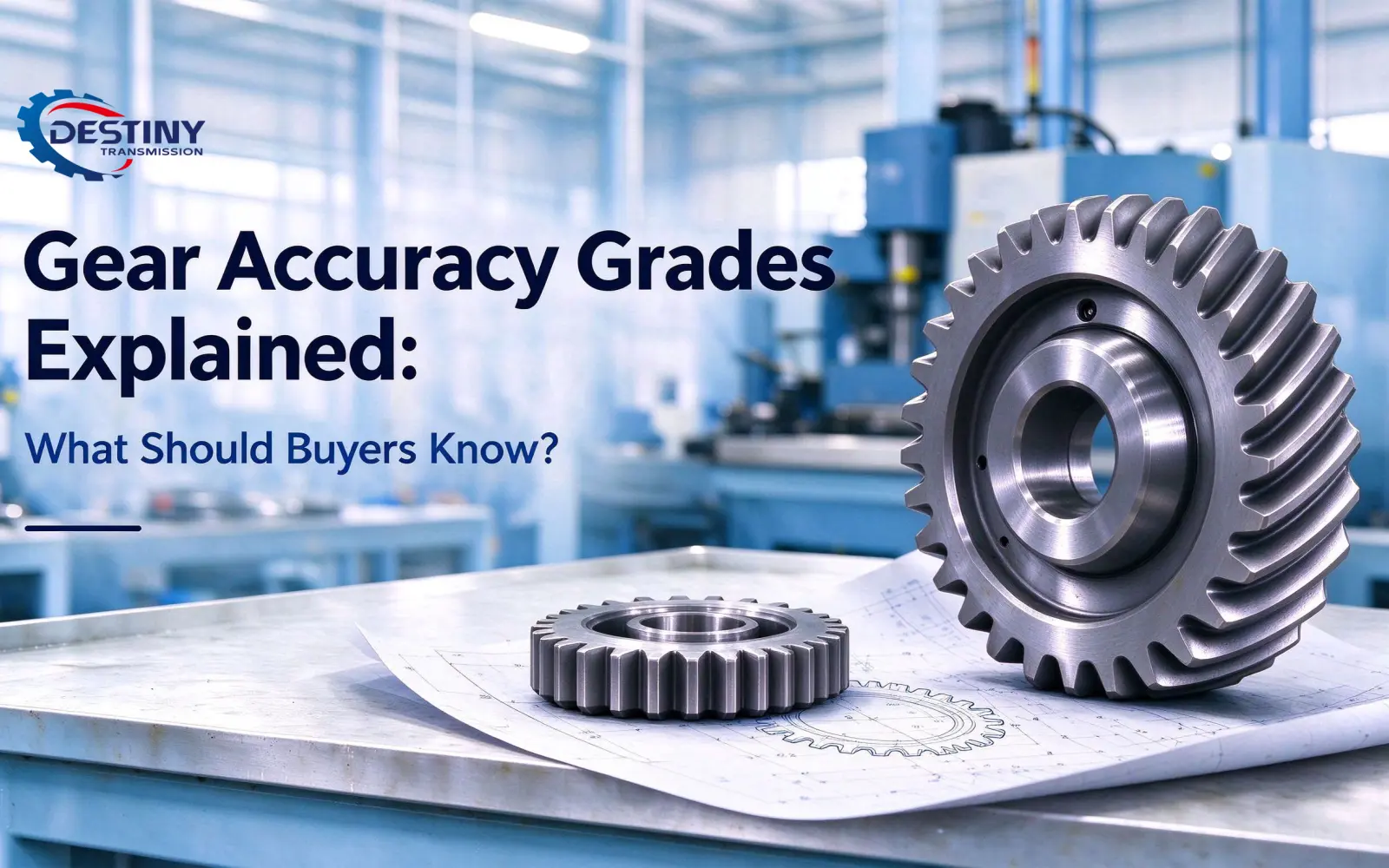
Introduction: Why Are Gear Accuracy Grades Important for Buyers?
Gear accuracy directly affects gear meshing, operating smoothness, noise, transmission error, and positioning accuracy. For equipment involving high-speed transmission, precision positioning, or continuous operation, even when the gear dimensions meet drawing requirements, significant errors in tooth profile, tooth pitch, or tooth lead can still affect actual equipment performance.
Therefore, buyers often face an important question when purchasing gears: Is a higher gear accuracy grade always better?
The answer is not simply “the higher, the better.” A higher accuracy grade generally requires more stringent machining and inspection requirements, which may also result in higher manufacturing costs. When selecting the appropriate accuracy grade, buyers should also consider operating speed, load, positioning requirements, working environment, assembly conditions, and cost considerations.
1. What Is a Gear Accuracy Grade?
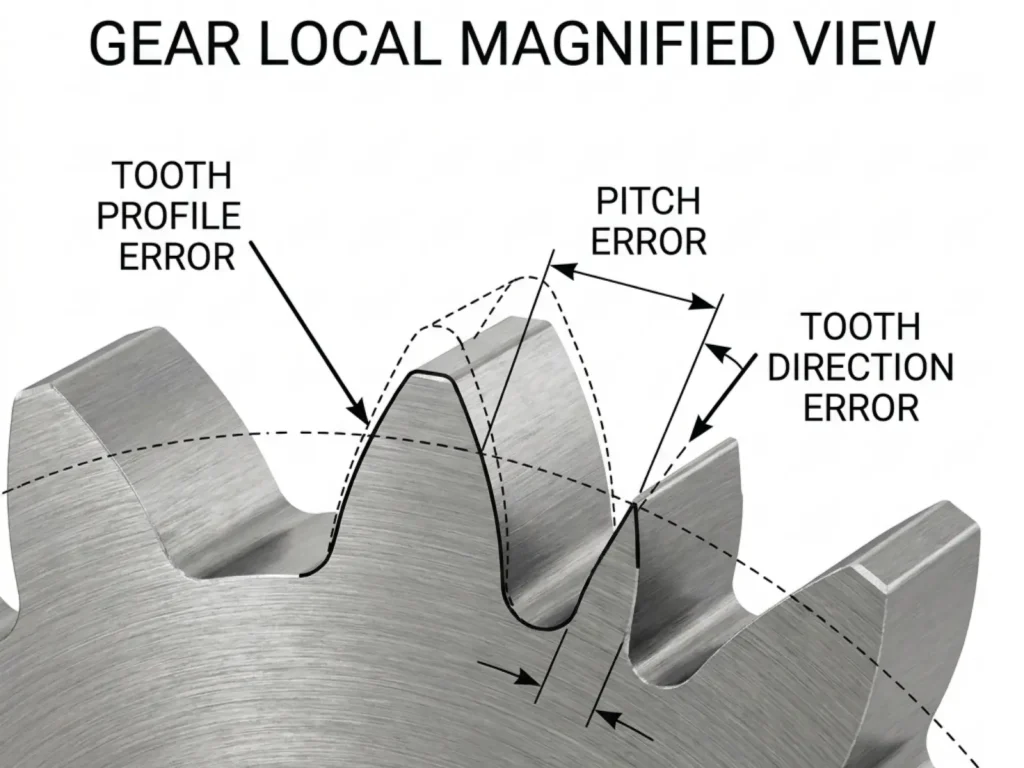
A gear accuracy grade is a standardized indicator used to evaluate the level of geometric deviations associated with gear manufacturing. It does not simply indicate how accurately the overall dimensions of a gear have been machined. Instead, it provides a comprehensive assessment of deviations in the tooth profile, tooth pitch, tooth lead, and other relevant geometric characteristics after manufacturing.
Among these parameters, tooth profile error refers primarily to the deviation between the actual tooth profile and the theoretical tooth profile. Tooth pitch error is related to the accuracy of the spacing between adjacent teeth. Tooth lead error indicates the positional deviation of the tooth surface along the face width. Radial runout refers to variations in the radial position of individual teeth relative to the rotational center as the gear rotates.
These errors can affect gear meshing to varying degrees. Gears with better accuracy control can generally maintain more stable meshing, helping reduce transmission error, vibration, and noise. For buyers, a gear accuracy grade is better understood as a comprehensive classification of gear manufacturing deviations and tolerances, rather than as a single dimensional tolerance value.
2. What Standards Are Commonly Used to Define Gear Accuracy Grades?
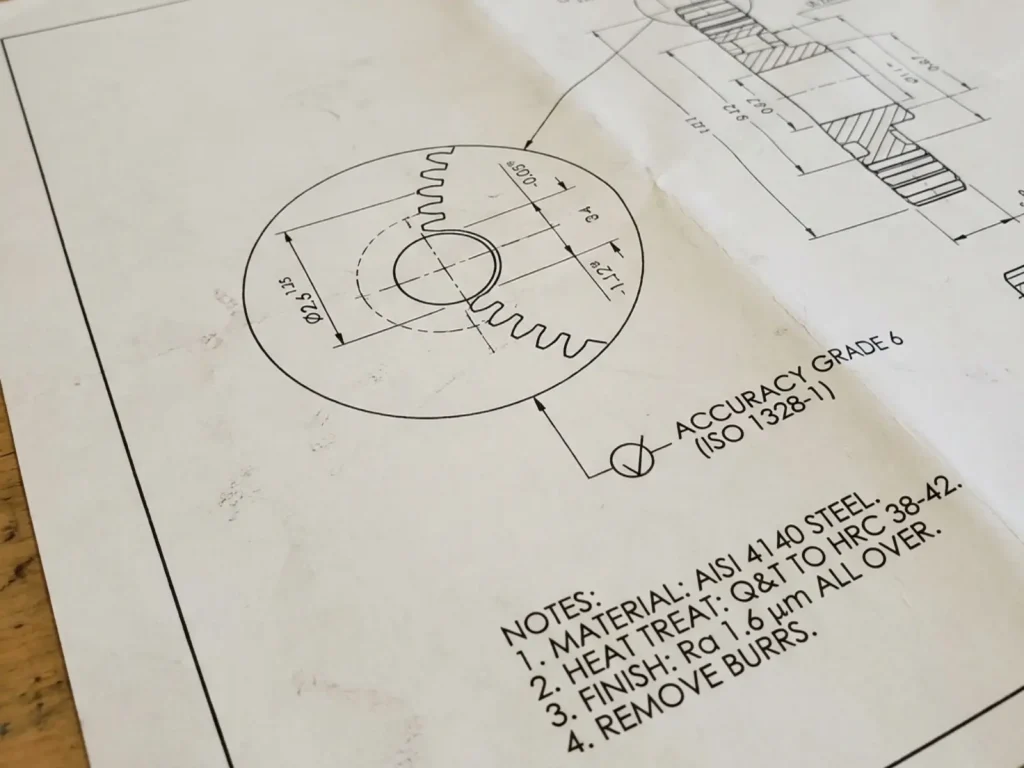
Gear accuracy grades are typically determined according to relevant gear accuracy standards. In practical procurement, DIN and ISO are among the most commonly referenced standard systems. Different standards do not define gear deviation items, accuracy grades, and evaluation methods in exactly the same way. Therefore, gear accuracy cannot be assessed simply by comparing the grade number alone. ISO 1328-1:2013 remains the current edition and is primarily used to classify tolerances for flank deviations of cylindrical involute gears, providing a common reference for gear manufacturers and buyers.
DIN Gear Accuracy Standards
In industrial gear procurement and manufacturing, gear accuracy grades specified according to DIN standards are commonly encountered. In technical drawings or purchasing specifications, customers may directly specify a particular DIN accuracy grade, and the manufacturer is then required to carry out machining and inspection according to the applicable standard and inspection requirements.
It is important to note that the grade numbers in the DIN system cannot simply be considered directly equivalent to those in other standards. During procurement, buyers should confirm not only the accuracy grade but also the specific standard version and inspection requirements to avoid different interpretations of the same grade.
ISO Gear Accuracy Standards
ISO 1328-1:2013 remains the current edition. It defines a flank tolerance classification system for cylindrical involute gears, and the grade number should be interpreted together with the applicable standard requirements and specific gear parameters.
For applicable cylindrical involute gears, our factory can manufacture gears to ISO accuracy Grade 4, with corresponding machining and inspection processes controlled according to the specified accuracy requirements. For more information, see our [precision gear products].
Therefore, in international procurement, “Grade 6” is not a complete technical requirement by itself. A more reliable approach is to confirm the applicable standard, such as ISO or another customer-specified standard, and then determine the final requirements based on the gear dimensions, module, face width, number of teeth, and specific inspection items..
For buyers, the most important consideration is not simply comparing “DIN Grade X” with “ISO Grade X,” but confirming the specific standard used by the manufacturer, the required accuracy grade, and the inspection method. Accuracy grade numbers and evaluation systems from different standards cannot be directly converted on a simple one-to-one basis. This is an important point to clarify in advance when requesting quotations for custom gears.
3. What Is the Difference Between High-Precision and Standard-Precision Gears?
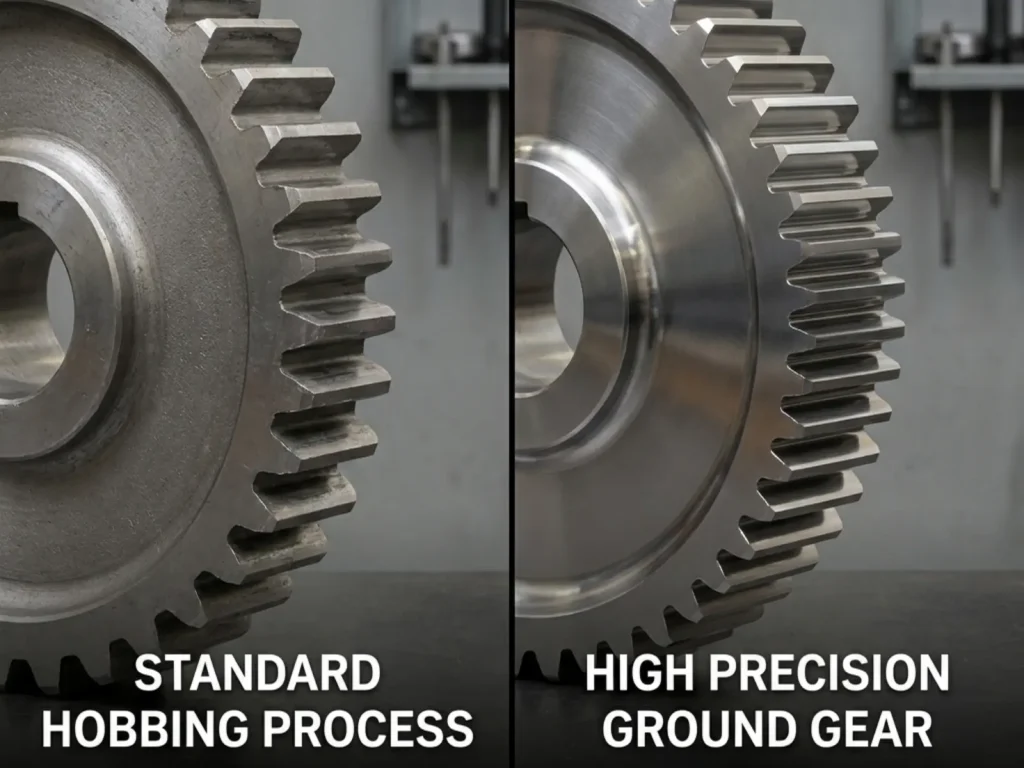
The main differences between high-precision gears and standard-precision gears lie in their machining requirements, operating performance, application areas, and manufacturing costs, rather than simply in their accuracy grade numbers.
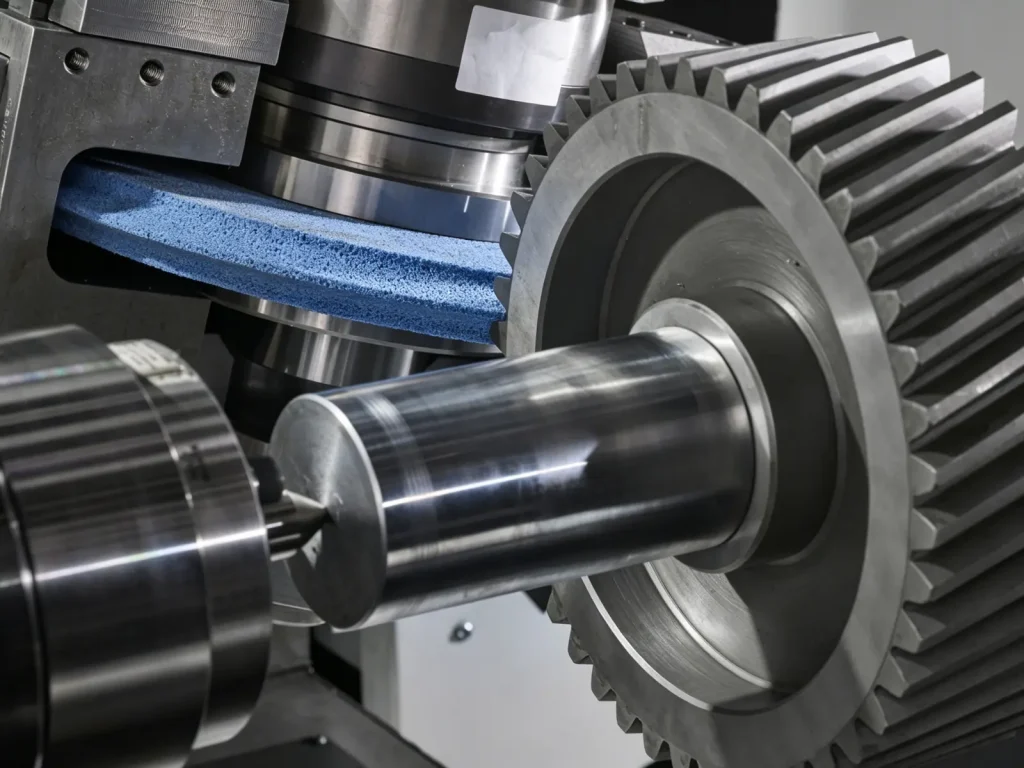
During manufacturing, high-precision gears require stricter control of tooth profile, tooth pitch, tooth lead, and relevant dimensional tolerances. For gears with higher accuracy requirements that have undergone heat treatment, additional finishing processes such as gear grinding may also be required to correct heat treatment errors and achieve the final accuracy requirements.
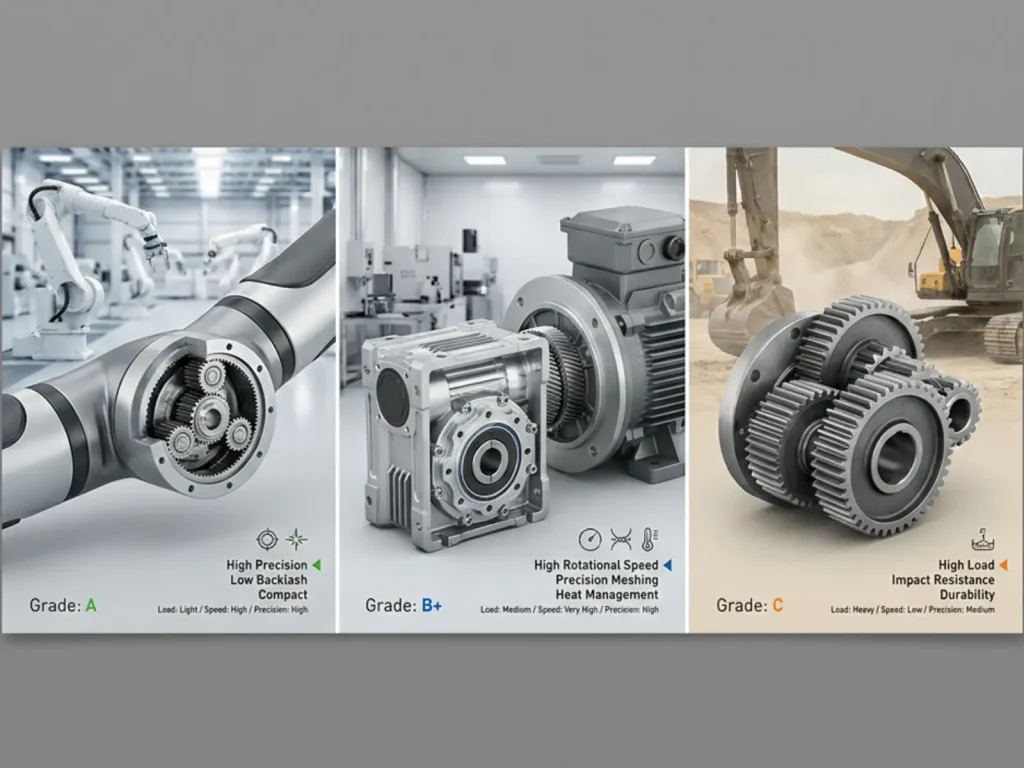
In actual operation, high-precision gears are more suitable for high-speed transmission systems, precision positioning mechanisms, robots, CNC equipment, and other applications with stringent requirements for transmission stability. For mechanical equipment operating at lower speeds with relatively standard load and positioning requirements, a very high accuracy grade may not be necessary.
Higher accuracy requirements generally involve stricter machining and inspection requirements as well. During procurement, the appropriate accuracy grade should be selected according to the actual application requirements rather than simply pursuing a higher grade.
4. Is a Higher Gear Accuracy Grade Always Better?
A higher gear accuracy grade generally means stricter machining and inspection requirements. However, not every application requires the highest possible accuracy.
For low-speed, low-load, and general-purpose transmission equipment, the operating conditions may not require very low transmission error or high positioning accuracy. In such cases, an excessively high accuracy grade may increase machining and inspection costs. It may not provide significant performance benefits. For example, a standard conveyor drive may not require the same gear accuracy level as a servo-driven positioning axis. This can be true even when the two systems use gears of similar size.
For high-speed equipment, errors in tooth profile, tooth pitch, and tooth lead can have a greater effect on gear meshing. These errors may appear as vibration, noise, or unstable operation. Therefore, a higher level of accuracy control may be required based on operating speed and transmission requirements.
For robots, automated positioning equipment, and precision motion mechanisms, gear accuracy is not the only factor to consider. Transmission error, backlash, and assembly accuracy can also affect final positioning performance. Increasing the gear accuracy grade alone does not necessarily eliminate positioning errors. Backlash and assembly deviations must also be controlled.
Therefore, selecting a gear accuracy grade is not simply a matter of pursuing the highest possible grade. The appropriate balance should be maintained between equipment performance requirements and manufacturing costs. The suitable accuracy grade should be determined based on the actual operating conditions, application requirements, and overall transmission system design.
5. What Factors Affect the Final Accuracy of Gears?
The final accuracy of a gear is not determined by a single manufacturing process. It is influenced by factors including material condition, tooth machining, heat treatment, finishing, tooth surface quality, and final inspection. During manufacturing, each process needs to be properly coordinated, as deviations introduced during one stage may affect the results of subsequent operations.
Material and Heat Treatment
The material’s microstructure and machinability can affect machining stability. Heat treatment processes such as quenching, carburizing and quenching, and induction hardening can improve strength, hardness, and wear resistance, but may also cause dimensional changes and deformation. Therefore, the heat treatment process should be planned according to the material, gear structure, and final accuracy requirements, with appropriate machining allowance reserved for subsequent finishing operations.
Tooth Machining and Finishing
Processes such as gear hobbing, gear shaping, and gear milling should be selected according to the gear structure, module, number of teeth, and accuracy requirements. The condition of the machining equipment, tool accuracy, and machining parameters can all affect tooth profile, tooth pitch, and related dimensions. For gears with higher accuracy requirements, finishing processes are typically required after heat treatment, with gear grinding used when necessary to further correct tooth profile, tooth lead, and tooth pitch errors.
Tooth Surface Quality and Assembly
Tooth surface roughness, local defects, and machining errors can all affect gear meshing. During assembly, the mating relationship between the gear and other transmission components also needs to be properly controlled to prevent installation deviations from affecting the final transmission accuracy.
Final Inspection
After machining is completed, the gears should be inspected according to the drawings and technical requirements. Common inspection items include dimensions, tooth profile, tooth pitch, tooth lead, radial runout, and hardness. For batch production, consistency between individual gears should also be monitored to ensure stable quality across delivered products.
6. How Should Gear Accuracy Grades Be Selected for Different Applications?
The selection of a gear accuracy grade should be based on the specific operating conditions of the equipment rather than evaluated independently of the application. Different applications have different requirements for transmission speed, positioning accuracy, load capacity, and operating stability, so the appropriate accuracy grade will vary accordingly.
General Mechanical Transmission
For general mechanical transmission, if the equipment operates at relatively low speeds and does not require high positioning accuracy, the primary considerations are usually meeting basic transmission requirements and controlling manufacturing costs. In this situation, specifying an unnecessarily high accuracy grade may add machining and inspection costs without delivering a meaningful improvement in equipment performance.
High-Speed Transmission Equipment
For high-speed transmission equipment, tooth profile, tooth pitch, and tooth lead errors are more likely to affect gear meshing and manifest as vibration and noise. In these applications, buyers should evaluate the required accuracy grade together with rotational speed, transmission error, and operating noise rather than specifying a high grade based on speed alone.
Therefore, greater attention should be paid to gear accuracy and operating smoothness. The appropriate accuracy grade should be determined based on rotational speed, load, and transmission requirements.
Robots and Precision Positioning Equipment
For robots and precision positioning equipment, gears not only transmit power but also directly contribute to motion and position control. In these applications, in addition to gear accuracy itself, transmission error, backlash, and assembly accuracy should also be considered to prevent the accumulation of multiple sources of error from affecting final positioning performance.
Heavy-Duty Equipment
For heavy-duty equipment, accuracy is not the only consideration. Material strength, tooth surface performance, heat treatment condition, and manufacturing cost should also be evaluated comprehensively.
Some heavy-duty gears may not require the highest accuracy grade, but still need to meet load-carrying requirements through appropriate material selection and heat treatment. For these applications, improving material strength or tooth surface hardness may have a greater impact on service life than moving to a higher accuracy grade.
High-Volume Automation Equipment
For high-volume automation equipment, consistency between production batches is also important in addition to ensuring that each individual gear meets the specified accuracy requirements. Stable machining processes, heat treatment procedures, and inspection standards help reduce dimensional and transmission variations during batch assembly.
Therefore, when selecting a gear accuracy grade, the key is to choose an appropriate accuracy level based on the actual operating conditions of the equipment, rather than simply pursuing the highest possible accuracy.
FAQ
Q1. Is DIN Grade 6 More Accurate Than DIN Grade 8?
Yes. Within the same accuracy grading system, a lower grade number generally indicates a higher accuracy level, so Grade 6 has tighter tolerance requirements than Grade 8. However, when comparing different standards, buyers should confirm the applicable standard and its specific grading system.
Q2. What Is the Relationship Between Gear Accuracy Grade and Gear Hardness?
They are different performance indicators. Accuracy grade reflects manufacturing deviations, while hardness is mainly related to material, heat treatment, and wear resistance. High hardness does not necessarily mean higher gear accuracy.
Q3. Do High-Precision Gears Necessarily Require Gear Grinding?
Not necessarily. The need for gear grinding depends on the accuracy requirements, material, heat treatment condition, and manufacturing process. For heat-treated gears requiring high accuracy, gear grinding may be used to correct tooth profile, tooth lead, and tooth pitch errors.
Q4. Does Gear Accuracy Grade Affect the Price?
Yes. Higher accuracy requirements generally involve stricter machining, finishing, and inspection, which may increase manufacturing costs. However, material, gear size, heat treatment, order quantity, and inspection requirements also affect the final price.
Q5. Are Gear Accuracy Grade and Transmission Error the Same Thing?
No. Gear accuracy grade describes specified gear deviations and tolerance levels, while transmission error reflects the actual error during gear meshing and motion transmission. For precision applications, backlash and assembly accuracy should also be considered.
Conclusion
The selection of a gear accuracy grade should be based on the specific operating conditions of the equipment and the procurement requirements.
When purchasing custom gears, buyers should confirm more than the accuracy grade. They should also verify the applicable gear accuracy standard, specific accuracy requirements, material, heat treatment, and inspection requirements.
For custom gears, a manufacturer’s ability to develop an appropriate machining and inspection plan can be more important than simply pursuing a higher accuracy grade.
A practical procurement decision should consider the complete manufacturing process. This includes material selection, heat treatment, machining capability, inspection methods, and batch-to-batch consistency.