+86 184 3796 0706
 info@destinytrans.com


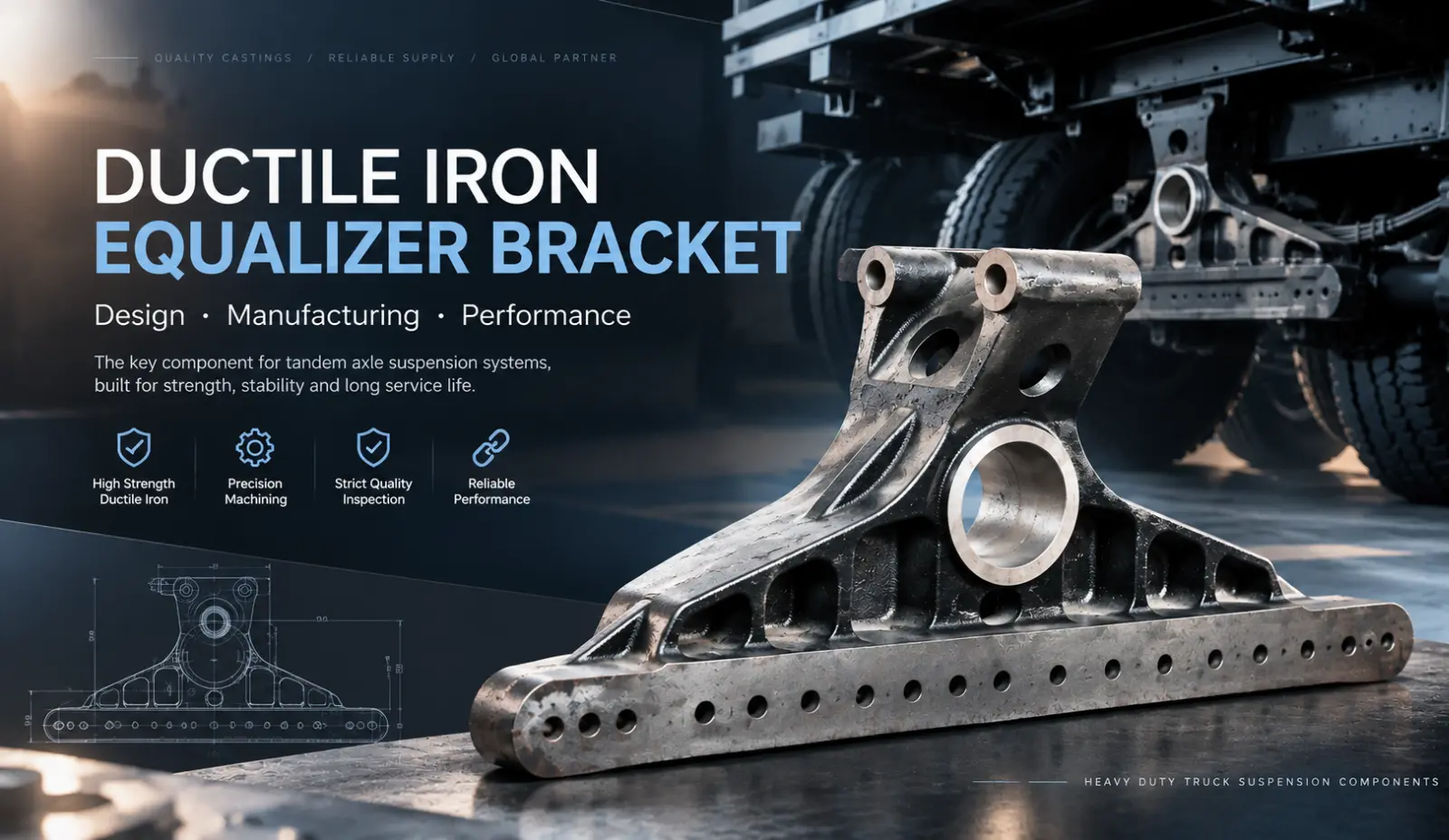
In a tandem-axle truck or trailer, suspension components have to do more than carry static weight. They also respond to potholes, uneven road surfaces, braking, cornering and repeated vibration. An equalizer bracket is a structural part in certain leaf-spring suspension systems that supports the equalizer mechanism and its pivot. Its geometry and condition influence how the suspension moves and how forces are transferred through the chassis.
For engineers and purchasing teams, choosing an equalizer bracket is not simply a matter of matching its outside shape. The material grade, casting integrity, machined interfaces, mounting dimensions and inspection plan all need to match the application. This guide explains how the component works, what to look for in a ductile iron equalizer bracket, how it is typically manufactured, and which questions help when evaluating a casting supplier.
1. What Is an Equalizer Bracket?
An equalizer bracket—sometimes described as a balance axle bracket or suspension equalizer hanger—is a load-bearing mounting component used in some tandem-axle suspension arrangements. It is typically attached to the vehicle frame and supports a pivot or balance-shaft assembly associated with the leaf springs of two axles. As the axles move over uneven ground, the equalizer mechanism pivots and helps accommodate the difference in suspension travel.
The bracket is not the equalizer arm itself. It provides the structural support and mounting interfaces that allow the mechanism to operate in its intended position. Depending on the suspension design, the assembly may include a pivot shaft, bushings, equalizer beam, spring connections and frame fasteners. Terminology varies by vehicle maker and region, so buyers should confirm the part number and drawing rather than rely on the product name alone.
Why the bracket matters
- Pivot support: The bore or bearing interface holds the pivot assembly in the required position. Excessive clearance or poor geometry can allow unwanted movement.
- Load transfer: The bracket carries reaction forces from the equalizer mechanism into the frame. It must be suitable for the specified static and dynamic loads.
- Mounting accuracy: The flange and bolt pattern locate the component relative to the chassis. Incorrect alignment can complicate installation and affect suspension geometry.
- Long-term durability: The casting must tolerate repeated load cycles, vibration and the operating environment without unacceptable cracking, deformation or wear.
These functions explain why a bracket that looks correct may still be unsuitable. Its internal soundness, material properties and machined features are just as important as its visible profile.
2. Design Features That Affect Fit and Service Life
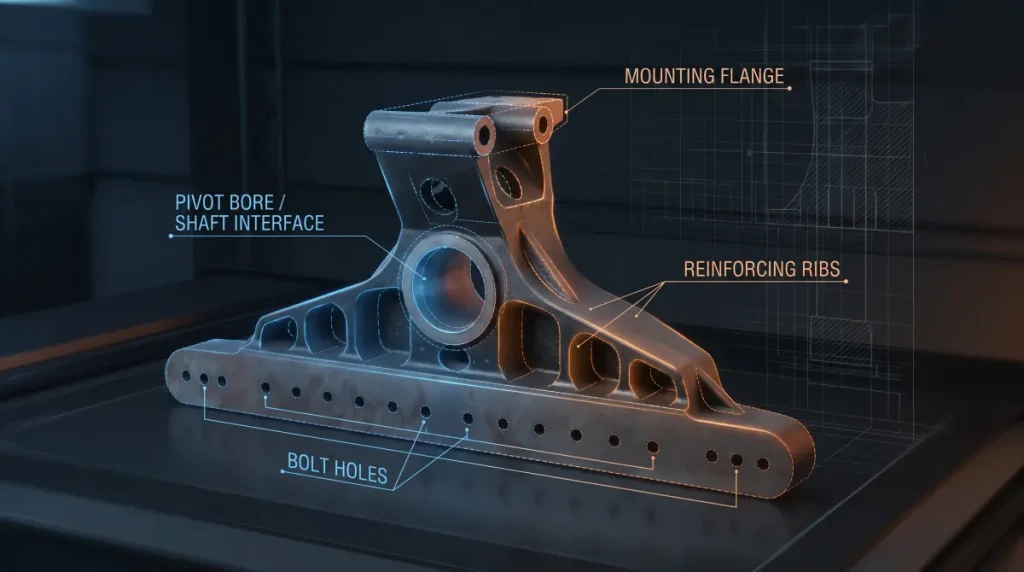
Equalizer brackets often combine a substantial pivot area, mounting flanges and reinforcing ribs. The shape is intended to carry forces through the body while keeping the component practical to cast and install. The exact geometry is application-specific; there is no single dimension or tolerance that fits every truck or trailer.
| Feature | What buyers and engineers should verify | Why it matters |
|---|---|---|
| Pivot or shaft bore | Diameter, roundness, cylindricity, surface finish and fit with the specified shaft or bushing | Controls alignment and clearance at the pivot interface |
| Mounting flange | Flatness, thickness, contact area and bolt pattern | Supports stable attachment to the frame or subframe |
| Bolt holes | Hole diameter, position, spacing and edge distance | Ensures the part can be installed without forced alignment |
| Ribs and section transitions | Wall thickness, rib continuity, fillet radii and casting feasibility | Influence stiffness, stress concentration and casting quality |
| Lightening holes or cavities | Location, shape, edge radii and core quality where applicable | Reduce mass where the design permits without compromising the load path |
| Spring or linkage interface | Position and geometry according to the suspension drawing | Maintains the intended relationship between connected components |
| Surface protection | Coating type, coverage and protection of machined surfaces | Helps manage corrosion during storage, transport and use |
Why ribs and transitions deserve attention
Ribs can increase stiffness without making every section uniformly thick. However, a rib is not automatically beneficial simply because it adds material. Abrupt changes in section thickness may increase local stress and complicate solidification. Sharp corners can also create stress concentrations. During design review, casting feasibility, machining access and structural requirements should be considered together.
For custom projects, the supplier should work from a controlled 2D drawing or 3D model. Any proposed change to rib thickness, fillet radius, draft angle, core layout or machining allowance should be reviewed and approved before tooling or production is changed.
3. Choosing Ductile Iron for an Equalizer Bracket
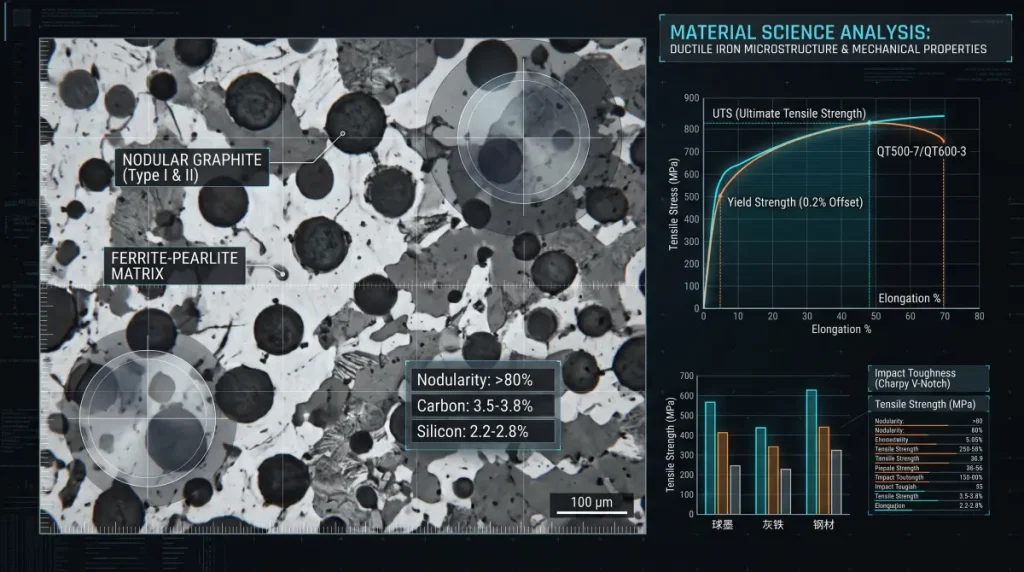
Ductile iron is frequently considered for load-bearing cast components because its graphite forms nodules rather than the flakes found in grey iron. This microstructure can provide a useful balance of tensile strength, elongation, toughness and castability. It also allows complex shapes to be produced as castings, reducing the need to assemble several separate pieces.
Grades such as QT500-7, QT600-3 and QT800-series materials may appear in discussions of high-strength ductile iron components. They are not interchangeable options to select by strength number alone. Mechanical properties depend on the specified standard, section size, heat treatment, test method and acceptance criteria. The required grade should be set by the vehicle or suspension specification and confirmed with material test data.
| Material consideration | Questions to ask |
|---|---|
| Strength | Does the specified grade meet the design’s tensile and yield requirements? |
| Ductility and toughness | Are elongation and any impact requirements suitable for the operating temperature and duty cycle? |
| Fatigue performance | Has the design considered cyclic loads, local stress concentrations and casting quality? |
| Castability | Can the foundry reliably fill the section geometry and control shrinkage and other casting risks? |
| Traceability | Can each production heat or lot be linked to the required test records? |
4. How Are Ductile Iron Equalizer Brackets Manufactured?
A typical ductile iron equalizer bracket route includes casting, cleaning, any required heat treatment, CNC machining and inspection. Process details vary with the part design, material grade and customer requirements, so the following is a general overview rather than a fixed recipe.
Step 1: Drawing review and pattern preparation
The supplier reviews the 2D drawing or 3D model, material callout, critical dimensions, machining allowances and inspection requirements. Pattern and core arrangements are planned to form the bracket’s outer profile and any internal openings. A design-for-manufacture review at this stage can identify difficult-to-cast sections, inaccessible machining surfaces or dimensions that need clearer definition.
Step 2: Melting and ductile iron treatment
Base iron and other charge materials are melted, and the chemistry is adjusted to the specified grade. Magnesium treatment is used in ductile iron production to promote nodular graphite formation; inoculation and process control help achieve the required microstructure. Temperature, treatment practice, chemistry and pouring conditions need to be controlled and recorded according to the foundry’s process plan.
Step 3: Molding, pouring and solidification
The prepared mold is assembled with the required cores, then filled with treated molten iron. Gating and feeding design help manage metal flow and solidification. For a bracket with varying section thickness, the foundry needs to consider the risk of shrinkage, porosity, misruns and other defects. The casting is allowed to solidify and cool before the mold is removed.
Step 4: Shakeout and cleaning
After cooling, the mold and cores are removed. Gates and risers are cut off, and the casting is cleaned to remove adhering sand and scale. Shot blasting may be used to prepare the surface for visual examination and subsequent operations. Any surface indications should be assessed against the agreed acceptance criteria rather than judged only by appearance.
Step 5: Heat treatment or stress relief, if specified
Some parts require heat treatment to achieve the specified mechanical properties or to manage residual stress. This is not a universal step with one standard temperature and holding time: the route must match the material grade, section size and approved process. The supplier should retain relevant process records when heat treatment is part of the specification.
Step 6: CNC machining
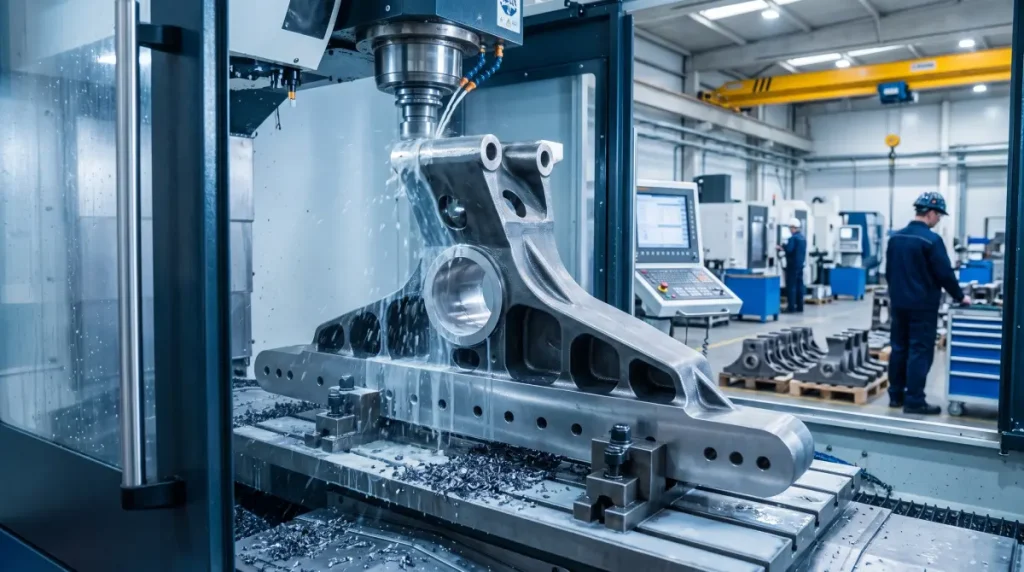
Machining creates the functional interfaces that need tighter tolerances than the as-cast surfaces can normally provide. Depending on the drawing, operations may include boring the pivot hole, milling the mounting face, drilling bolt holes and machining spring or linkage interfaces. Fixtures must locate the casting consistently, and machining allowances must be sufficient to clean up the required surfaces without compromising the design.
Step 7: Final inspection and packaging
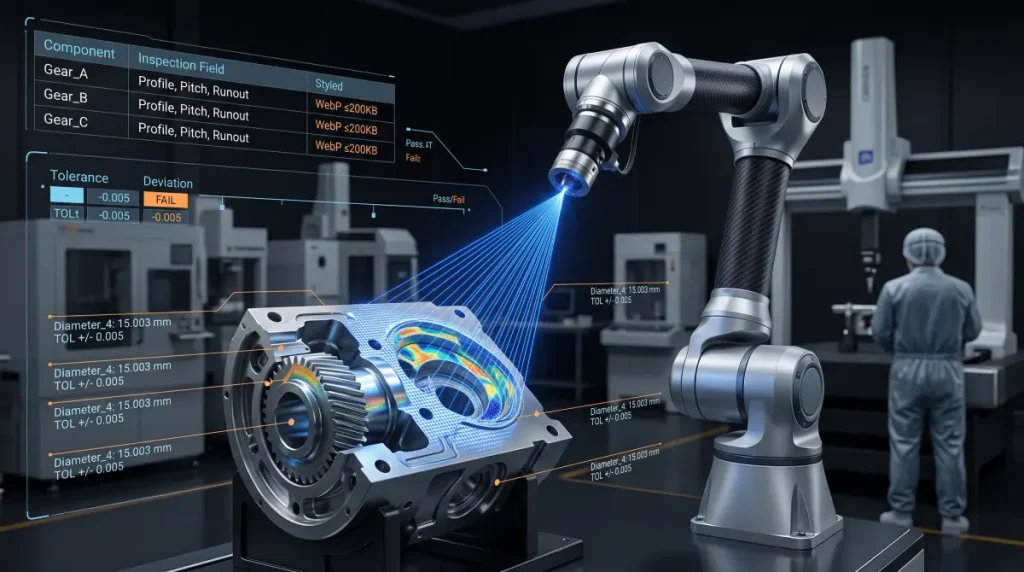
The finished component is checked against the drawing and inspection plan. Critical dimensions may be measured with bore gauges, coordinate measuring machines (CMMs), fixtures or other calibrated instruments. Visual inspection and specified non-destructive testing may be used to assess casting integrity. Machined surfaces can receive rust-preventive protection, while external surfaces are coated as agreed. Packaging should protect the bore, mounting faces and other finished surfaces during shipment.
5. Inspection and Quality Control
For a suspension casting, quality is demonstrated through records and repeatable results—not simply a polished surface or a general statement that the part is “high strength.” Buyers should agree on inspection requirements before production and identify which characteristics are critical to fit, function and safety.
| Inspection area | Useful evidence | Purpose |
|---|---|---|
| Material | Heat or lot identification, chemical analysis and mechanical test report as specified | Confirms conformity to the required material grade |
| Microstructure | Metallographic results or nodularity checks when required | Evaluates graphite form and relevant microstructural criteria |
| Critical dimensions | Inspection report for bore, flange, hole positions and overall geometry | Confirms fit with the mating components |
| Surface condition | Visual inspection against agreed acceptance criteria | Identifies visible defects and surface damage |
| Non-destructive testing | MPI or another specified method, with acceptance criteria | Checks for relevant surface or near-surface indications |
| Process traceability | Production lot, inspection records and applicable heat-treatment records | Supports investigation if a nonconformance occurs |
| Coating and packing | Coating confirmation and packaging specification | Reduces corrosion and transport damage |
Magnetic particle inspection (MPI) can be specified for suitable ferromagnetic materials to detect certain surface and near-surface discontinuities. It is not a substitute for dimensional inspection or material testing, and it should be applied by a suitable procedure with defined acceptance criteria. The applicable test method and inspection extent should be agreed between buyer and supplier.
It is also useful to distinguish first-article inspection from routine production checks. A first article can verify that the drawing, tooling, fixture and process produce an acceptable part. Ongoing checks then help confirm that critical dimensions remain stable from batch to batch. For recurring orders, ask how nonconforming parts are identified, segregated and corrected.
6. Common Wear and Failure Concerns
Service problems can arise from the component itself, the surrounding suspension system, installation or operating conditions. Three areas deserve particular attention during design review and maintenance.
Fatigue cracking
Repeated loading can initiate and propagate cracks, particularly around section transitions, hole edges, mounting features or areas affected by casting defects. The risk depends on the load spectrum, geometry, material properties, surface condition and manufacturing quality. Rounded transitions, sound castings and a material specification suited to the application all contribute to a robust design, but none alone guarantees a particular service life.
Pivot bore wear or excess clearance
If the pivot interface wears, clearance may increase and allow unwanted movement. Possible contributing factors include the shaft or bushing condition, lubrication where applicable, contamination, alignment and the original fit. When diagnosing wear, inspect the mating shaft and related components as well as the bracket; replacing only one worn part may not address the underlying cause.
Mounting or alignment problems
Incorrect bolt-hole locations, an uneven mounting face, damaged fasteners or installation on a distorted frame can prevent proper seating. Forced installation may introduce unwanted stress. Check the part against the approved drawing and follow the vehicle manufacturer’s installation and torque procedures.
Cracks, unusual movement or a damaged suspension mounting should be assessed by qualified maintenance personnel. A structural suspension component should not be returned to service solely because a visible defect appears small.

7. How to Evaluate an Equalizer Bracket Supplier
When sourcing an equalizer bracket, compare suppliers on technical fit, process control and documentation as well as unit price. A low quotation has limited value if the part requires rework, does not fit the assembly or arrives without the records required by your quality system.
| Evaluation point | Questions for the supplier |
|---|---|
| Drawing review | Can the team review your drawing, identify critical-to-quality dimensions and clarify missing requirements before quotation? |
| Foundry process | What casting process is proposed, and how are chemistry, treatment, molds and cores controlled? |
| Material documentation | Can the supplier provide test reports and link them to the relevant production lot? |
| Machining capability | Can the bore, mounting face and bolt pattern be machined and measured to the approved tolerances? |
| Inspection plan | Which dimensions are checked, how often are they measured, and what reports are supplied? |
| Defect management | How are nonconforming castings identified, dispositioned and prevented from being shipped? |
| Traceability | Can finished parts be traced to production and inspection records? |
| Customization | Can the supplier support drawing-based development, sample approval and controlled engineering changes? |
| Packaging | How are machined surfaces protected from corrosion, impact and abrasion in transit? |
Before placing a production order, provide the part drawing or model, target material grade, annual demand or batch quantity, required tests, coating details and destination-market documentation needs. If the part is intended to replace an existing OEM component, clarify whether the order requires exact dimensional interchangeability, an approved modification or a new design. Sample inspection and fitment validation should be completed before volume production where the project requires it.
8. Applications and Customization
Equalizer brackets may be used in tandem-axle suspension systems for heavy-duty trucks, dump trucks, trailers and vocational vehicles. Actual use depends on the vehicle’s suspension architecture; not every tandem-axle vehicle uses the same equalizer arrangement.
- Dump and construction trucks: Suspension parts may face frequent impact, uneven ground, dust and mud. The design and material must reflect the vehicle’s specified loads and operating conditions.
- Freight and semi-trailers: Long periods of road operation make fit, fatigue performance, corrosion protection and consistent replacement dimensions important.
- Special-purpose vehicles: Refuse, utility and other vocational vehicles can have specific frame layouts and duty cycles, making drawing control and application review essential.
- Aftermarket replacement: Buyers need to confirm part number, interfaces, material requirements and interchangeability rather than assume that visually similar parts are equivalent.
For custom manufacture, a complete inquiry usually includes a 2D engineering drawing or 3D model, material and mechanical-property requirements, critical tolerances, testing requirements, surface finish or coating, quantity and packaging instructions. A physical sample can help clarify an existing part, but a sample alone may not communicate hidden tolerances or material requirements. Where possible, pair it with the drawing and inspection criteria.
9. Frequently Asked Questions
What does an equalizer bracket do?
It provides structural support and a pivot mounting for the equalizer mechanism used in certain tandem-axle leaf-spring suspensions. The mechanism accommodates relative axle movement and helps manage load transfer within the suspension system.
What material is commonly used for an equalizer bracket?
Ductile iron is one common option because it combines strength, toughness and castability. The correct grade depends on the vehicle design, loading, environment and customer specification. Material selection should be verified against the approved engineering requirements.
How is a ductile iron equalizer bracket manufactured?
A typical process includes pattern and mold preparation, melting and ductile iron treatment, pouring, shakeout, cleaning, any specified heat treatment, CNC machining, inspection and protective packaging. The exact process depends on the component and specification.
Which dimensions are most important?
Common critical features include the pivot bore, mounting-face flatness, bolt-hole positions and overall geometry. The approved drawing should define the actual tolerances and inspection requirements for each application.
Can an equalizer bracket be customized for a particular truck or trailer?
Custom manufacture may be possible from an approved drawing or model. Buyers should provide the material grade, critical dimensions, testing requirements, finish and quantity, then validate samples against the intended suspension system before production where required.
What documents should accompany an order?
Depending on the contract, useful documents may include material test reports, dimensional inspection results, specified NDT reports, heat-treatment records, traceability information and coating confirmation. Agree on the required documents before production begins.
Discuss Your Equalizer Bracket Requirements
Ruixi Casting Co., Ltd. works with casting and machining requirements for industrial and vehicle components. For an equalizer bracket inquiry, share the drawing or 3D model, required material grade, quantity, critical tolerances and inspection plan so the project can be assessed against your specification.
For a technical quotation, please include:
- Part drawing, 3D model or sample reference
- Material grade and applicable standard
- Order quantity and expected repeat demand
- Machining, NDT, dimensional report and coating requirements
- Destination and packaging requirements
Email: info@destinytrans.com
WhatsApp:+86 184 3796 0706
Confirm contact details and all claimed production or inspection capabilities with the supplier before publishing or issuing a purchase order.