+86 184 3796 0706
 info@destinytrans.com


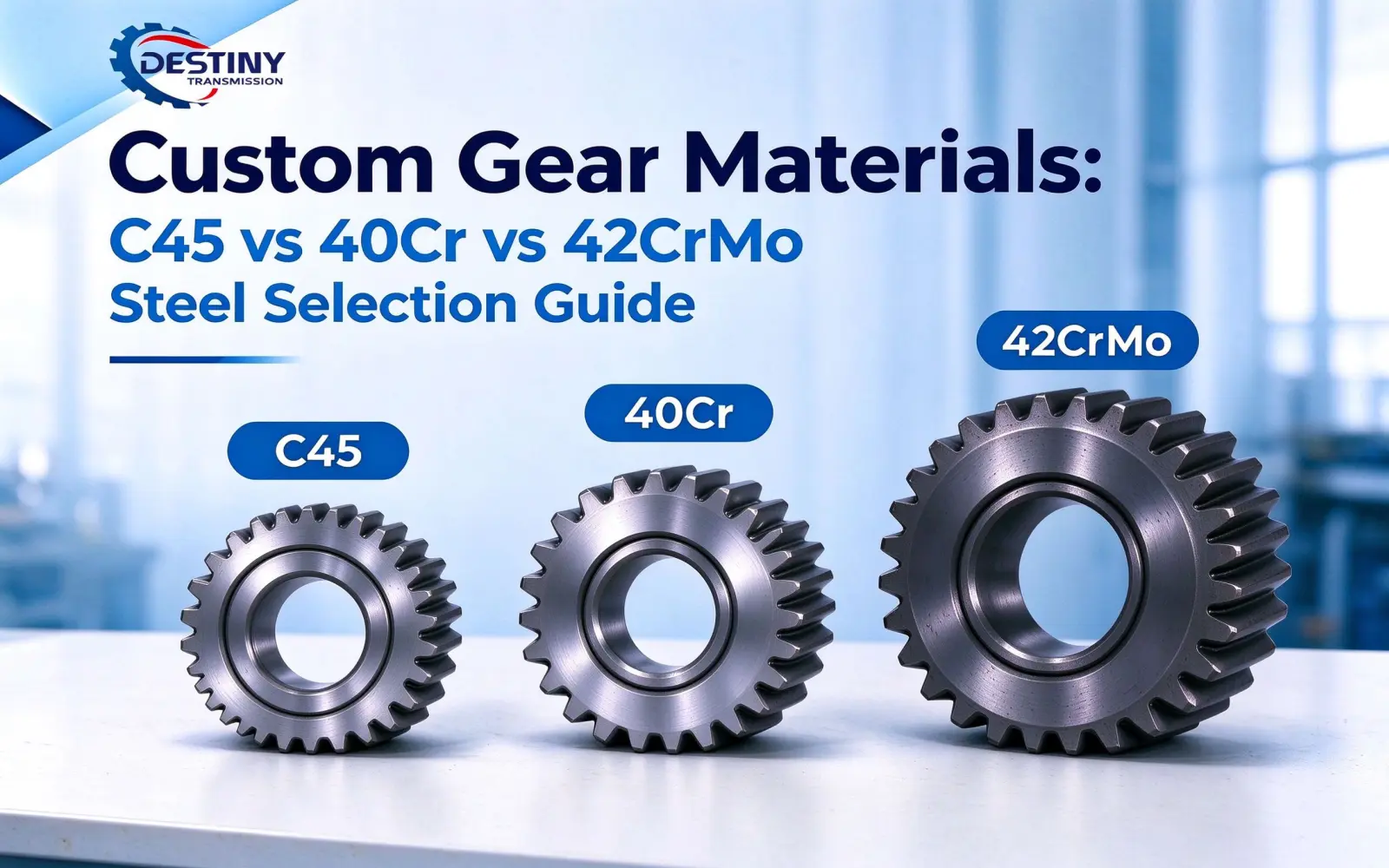
Introduction: Why Are Custom Gear Materials Important?
Custom gear materials directly affect strength, wear resistance, toughness, and service life. Different applications place different demands on these properties depending on load, operating speed, impact conditions, gear dimensions, and heat treatment.
Choosing a gear steel is therefore not simply a matter of selecting the strongest material. The right choice should provide sufficient performance for the application. It should also help control material and manufacturing costs.
Quick Answer
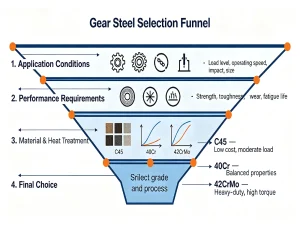
C45 is generally suitable for general-purpose and moderate-load gears where cost and machinability are important. 40Cr offers a balanced combination of strength, toughness, hardenability, and cost for many industrial transmission gears, while 42CrMo is better suited to heavy-duty and high-torque applications requiring higher strength and toughness.
The final choice also depends on gear size, load, operating speed, heat treatment, and required service life.
1. What Factors Should Be Considered for Gear Material Selection?
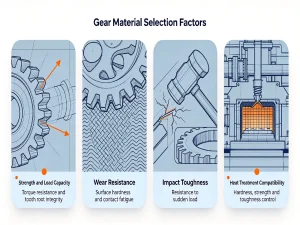
1.1 Strength and Load-Carrying Capacity
Gears are subjected to loads generated by torque during power transmission. For gears exposed to higher torque or sustained loads, sufficient strength and fatigue resistance are essential to maintain tooth root integrity and overall structural strength. Insufficient strength can lead to tooth root fatigue, plastic deformation, or fracture during prolonged operation.
1.2 Wear Resistance and Fatigue Performance
During gear meshing, the tooth surfaces are continuously subjected to friction and contact stress. Material hardness, microstructure, and heat treatment condition all affect tooth surface wear and contact fatigue life.
1.3 Toughness and Impact Resistance
Construction machinery and other heavy-duty equipment may be exposed to impact loads during operation. In these conditions, good toughness and impact resistance are important for handling sudden loading and reducing the risk of brittle failure.
1.4 Heat Treatment Compatibility
Different steels respond differently to heat treatment. The selected process can change the gear’s hardness, strength, toughness, wear resistance, and fatigue performance.
For example:
- C45 steel can be quenched and tempered to improve its overall mechanical properties and may also undergo surface hardening where higher surface hardness is required.
- 40Cr alloy steel has good hardenability and is commonly used in the quenched-and-tempered condition, with induction hardening applied where higher surface hardness is required.
- 42CrMo alloy steel has relatively high hardenability and is well suited to quenching and tempering when higher strength and toughness are required.
2. C45 Steel for Gear Manufacturing
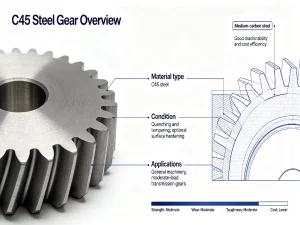
C45 steel (45 steel) is a commonly used medium-carbon structural steel specified under GB/T 699 and commonly compared with AISI 1045 in international material selection. In gear manufacturing, its good machinability and relatively low material cost make it suitable for medium- and low-load transmission applications where extremely high hardenability is not required.
Depending on the supply and heat treatment condition, C45 may typically fall within a hardness range of around 217–269 HB. Suitable surface hardening can produce a surface hardness of approximately 45–55 HRC.
Compared with alloy steels, C45 has lower hardenability, which can limit its load-carrying capacity and fatigue performance in applications involving high loads, heavy impact, or prolonged heavy-duty operation. Its suitability therefore depends strongly on the actual gear size, loading conditions, and heat treatment.
C45 is commonly used in general machinery and conventional transmission mechanisms, particularly where loads are moderate and operating conditions are relatively stable.
3. 40Cr Steel for Gear Manufacturing
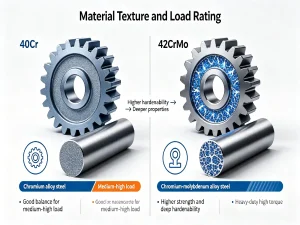
40Cr is a commonly used chromium alloy steel specified under GB/T 3077 and commonly compared with AISI 5140 in international material selection. It provides a useful balance of strength, toughness, hardenability, and cost and, compared with C45, is better suited to gears exposed to higher loads and more demanding operating conditions.
After quenching and tempering, 40Cr may typically reach around 241–286 HB, while induction hardening can produce a surface hardness of approximately 48–55 HRC, depending on section size and heat treatment parameters. These are typical reference ranges; the actual hardness should be confirmed against the specified material standard, heat treatment condition, and material certificate.
After appropriate heat treatment, 40Cr can provide improved hardness, strength, wear resistance, and fatigue performance. It is widely used in industrial gear reducers, automation equipment, and medium- to high-load mechanical transmission systems.
4. 42CrMo Steel for Heavy-Duty Gear Manufacturing
42CrMo is a high-strength chromium-molybdenum alloy steel specified under GB/T 3077 and commonly compared with AISI 4140 for international material selection. It combines high strength, toughness, and hardenability, making it suitable for gears subjected to demanding load conditions.
After quenching and tempering, 42CrMo may typically reach around 269–321 HB. Its relatively high hardenability compared with C45 and 40Cr also makes it more suitable for larger-section gears where consistent mechanical properties through the section are important. The actual hardness and mechanical properties depend on section size, heat treatment parameters, and the applicable material standard.
42CrMo is commonly used for heavy-duty machinery gears, high-torque transmission systems, construction machinery, and other high-load industrial gears.
The higher performance of 42CrMo generally comes with higher material and machining costs. For less demanding applications, C45 or 40Cr may offer a more economical solution.
5. How Do Gear Materials and Heat Treatment Affect Performance?
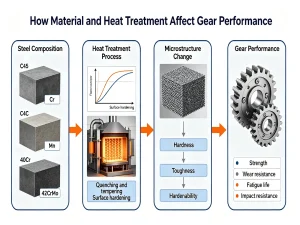
Material grade and heat treatment work together to determine the final properties of a gear. The steel provides the basic mechanical characteristics, while heat treatment changes the material’s hardness, strength, toughness, wear resistance, and fatigue performance.
Even with the same steel grade, the required heat treatment condition may vary with gear size, load, tooth surface requirements, and service conditions. Differences in heat treatment control, machining accuracy, gear design, and manufacturing processes can therefore affect the final load-carrying capacity and service life of the gear.
The material grade and heat treatment condition should be confirmed according to the applicable material standards, gear design, operating conditions, and required performance.
In addition to material selection and heat treatment, machining accuracy also plays an important role in final gear performance. Through advanced manufacturing processes and quality control, our gears can achieve ISO Grade 4 accuracy, helping meet the requirements of applications that require high transmission accuracy and stable operation.
6. C45, 40Cr, and 42CrMo Custom Gear Materials Comparison
C45, 40Cr, and 42CrMo are all used in gear manufacturing, but they differ in strength, toughness, hardenability, cost, and suitability for different operating conditions.
| Property | C45 Steel | 40Cr Steel | 42CrMo Steel |
| Steel type | Medium-carbon steel | Chromium alloy steel | Chromium-molybdenum alloy steel |
| Main alloying elements | C, Si, Mn | C, Si, Mn, Cr | C, Si, Mn, Cr, Mo |
| Relative strength level | Moderate | Higher | High |
| Toughness | Moderate | Good | Good to high |
| Hardenability | Relatively low | Moderate | High |
| Typical heat treatment | Quenching and tempering; surface hardening where required | Quenching and tempering; induction hardening where required | Quenching and tempering; surface hardening where required |
| Typical gear applications | General-purpose and moderate-load gears | Medium- to high-load industrial gears | Heavy-duty and high-torque gears |
| Cost level | Relatively low | Moderate | Relatively high |
Note: The hardness ranges stated above are typical reference values, not universal requirements. Exact chemical composition, tensile strength, yield strength, hardness, and heat-treatment parameters depend on the applicable material standard, section size, supply condition, and heat treatment. These values should be confirmed against the material certificate or relevant standard for the specific gear.
In actual gear manufacturing, material selection should match the specific operating conditions rather than simply choosing the steel with the highest strength.
As a general selection rule: C45 is suitable when cost and machinability are the main priorities. 40Cr is a practical choice when a balance of strength, toughness, and cost is required. 42CrMo is more suitable for heavy-duty or high-torque applications that require higher strength and reliability.
The final choice should also consider gear dimensions, load conditions, operating speed, heat treatment, required service life, and manufacturing requirements.
7. How Do Manufacturers Select the Right Custom Gear Materials?
In custom gear manufacturing, selecting suitable custom gear materials starts with the gear’s design, working conditions, and performance requirements.
Gear Material Selection Matrix
The following matrix provides a general starting point for material selection. The final material and heat treatment should be confirmed through gear strength calculations, operating conditions, and applicable material and heat treatment standards.
| Gear Type | Typical Load | Typical Material Options | Typical Heat Treatment |
| Small gear / pinion | Light to moderate | C45 / 40Cr | Quenching and tempering; surface hardening where required |
| Small gear / pinion | Heavy or cyclic | 40Cr / 42CrMo | Quenching and tempering; induction or other surface hardening where required |
| Large gear | Light to moderate | C45 / 40Cr | Quenching and tempering |
| Large gear | Heavy load | 40Cr / 42CrMo | Quenching and tempering; surface hardening where required |
| Gear exposed to impact | Moderate to heavy | 40Cr / 42CrMo | Quenching and tempering, selected according to required toughness and hardness |
| High-torque gear | Heavy load | 42CrMo | Quenching and tempering; additional surface hardening where required |
This matrix should be treated as a general selection guide rather than a substitute for gear strength calculations. Gear geometry, tooth size, contact stress, bending stress, speed, lubrication, and required service life can all affect the final material and heat treatment selection.
Frequently Asked Questions (FAQ)
1. Is More Expensive Gear Material Always Better?
No. More expensive materials often offer better overall properties, but that does not mean they are suitable for every gear application. If the material’s performance exceeds the actual operating requirements, it can increase manufacturing costs unnecessarily. Material selection should be based on load, working environment, and required service life.
2. Can Different Custom Gear Materials Be Used as Direct Substitutes?
Not necessarily. Although these materials can be used for some similar gear applications, they differ in strength, hardenability, heat treatment response, and cost. Substitution should be evaluated based on the gear’s load, dimensions, operating conditions, and heat treatment requirements. Required service life should also be considered. Nominal material strength alone is not enough for material selection.
3. Will Gears Made from the Same Material Have the Same Performance?
No. Even when the same material is used, gear performance can be affected by heat treatment, machining accuracy, gear design, and manufacturing processes. Material is only one factor affecting gear performance. The overall manufacturing process also plays an important role.
4. Why Can Gears Made from the Same Material Have Different Prices?
Gear pricing depends not only on the material itself but also on factors such as gear dimensions, machining accuracy, heat treatment requirements, manufacturing processes, and inspection standards. Therefore, even when the same steel grade is used, the final cost can vary according to the specific manufacturing requirements.
5. Can C45 Be Used for Heavy-Duty Gears?
C45 can be used for some gears with moderate loads. However, it is generally less suitable for heavy-duty applications requiring high strength, high hardenability, or long-term resistance to heavy or impact loading. In such cases, 40Cr or 42CrMo may provide a more suitable option depending on the gear design, heat treatment, and operating conditions.
6. How Can You Determine Whether a Gear Material Is Suitable for a Specific Application?
A gear material is suitable when its properties meet the gear’s strength, wear resistance, toughness, and service-life requirements under actual operating conditions. The decision should be verified against the gear design, load, operating speed, and heat treatment condition.
Still unsure which steel is suitable for your gear design? Send us your technical drawings or operating torque requirements. Our engineering team can help assess the appropriate material grade and heat treatment condition for your application.