+86 184 3796 0706
 info@destinytrans.com


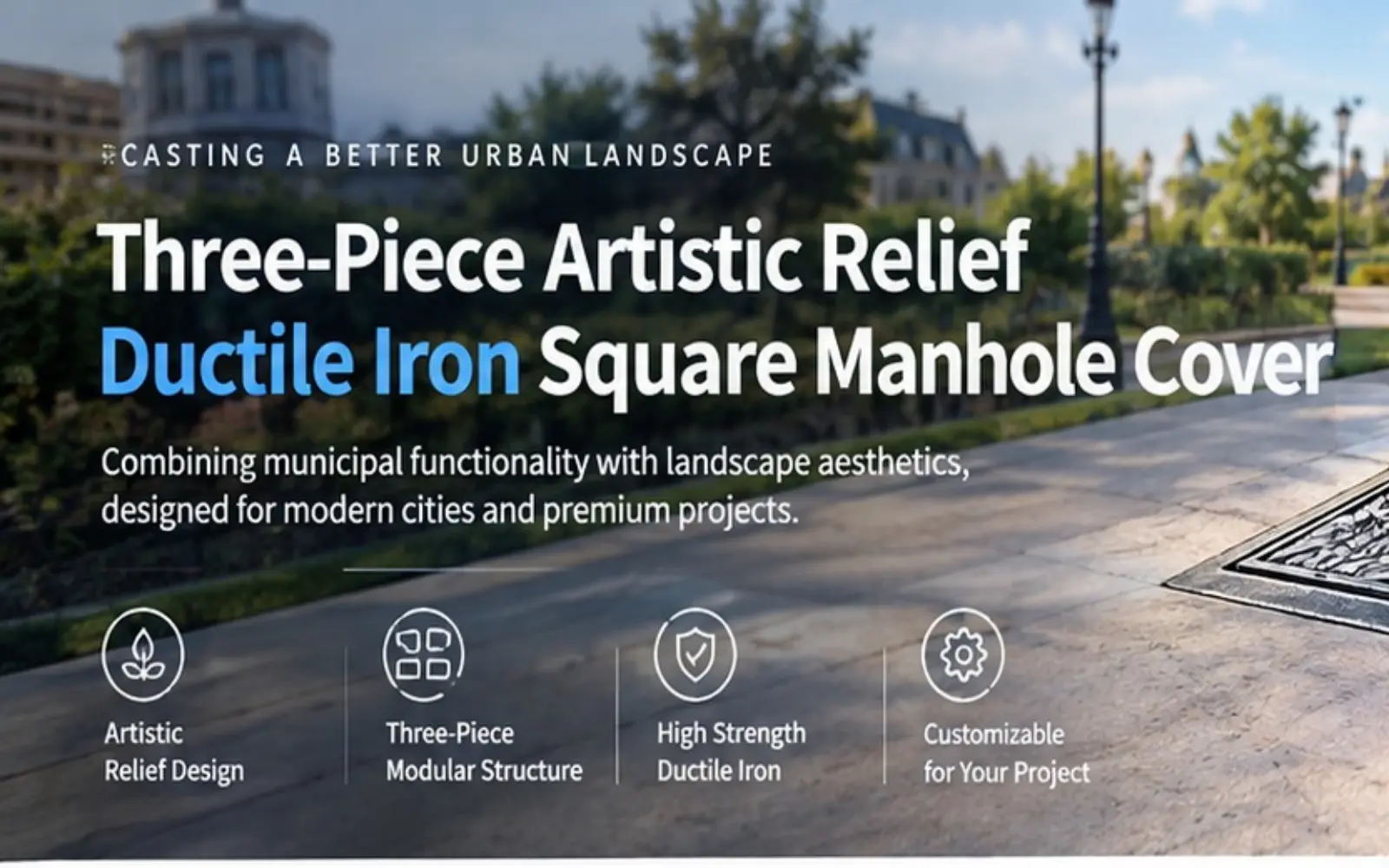
Walk through any well-designed park, historic district, or cultural quarter, and you may notice something unexpected at your feet — a manhole cover that does not look like a manhole cover. Instead of the utilitarian cross-hatched disc synonymous with urban infrastructure, you find a cast-iron panel embossed with lotus flowers, swimming fish, and rippling water patterns — an artwork embedded in the pavement.This is the artistic relief ductile iron square manhole cover, a product category where foundry craftsmanship meets landscape architecture, and where the infrastructure that keeps a city running also contributes to its visual identity.This guide explores the design philosophy, casting artistry, and practical engineering behind three-panel artistic relief ductile iron square manhole covers — from the rationale for square geometry in landscape settings, to the modular three-opening innovation, to the cultural storytelling made possible by cast-in-relief patterns.
1. From Utility to Urban Art: The Evolution of Decorative Manhole Covers
For most of the 20th century, manhole covers were designed with a single priority: functionality. The standard round cover with a cross-hatched anti-slip grid became the global default — efficient to manufacture, easy to install, and reliable under traffic. But as cities began investing in placemaking, cultural identity, and pedestrian-friendly design, a question emerged: why should the most frequently encountered piece of municipal infrastructure also be the most visually indifferent?
The answer came in the form of decorative manhole covers — castings that replace the standard anti-slip grid with artistic relief patterns. Japan led this movement in the 1980s, transforming thousands of covers into canvases for local landmarks, anime characters, and floral motifs. The trend spread globally: Richmond, Virginia commissioned artist-designed covers featuring the city’s “shou” longevity symbol; Barcelona’s sidewalk covers feature Modernist-inspired patterns; and Chinese eco-cities began specifying custom-branded covers with district logos and cultural motifs.
Today, artistic relief manhole covers are no longer a novelty — they are a recognized category within municipal and landscape infrastructure. Their value proposition is clear: for a marginal cost premium over standard covers, they deliver outsized visual impact at the most intimate scale of urban experience — the ground beneath our feet. Every pedestrian who walks past, every visitor who looks down, encounters the cover. No billboard, banner, or monument achieves that kind of sustained, close-range exposure.
2. Why Square? The Design Case for Square Covers in Landscape Projects
The question “why are manhole covers round?” has become an engineering interview cliché. The classic answers — a round cover cannot fall through its own opening, it can be rolled for transport, and it distributes load evenly — are all correct for road infrastructure. But landscape projects operate under different constraints, and in these contexts, square manhole covers offer distinct advantages that make them the preferred choice for parks, plazas, and cultural districts.
Alignment with Paving Geometry
Landscape hardscapes are predominantly rectangular. Stone slabs, concrete pavers, brick pathways, and plaza tiles are laid in grid patterns that follow straight lines and right angles. A square manhole cover integrates naturally into this geometry — it can be set within the paving grid without disrupting the visual rhythm, creating a seamless transition between cover and surrounding surface. A round cover, by contrast, always breaks the grid, creating awkward curved cuts in adjacent pavers and a visual circle in a field of rectangles.
Maximized Relief Canvas
For artistic relief covers, the top surface is the canvas. A square cover provides approximately 27% more surface area than a round cover of the same nominal width — and crucially, that surface is a continuous rectangle rather than a circle interrupted by curvature. This allows for narrative compositions: a panoramic scene spanning the full width, or three distinct panels each telling part of a story. The lotus pond motif on our three-panel cover — with its flowing water, blooming flowers, and swimming fish — would be compressed and truncated on a round surface.
Orientation and Directional Meaning
A square cover has a defined orientation. It can be aligned with a building facade, pointed toward a scenic view, or oriented to match the directional flow of a pathway. This is impossible with a round cover, which is rotationally symmetric. In landscape design, where directional cues and visual alignment matter, this orientation capability is a genuine design tool — not a trivial detail.
| Design Factor | Round Cover | Square Cover |
| Paving Integration | Breaks rectangular grid; requires curved cuts | Aligns with rectangular paving units |
| Relief Canvas Area | ~78.5% of bounding square | 100% of bounding square |
| Orientation | Rotationally symmetric — no directional meaning | Can be aligned with facades, pathways, or views |
| Narrative Composition | Limited to radial or concentric patterns | Supports panoramic, multi-panel, and directional scenes |
| Best Application | Roads, carriageways, utility corridors | Parks, plazas, historic districts, landscape paths |
3. The Three-Panel Innovation: Modular Access for Maintenance Efficiency
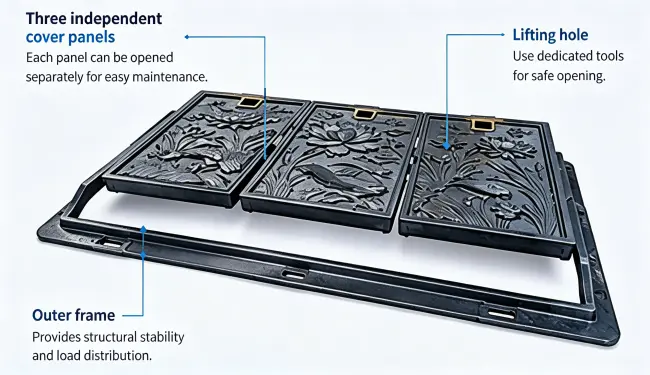
One of the most distinctive features of this cover is its three-panel (three-opening) design. Rather than a single solid lid, the square cover is divided into three independently removable sections, each seated in the shared outer frame. This is not merely an aesthetic choice — it is a functional innovation that addresses several real-world maintenance challenges.
Selective Access
Underground utility chambers often serve multiple purposes — a single inspection pit may house water supply valves, drainage connections, and communication cable bundles, each located in a different section of the chamber. With a three-panel cover, maintenance crews can open only the panel above the specific utility they need to access, leaving the other two closed. This reduces the opening exposed to the surface, minimizing safety hazards for pedestrians, preventing debris from entering the chamber, and reducing the amount of surface area that must be barricaded.
Reduced Lifting Force
A single-piece square cover large enough to span a utility chamber can weigh 80–120 kg depending on dimensions and material density. Lifting such a cover requires two personnel, a mechanical lifting device, or significant physical exertion — all of which slow down routine maintenance. By dividing the cover into three panels, each section weighs roughly one-third of the total — bringing individual panel weight into the 25–40 kg range that a single worker can manage safely using the integrated lifting holes.
Independent Replacement
If a single panel is damaged — by impact, wear, or casting defect — only that panel needs replacement, not the entire cover assembly. This reduces lifecycle maintenance costs and spare-parts inventory, especially valuable for large landscape projects with many covers distributed across extensive grounds.
Designing a landscape project with multiple utility chambers?
Ruixi Casting manufactures three-panel artistic relief square manhole covers in ductile iron, with custom relief patterns, EN124 load classes, and dimensional specifications tailored to your project. Contact our design team to discuss pattern customization and project specifications.
4. Relief Casting Artistry: From Pattern Design to Cast Iron
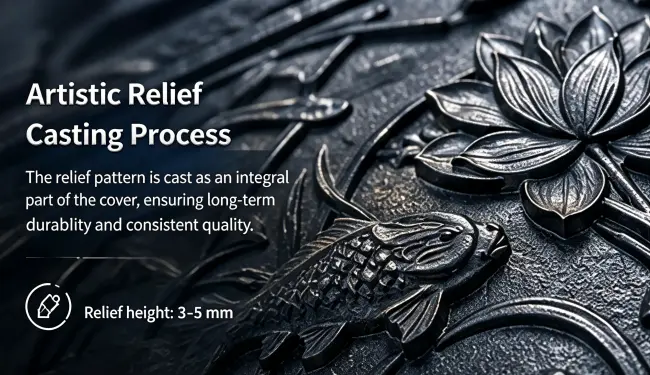
The artistic relief on a ductile iron manhole cover is not stamped, etched, or applied as a surface treatment — it is cast integrally into the metal during the sand casting process. This means the relief pattern exists as a three-dimensional feature of the iron itself, not as a coating that can wear off, fade, or delaminate. The pattern will remain visible for the full service life of the casting — decades of rain, sun, foot traffic, and freeze-thaw cycles.
The Pattern Plate: Where Art Meets Engineering
Every relief cover begins with a custom pattern plate — a precise master model that contains the mirror image of the relief design. The pattern plate is the most critical and labor-intensive element of the production process. It requires a collaboration between a relief designer (who creates the artistic composition) and a pattern engineer (who translates that composition into a mechanically viable casting geometry).
The key engineering constraint is relief depth. Too shallow, and the pattern is invisible after asphalt coating and weathering; too deep, and the cover loses structural thickness where the iron is displaced. The optimal range is typically 3–5 mm of raised relief above the cover’s base surface — enough to catch raking light and create visible shadows, but not enough to compromise the cover’s load-bearing cross-section.
Sand Casting: The Process
The production process for artistic relief covers follows the fundamental sand casting workflow, with pattern-specific modifications:
- Pattern fabrication: The relief design is carved or machined into a metal or resin pattern plate — the negative of the final relief. This is a one-time investment; the same pattern plate produces hundreds to thousands of covers.
- Mold creation: Sand is compacted around the pattern plate in a molding flask, capturing every detail of the relief in the sand impression. The sand’s fine grain size reproduces detail down to sub-millimeter resolution.
- Pouring: Molten ductile iron (QT500-7, at approximately 1,300–1,400°C) is poured into the sand mold. The metal flows into every channel of the relief impression, filling the finest details.
- Shakeout and cleaning: After solidification and cooling, the sand mold is broken away. The casting is cleaned of sand residue, and the relief surfaces are inspected for fill completeness and detail sharpness.
- Surface treatment: The cover receives an asphalt anti-rust coating, which darkens the surface uniformly and protects the iron from corrosion without obscuring the relief pattern.
Why Ductile Iron, Not Grey Iron, for Relief Covers
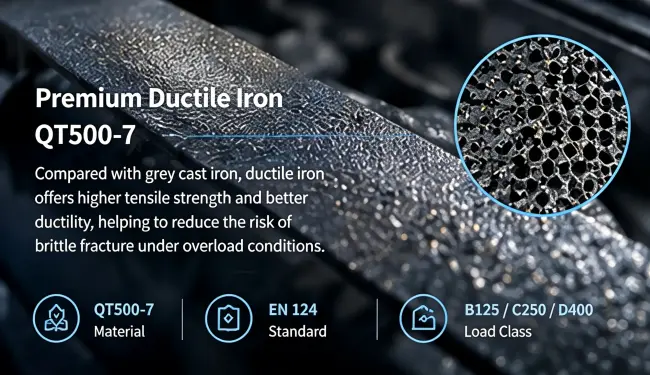
While grey cast iron is traditionally used for decorative castings due to its excellent castability and ability to reproduce fine detail, ductile iron (QT500-7) offers a critical advantage for relief covers installed in trafficked or public areas: toughness. A grey iron relief cover may crack if a maintenance vehicle drives over it or if a heavy object is dropped on it — and a cracked cover with a decorative pattern is both a safety hazard and an aesthetic failure. Ductile iron’s spheroidal graphite structure provides the elongation and impact resistance that grey iron lacks, ensuring the relief cover withstands real-world service conditions without fracturing.
The trade-off is that ductile iron’s slightly different solidification characteristics require more careful pattern design and pouring parameters to achieve the same level of detail reproduction as grey iron. But modern foundry practice has largely closed this gap, and the structural benefit is decisive for covers installed in any location accessible to vehicles or heavy foot traffic.

5. Cultural Storytelling: Lotus, Fish, and the Language of Relief Patterns
The relief pattern on a manhole cover is not arbitrary decoration — it is a deliberate cultural statement. The lotus pond motif featured on this cover — with blooming lotus flowers, swimming fish, and rippling water grasses — carries layers of meaning rooted in East Asian cultural tradition.
The Lotus: Purity and Resilience
The lotus grows in muddy water but produces a pristine flower — a symbol of purity emerging from impurity that resonates across Buddhist, Confucian, and folk traditions. For a manhole cover, which sits at the boundary between the visible world above and the hidden infrastructure below, the lotus is an apt metaphor: beauty at the surface, sustained by the unseen systems beneath.
The Fish: Abundance and Continuity
Fish is a homophone for “surplus” or “abundance” in Chinese. The combination of lotus and fish creates the phrase “lián nián yǒu yú” — “may there be abundance year after year.” This is one of the most widely recognized auspicious motifs in Chinese decorative arts, and its appearance on a manhole cover in a public space transforms a piece of infrastructure into a quiet blessing for the community that walks over it.
Beyond Traditional Motifs
While the lotus-and-fish pattern is culturally rich, the relief casting process accommodates virtually any two-dimensional design that can be expressed in 3–5 mm of depth variation. Modern landscape projects have commissioned:
- Geometric patterns — Greek key, interlocking circles, or parametric designs that complement contemporary architecture
- Botanical themes — local flora, seasonal flowers, or ecological motifs tied to the site’s landscape design
- Cultural symbols — district logos, city emblems, or historical references that reinforce place identity
- Wayfinding text — cast-in utility identification (“RAINWATER,” “POWER,” “TELECOM”) integrated into the relief design rather than applied as a separate marking
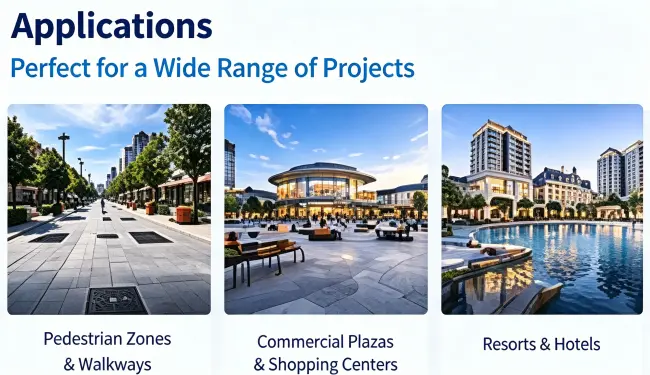
6. Landscape Integration: Where Artistic Covers Belong
The choice to specify artistic relief covers is fundamentally a context-driven decision. These covers are not designed for highway carriageways or industrial loading docks — that is the domain of standard round D400 covers. Artistic relief square covers find their value in environments where the visual quality of the ground plane matters as much as the functional performance of the access point.
Application 1: Public Parks and Botanical Gardens
In parks, where pathways meander through curated landscapes, a standard manhole cover disrupts the designed experience. An artistic relief cover, by contrast, becomes part of the landscape narrative — the lotus pond motif resonates with actual water features, the botanical pattern echoes surrounding plantings, and the dark cast-iron surface integrates with stone and timber paving. The cover’s location along a garden path, set flush with irregular stone slabs, transforms a utility access point into a designed element that rewards attention.
Ideal for: botanical garden pathways, park promenades, waterside boardwalks, and sculpture garden circulation zones where the ground plane is part of the visitor experience.
Application 2: Historic Districts and Cultural Quarters
Historic districts invest heavily in material authenticity — stone paving, traditional brick, and period-appropriate street furniture. A modern cross-hatched manhole cover in such a setting is a jarring anachronism. An artistic relief cover with a culturally relevant motif (peonies for prosperity, traditional geometric borders, or district-specific emblems) integrates with the historic material palette and reinforces the district’s identity. The cast-iron surface, with its dark patina and textured relief, harmonizes with weathered stone and aged brick in a way that no stamped steel or composite cover can match.
Ideal for: heritage streetscape renovation, cultural tourism districts, traditional architecture preservation zones, and civic plaza upgrades in historic cores.
Application 3: Residential Communities and Estate Grounds
Upscale residential communities and private estates increasingly prioritize landscape quality as a differentiator. The ground plane — paving, lighting, planting, and infrastructure — is scrutinized by prospective residents and landscape architects alike. An artistic relief cover communicates attention to detail at the most granular level: if the manhole cover is beautiful, the reasoning goes, the development’s overall quality must be exceptional. The three-panel design is particularly valuable in residential settings, where individual utility access (water meter reading, communication line maintenance) can be performed by opening a single panel without disrupting the landscape surface.
Ideal for: gated community landscape paths, private estate grounds, residential courtyard paving, and mixed-use development pedestrian zones.
Application 4: Scenic Areas and Tourist Destinations
At scenic areas and tourist destinations, every element of the built environment contributes to the visitor experience. A generic manhole cover on a mountain trail, temple path, or lakeside promenade is a missed opportunity. An artistic relief cover featuring locally significant motifs — regional flora, cultural symbols, or landmark silhouettes — becomes a subtle but consistent brand touchpoint that visitors photograph, share, and associate with the destination. In Japan, decorative manhole covers have become a tourist attraction in their own right, with dedicated “manhole cover spotting” routes and collectible cards. This model is increasingly adopted by Chinese scenic areas and eco-cities.
Ideal for: national park trailheads, temple and monastery grounds, lakeside promenades, eco-city pedestrian zones, and tourism district wayfinding paths.
7. Customization: Making Each Cover Tell a Story
The defining feature of artistic relief covers is their capacity for project-specific customization. Unlike standard covers, where the only variables are diameter, load class, and marking text, artistic relief covers offer a full design parameter set:
| Customization Parameter | Options | Design Impact |
| Relief Pattern | Lotus pond, peony, geometric, cultural symbol, custom logo, landmark silhouette | Primary visual identity of the cover |
| Panel Division | Single panel, two-panel, three-panel, four-panel | Access configuration and narrative segmentation |
| Cover Dimensions | Custom width × length to match paving module | Integration with surrounding hardscape grid |
| Load Class (EN124) | B125, C250, D400 (site-specific) | Structural performance for expected traffic |
| Cast-in Text | District name, utility identification, year, project title | Branding, wayfinding, and traceability |
| Surface Treatment | Asphalt coating (standard), black bitumen, natural iron patina | Color and texture matching with adjacent surfaces |
| Border Pattern | Greek key, interlocking circles, plain, custom | Frame-to-cover visual transition |
The customization process typically follows this workflow:
1.Concept phase: The project design team provides the desired motif, either as a reference image, a hand sketch, or a digital file. Ruixi Casting’s design team reviews the concept for castability — confirming that the relief depth, detail resolution, and structural implications are compatible with the sand casting process.
2.Pattern engineering: The concept is translated into a technical pattern plate specification, with relief depths, draft angles, and fillet radii optimized for clean sand mold release and complete metal fill.
3.Sample casting: A first article cover is produced and submitted to the client for visual approval. Adjustments to relief depth, pattern clarity, or dimensional fit are made at this stage.
4.Production run: Upon sample approval, the pattern plate enters production, producing covers to the project’s quantity, dimensional, and load-class specifications.
8. Technical Specifications
| Parameter | Specification |
| Product Type | Three-panel artistic relief square manhole cover with outer frame |
| Material | Ductile Iron QT500-7 |
| Cover Configuration | Outer frame + three independently removable relief panels |
| Shape | Square / rectangular (custom dimensions available) |
| Relief Pattern | Cast-in lotus pond motif (standard); custom patterns available |
| Relief Depth | 3–5 mm raised above base surface |
| Casting Process | Sand casting with custom pattern plate |
| Surface Treatment | Asphalt anti-rust coating |
| Lifting Feature | Cast-in lifting holes on each panel |
| Load Rating | Customizable to EN124 B125 / C250 / D400 per project requirements |
| Functional Features | Anti-settlement, anti-rattle, individual panel access, corrosion resistant |
| Customization | Custom relief patterns, dimensions, text, load class, border design |
| Applicable Standards | EN 124 (load class as specified) |
| Typical Service Life | 30+ years (with proper installation and coating maintenance) |
| Quality Documentation | Material test report, dimensional inspection report, pattern approval sample |

9. Frequently Asked Questions
What is an artistic relief manhole cover?
An artistic relief manhole cover is a ductile iron casting whose top surface features decorative relief patterns — such as lotus flowers, fish, geometric motifs, or cultural symbols — cast integrally into the metal during the sand casting process. Unlike standard covers with purely functional anti-slip grids, artistic covers serve as both access points for underground utilities and as visual design elements that enhance the surrounding landscape. The relief is part of the iron itself, not a surface treatment, so it remains visible for the full service life of the cover.
Why choose a square manhole cover instead of a round one for landscape projects?
Square manhole covers align naturally with rectangular paving units, stone slabs, and plaza geometries common in landscape architecture, eliminating the awkward curved cuts that round covers require in grid-pattern hardscapes. They also provide approximately 27% more surface area for relief artwork and can be oriented to match building facades or pathway directions — something rotationally symmetric round covers cannot do. For parks, plazas, and historic districts where the ground plane is a designed element, square covers integrate visually in ways round covers cannot.
What is the advantage of a three-panel (three-opening) manhole cover?
A three-panel design divides the cover into three independently removable sections, allowing maintenance crews to open only the panel above the specific utility they need to access. This reduces the exposed opening, minimizes pedestrian safety hazards, prevents debris from entering the chamber, and reduces the lifting force required — each panel weighs roughly one-third of a single-piece equivalent, bringing it into the range a single worker can manage safely. Individual panels can also be replaced independently if damaged, reducing lifecycle maintenance costs.
Can the relief pattern be customized for my project?
Yes. Relief patterns are created using custom pattern plates in the sand casting process. Customers can specify cultural motifs (lotus, peony, geometric designs), city logos, botanical themes, landmark silhouettes, or wayfinding text. The design team reviews each concept for castability — ensuring that relief depth (typically 3–5 mm), detail resolution, and structural integrity are compatible with the casting process. A sample casting is produced for client visual approval before the production run begins.
How durable are artistic relief patterns in outdoor conditions?
Because the relief is cast integrally into the ductile iron — not painted, stamped, or applied as a surface coating — it does not fade, peel, or wear away. The pattern remains visible for the full service life of the cover, typically 30+ years with proper installation and asphalt anti-rust coating. The QT500-7 ductile iron base provides impact resistance that prevents cracking under foot traffic or light vehicle loads, ensuring both the structural cover and the artistic relief endure together.
What load classes are available for artistic relief square covers?
Artistic relief square covers can be manufactured to any EN124 load class — B125 (pedestrian and light vehicle areas), C250 (curbside and light traffic zones), or D400 (heavy vehicle traffic areas). The appropriate load class depends on the installation location: B125 is typically sufficient for park pathways and pedestrian-only zones, while C250 or D400 may be required for areas with maintenance vehicle access. The relief pattern depth is adjusted to maintain structural integrity at each load class.
Looking to integrate artistic manhole covers into your landscape project?
Ruixi Casting Co., Ltd. specializes in custom artistic relief ductile iron castings for landscape and municipal infrastructure. Our design team collaborates with landscape architects, urban designers, and municipal project managers to develop relief patterns, panel configurations, and technical specifications tailored to each project’s visual identity and performance requirements.