+86 184 3796 0706
 info@destinytrans.com


Destiny Transmission
Custom Power Transmission Solutions for Global Industry
Core Calculation Steps
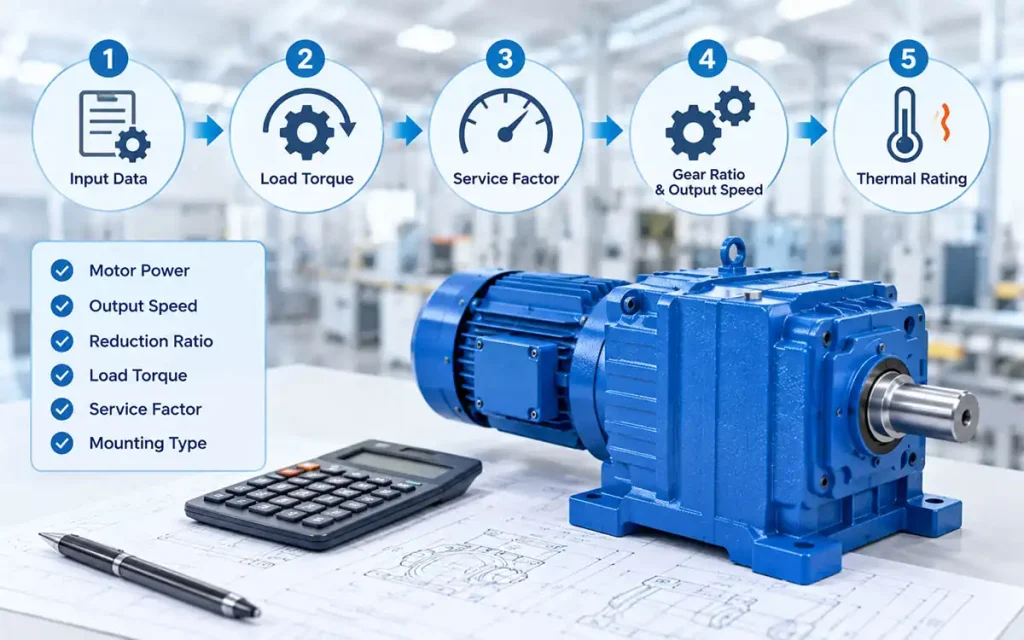
Accurate reducer selection starts with a clear understanding of load conditions, duty cycle, and the required output torque under realistic operating scenarios.
1. Pre-Selection Preparations
Collect motor power, input speed, required output speed, mounting orientation, ambient temperature, and any shock or reversing loads before comparing reducer families.
2. Calculate Load Torque
Convert the application load into equivalent torque at the reducer output shaft, including inertia effects for start-stop or indexing applications.
3. Determine Service Factor
Apply the correct service factor based on daily operating hours and load severity to avoid undersizing the transmission system.
| Load Type | Service Factor | Example |
|---|---|---|
| Uniform load, 8h/day | 1.00 – 1.25 | Fans, light conveyors |
| Moderate shock, 8–16h/day | 1.25 – 1.50 | Mixers, machine tools |
| Heavy shock, 16–24h/day | 1.50 – 2.00 | Crushers, rolling mills |
4. Gear Ratio and Output Speed
Match the target output speed and verify that the selected ratio keeps the motor within its efficient operating range.
5. Check Thermal Power Rating
Confirm the reducer thermal rating under continuous duty, especially in enclosed spaces or high ambient temperatures.